Japan Room Occupancy 60.8% in July 2026; Ryokan and Resort Hotels Turn PositiveA · FULL TRANSLATION
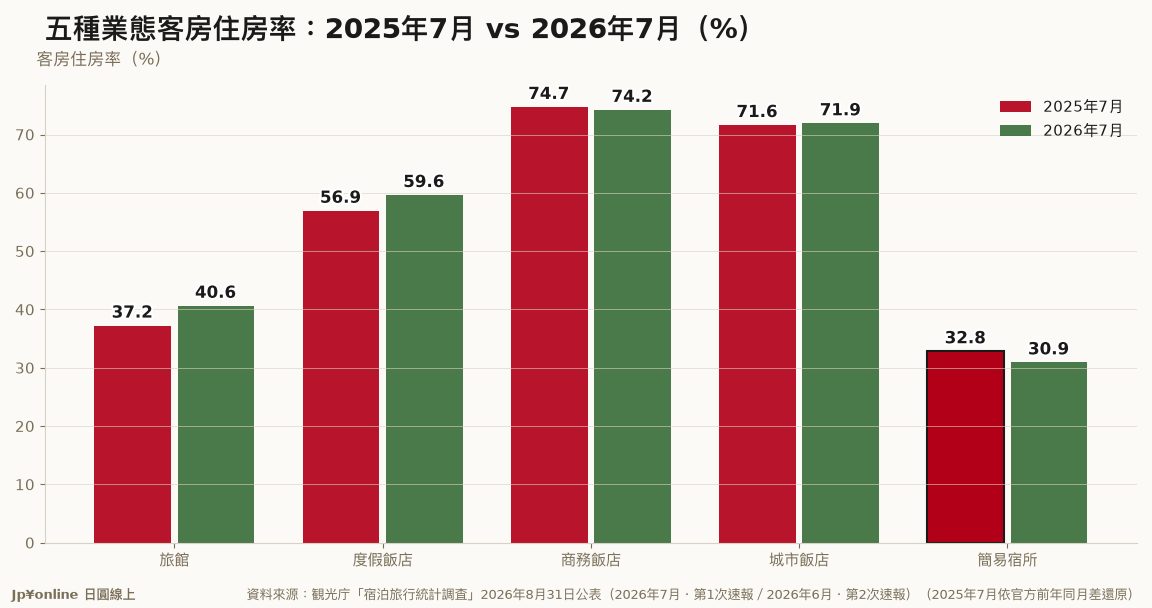
- National room occupancy was 60.8% in July 2026, down 0.4 points year on year, after 57.2% (-1.6pt) in June's second preliminary — the decline narrowed markedly
- By segment in July: ryokan 40.6% (+3.4pt), resort hotels 59.6% (+2.7pt), business hotels 74.2% (-0.5pt), city hotels 71.9% (+0.3pt), simple lodgings 30.9% (-1.9pt); ryokan and resort hotels turned positive
- June's first preliminary of 56.2% overall, reported here last month, was revised up to 57.2% in the second preliminary
- Business hotels were fullest at 74.2% but still down 0.5pt; simple lodgings remained emptiest at 30.9% and down 1.9pt, extending the weakness in Airbnb-style supply
- Break in series: from January 2026 the stratification variable changed to room count; July is first preliminary and will be revised on 30 September
Last month this series reported national occupancy at 56.2% (-2.6pt) on June's first preliminary; the second preliminary has revised June up to 57.2% (-1.6pt), and the newly added July first preliminary is 60.8% (-0.4pt). The year-on-year gap has narrowed each step — an unusual direction for this line this year.
The segment breakdown is where the story is. In July, ryokan reached 40.6% (+3.4pt) and resort hotels 59.6% (+2.7pt) — the two segments driven by domestic leisure, hot-spring and resort demand turned positive after several negative months. Business hotels (74.2%, -0.5pt) and simple lodgings (30.9%, -1.9pt) are still slipping. The summer peak has pulled families and domestic guests back into ryokan and resorts, consistent with the steadier signal on Japanese guest nights.
On the benchmarks: versus the revised June (57.2%) July is up 3.6 points, a seasonal move; versus a year earlier it is down just 0.4 points, the closest to flat this year; the release did not carry a July 2019 overall occupancy figure, so we do not estimate one. On revisions, June was lifted from 56.2% to 57.2% — the opposite direction to guest nights, because occupancy's denominator (room count) is more stable and revisions tend to be smaller.
For lodging investors: business hotels remain fullest at 74.2% but their growth has stalled; the genuine recovery is in ryokan and resort hotels. July is only a first preliminary (32.9% response rate); the 30 September second preliminary will revise it, and regional-ryokan occupancy in particular tends to move once the sample fills in.
Caveat: from January 2026 the survey's stratification variable changed from employee count to room count, so year-on-year comparisons spanning 2025 and 2026 carry a methodology effect.
Japan Tourism Agency, released 31 August 2026 — Overnight Travel Statistics Survey, room-occupancy section. Summary translation:
Change in survey design: from the January 2026 survey the stratification variable was changed from number of employees to number of guest rooms, so year-on-year differences may include the effect of this revision.
Room occupancy. The overall occupancy rate in July 2026 was 60.8% (-0.4 points year on year). By segment: ryokan 40.6% (+3.4pt), resort hotels 59.6% (+2.7pt), business hotels 74.2% (-0.5pt), city hotels 71.9% (+0.3pt), simple lodgings 30.9% (-1.9pt). Occupancy at ryokan and resort hotels improved year on year. June 2026 overall occupancy was 57.2% (-1.6pt): ryokan 36.7%, resort hotels 50.8%, business hotels 71.5%, city hotels 69.2%, simple lodgings 26.1%.
By prefecture. Tokyo recorded the highest overall occupancy nationwide at 75.4%. In June 2026 the number of prefectures above 80% occupancy was: business hotels 1 (1 a year earlier), city hotels 0 (1 a year earlier).
Basis. 2007-2025 are final values, January-June 2026 second preliminary, July 2026 first preliminary (32.9% response rate), to be revised in the second preliminary on 30 September 2026.
(Prefecture-level and segment detail is available in the original Japanese release.)