Tokyo Metropolitan Area New Resale Apartments: Average Price Breaks One Billion Yen in May, Booking Rate Rebounds to 64.9%A · FULL TRANSLATION
- In May 2026, 1,447 units were sold (year-on-year increase of 12.3%, two consecutive monthly increases) with an average price of ¥166 million (up 13.5% year-on-year and for two consecutive months), square meter prices at ¥1.563 million (continuing for 13 consecutive months), initial booking rate at 64.9%
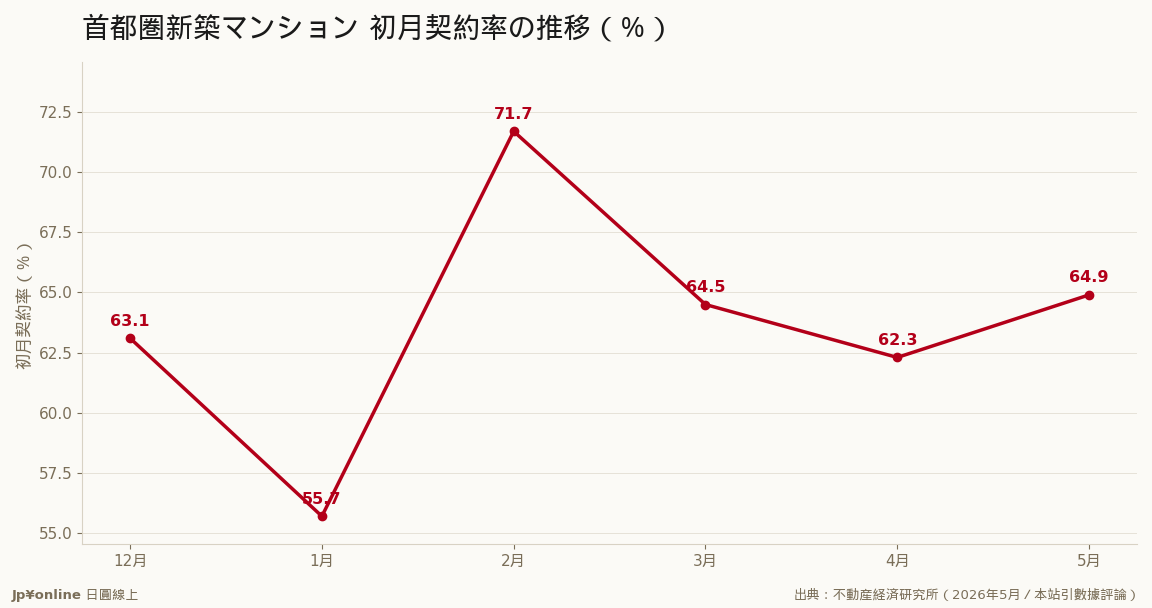
- Over the past half-year, booking rates have fluctuated: December at 63.1%, January at 55.7%, February at 71.7%, March at 64.5%, April at 62.3%, and May back to 64.9%; only February reached the critical line of 70%
- The average price breaking one billion yen was driven by ultra-high-rise buildings, with a booking rate of 80.7% (only 60.0% last year, with just 205 units) and tower momentum driving overall prices higher; warehouse stock decreased for five consecutive months to 6,270 units
- A unique perspective: booking rates tell the truth earlier than price movements—prices can be skewed by high-end cases, below 70% indicates pricing has hit buyer ceilings with recovery dependent on topic cases like tower buildings
- For Taiwanese readers: focus on whether initial booking rates for new resale apartments have reached 70%, investigate significant changes in average prices first by checking the share of ultra-high-rise and downtown cases; warehouse stock decreasing for five consecutive months supports price stability, but low booking rates indicate limited upward momentum
The Real Estate Economic Institute reported that in May 2026 for the Tokyo metropolitan area new resale apartments, there were 1,447 units sold (a year-on-year increase of 12.3%, and a second consecutive monthly rise), with an average price of ¥166 million (up 13.5% on a year-on-year basis and continuing for two consecutive months), square meter prices at ¥1.563 million (continuing for 13 consecutive months), and the initial booking rate reaching 64.9% (7.0 percentage points higher than the previous year, and 2.6 percentage points higher than last month). The booking rate has been fluctuating over the past half-year: December at 63.1%, January at 55.7%, February at 71.7%, March at 64.5%, April at 62.3%, and May back to 64.9%. Only February reached the industry’s critical threshold of 70%, while all others were below this level. The high price was driven by a concentration in ultra-high-rise buildings, which saw an initial booking rate of 80.7% (only 60.0% last year with just 205 units). Building momentum was supported by tower-style apartments, driving overall average prices and booking rates higher. Warehouse stock decreased for the fifth consecutive month to 6,270 units.
Why Taiwanese Readers Should Care: The Real Estate Economic Institute reported that in May 2026 for new resale apartments in the Tokyo metropolitan area, there were 1,447 units sold (a year-on-year increase of 12.3%, and a second consecutive monthly rise), with an average price of ¥166 million (up 13.5% on a year-on-year basis and continuing for two consecutive months), square meter prices at ¥1.563 million (continuing for 13 consecutive months). The initial booking rate increased to 64.9% (7.0 percentage points higher than the previous year, and 2.6 percentage points higher than last month). Prices continue to rise while booking rates have rebounded, but are still below a critical threshold.
For Taiwanese readers following new resale apartments in Tokyo or the Japanese real estate market, this data for May says: demand is recovering but hasn't reached the level where sellers hold all the cards.
Decoding the Numbers: The leading indicator here is the booking rate. Over the past half-year: December at 63.1%, January at 55.7%, February at 71.7%, March at 64.5%, April at 62.3%, and May back to 64.9%. Only in February did it reach the critical line of 70% seen as a dividing point, while all others were in the mid-60s. The average price breaking one billion yen (¥166 million) was driven by a concentration among ultra-high-rise buildings—12 cases with 435 units and an initial booking rate of 80.7% (only 60.0% last year, with only 205 units). Building momentum was supported by tower-style apartments, driving both the overall average price and booking rate higher. Geographically, in central Tokyo there were 551 units at ¥162.86 million per unit, while in downtown areas, 214 units averaged ¥213.72 million per unit, with high-end cases supporting the market; warehouse stock decreased for five consecutive months to 6,270 units.
A Unique Methodology Perspective: Booking Rates Tell the Truth Earlier than Prices—The 70% Line Matters. Assessing new resale apartment market activity, it’s better to focus on whether booking rates have reached 70% rather than chasing monthly changes in average prices. Average prices can be skewed by a few ultra-high-rise or downtown high-end cases (like those breaking one billion yen this month), but the booking rate reflects the true absorption from the offer end to the demand end for that month. Below 70% indicates pricing has hit the ceiling of buyer appetite, and recovery depends on topic cases like tower buildings or concessions. The combination of a 64.9% booking rate with an ultra-high-rise 80.7% suggests overall activity is still below the ceiling, with recovery dependent on these topic cases, while ordinary units have not yet seen a full rebound in absorption.
Who It’s Good For and Who It’s Risky: For developers and sellers of new properties, the jump from 60% to 80.7% booking rates among ultra-high-rises is a positive signal for sales momentum; for buyers considering entry (including Taiwanese investing in Japan), continued booking rates below 70% mean there is still room for negotiation without chasing high prices, especially non-ultra-high-rise properties; for investors, the average price breaking one billion yen has structural components, and should not be seen as a trend.
For Taiwanese Readers: One, check if booking rates on new resale apartments have reached 70% to get a more reliable sense of market activity. Two, when average prices see significant month-to-month changes, first investigate the share of ultra-high-rise and downtown cases; in May, this was driven by tower buildings. Three, while warehouse stock has decreased for five consecutive months supporting price stability, booking rates below 70% indicate limited upward momentum, giving buyers more time to act.
What to Watch Next: One, see if the June (forecasted at 1,500 units) booking rate can truly reach 70%; two, whether high booking rates among ultra-high-rises are a sign of sustained market heat; three, watch for any stop in warehouse stock compression as it may be the first signal of easing supply.