Analysis: Japan's Exports to Taiwan Up 15.1%, Trade Surplus Near ¥2.9 Trillion - One of Asia’s Biggest Buyers, China StallsA · FULL TRANSLATION
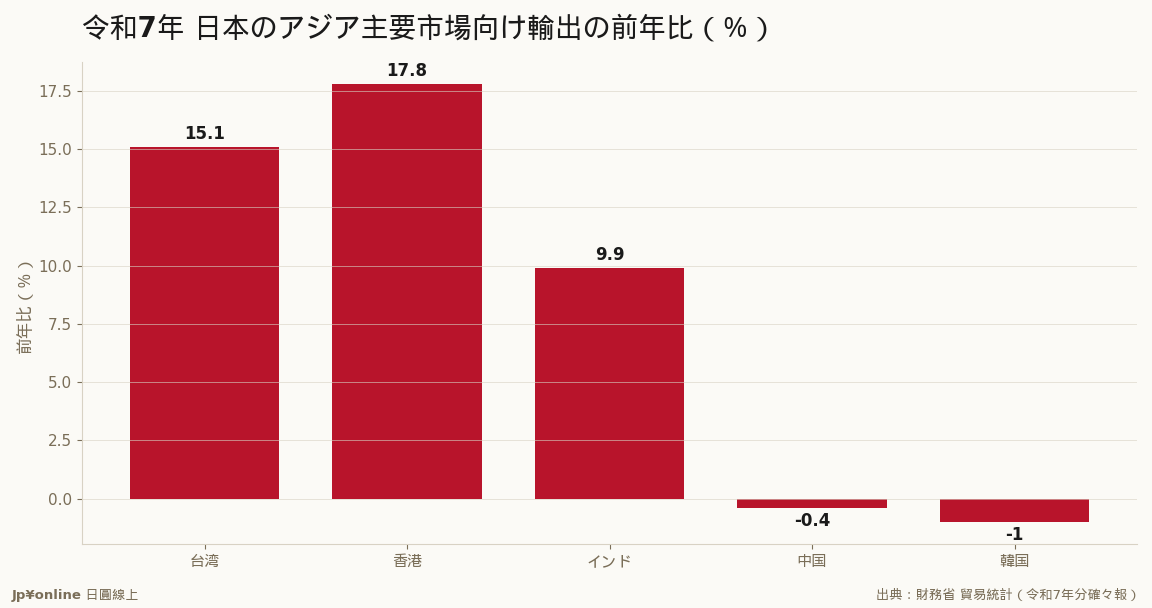
- Fiscal year 2025 (令和7年): Japanese exports to Taiwan reached ¥7.907 trillion (+15.1%), one of the fastest-growing markets in Asia; trade surplus with Taiwan was ¥2.9053 trillion;
- Comparison: Largest market China's imports decreased by 0.4%, South Korea by 1.0%; entire Asian region, Japan’s exports grew 5.3% to ¥59.8999 trillion, balance of trade surplus at ¥4.146 trillion = most important export destination
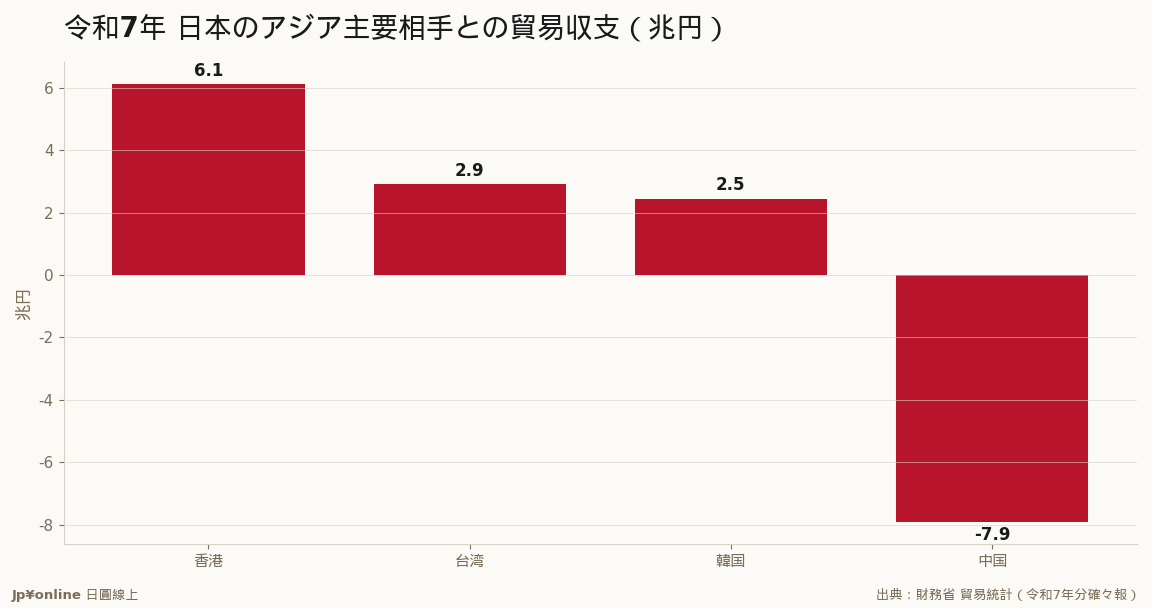
- Trade structure: Japanese surpluses with Hong Kong (¥6.1349 trillion) and Taiwan (¥2.9053 trillion) and South Korea (¥2.4528 trillion) are profitable, but deficit against China is ¥7.9218 trillion (long-term trade imbalance)
- Unique Angle: Read the Taiwan-Japan connection in two layers—1) Growth rates (Japan to Taiwan +15.1% reflects strong demand for electronics and machinery); 2) Trade balance structure (large surpluses with Japan indicate Taiwan as net buyer of Japanese semiconductors, electronics components, materials upstream)
- Practical Application: Use 'Japan's export growth rate to Taiwan' as a side indicator of the electronics supply chain’s heat; accelerating usually corresponds to expansion in Taiwan’s semiconductor/electronics industry
In the fiscal year 2025 (令和7年), Japanese exports to Taiwan reached ¥7.907 trillion, a rise of 15.1% compared to the previous year, making it one of Japan's fastest-growing markets in Asia. The trade surplus with Taiwan was ¥2.9053 trillion.同期对香港出口增长了17.8%,印度增长了9.9%,但最大市场中国却下降了0.4%,韩国也减少了1.0%。在贸易收支方面,日本对香港的顺差为¥61,349亿、对台顺差为¥29,053亿、对韩顺差为¥24,528亿都赚了;但对中国的逆差高达¥79,218亿。整个亚洲,日本出口增长了5.3%,总额达到¥598,999亿。
Why Taiwanese Readers Should Care: This analysis focuses on the Taiwan-Japan connection. In fiscal year 2025, Japan's exports to Taiwan reached ¥7.907 trillion and grew by 15.1%, one of the fastest in Asia; with a trade surplus of ¥2.9053 trillion (Japan sold far more to Taiwan than it bought from there). Meanwhile, exports to Hong Kong increased by 17.8% and India by 9.9%, while China's exports to Japan declined by 0.4% and South Korea's by 1.0%. For Taiwanese readers concerned about the Japanese economy and Sino-Japanese business relations, this data tells us: within Asia, Taiwan and Hong Kong are among few markets still accelerating their imports, while the largest market, China, is stagnating.
Breaking Down the Numbers: Who bought Japanese goods? Taiwan's import growth from Japan increased by 15.1% (approaching ¥8 trillion) and Hong Kong saw a 17.8% increase, making them the double-digit growth representatives in Asia; India also grew at 9.9%. In contrast, China decreased its imports from Japan by 0.4%, almost stagnating, while South Korea declined by 1.0%. Looking at trade balances (who profits): Japan's surplus with Hong Kong was ¥6.1349 trillion, the surplus with Taiwan was ¥2.9053 trillion, and the surplus with South Korea was ¥2.4528 trillion—all profits; but against China, it was a large deficit of ¥7.9218 trillion—Japan bought more from China (computers, communications equipment, various products) than it sold, reflecting Japan's long-term trade imbalance.
A Unique Methodology: Reading the Taiwan-Japan Connection in Two Layers—1) Growth Rates: A 15.1% increase to Taiwan and a 17.8% increase to Hong Kong reflect strong demand for Japanese electronics and machinery; 2) Trade Balance Structure: Japan's large surpluses with both Taiwan and Hong Kong indicate that Taiwan is a net buyer from Japan—Taiwan receives semiconductors, electronic components, materials from Japan for its upstream manufacturing. This relationship means that increased Japanese exports to Taiwan often signal expansion in Taiwan’s semiconductor/electronic industry chain; conversely, if Taiwan's economy cools down, the double-digit growth line between Japan and Taiwan will likely loosen first. Viewing 'Japan's export growth rate to Taiwan' as a side indicator of the Taiwan-Japan electronics supply chain's heat is this report's most practical use for Taiwanese readers.
Opportunities and Risks: For Taiwan’s semiconductor/electronics-related industries, the double-digit growth in Japanese exports to Taiwan reflects strong upstream equipment and materials supply; for those doing business with Japan goods going to Taiwan, a stable trade surplus structure indicates that there is solid demand from the Taiwanese market for Japanese products. For those focusing on China's market, stagnant exports (0.4% decrease) + large deficit against China indicate long-term economic temperature in Sino-Japanese trade.
Taiwanese Readers' Practical Application: 1) Use 'Japan's export growth rate to Taiwan' as a side indicator of the electronics supply chain’s heat; accelerating usually corresponds to expansion in Taiwan's semiconductor/electronics industry. 2) The large trade surplus structure with both Taiwan and Hong Kong means Taiwan is Japan's net buyer for electronics upstream, indicating that Sino-Japan interconnection primarily involves semiconductors and electronics. 3) Stagnant imports from China contrast sharply with double-digit growth in Taiwan/Hong Kong, making it key to observing changes in Japan’s Asian export map.