Japanese Apartment Price Index Surges to 2.2 Times of 2010 Levels – Land Prices Drop, Apartments Alone DominateA · FULL TRANSLATION
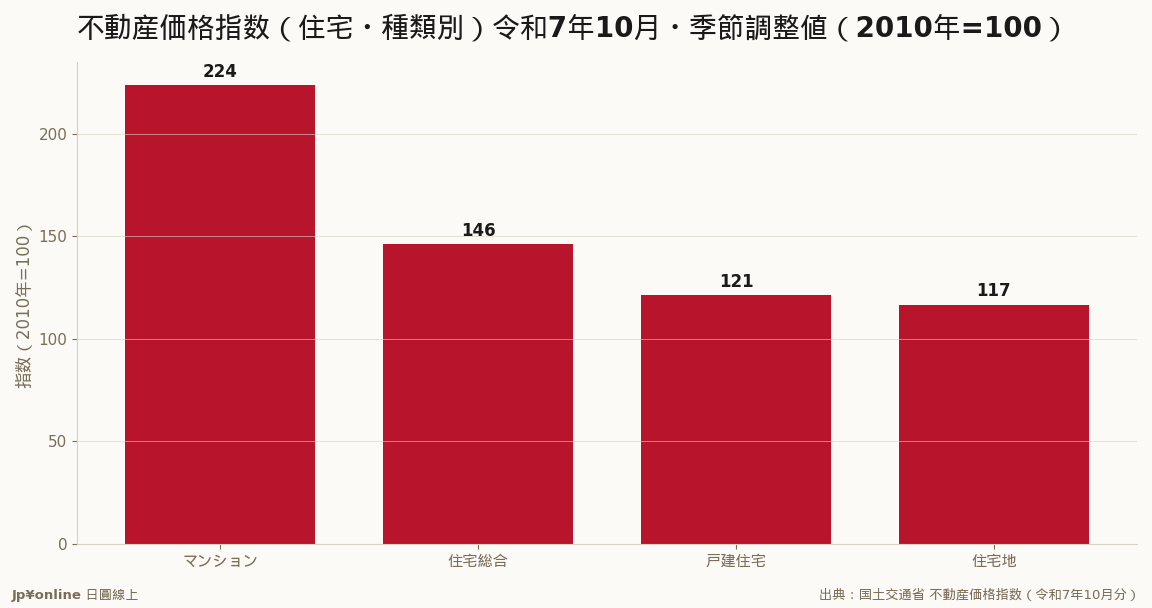
- MLIT Real Estate Price Index (October 2022 adjusted) shows apartments at 223.7, almost twice the level of 2010
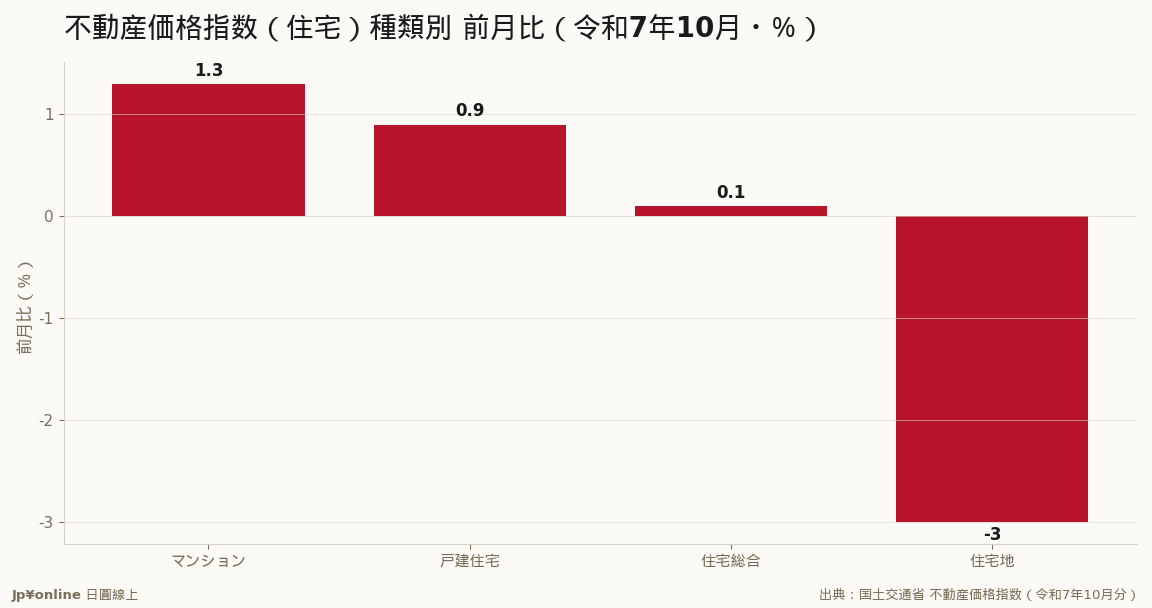
- Monthly changes show apartment price increases while land falls, indicating continued differentiation
- A unique methodology: use official index as a 'long lens' and cross-verify with REINS monthly reports to assess long-term trends versus recent momentum
- Conclusion credibility: when both the 'long lens' (MLIT index) and short lens (REINS reports) point to apartment strength while land and offices show weakness, it adds reliability
- Practical advice for Taiwanese readers: use MLIT index for long-term levels and REINS/Real Estate Economic Institute reports for recent trends; price increase highly concentrated in apartments
Ministry of Land, Infrastructure, Transport and Tourism (MLIT) Real Estate Price Index (As of October 2022 adjusted for seasonal factors; base: 100 in 2010, announced on January 30, 2023): Apartment prices (proprietary ownership) at 223.7 (2.2 times that of 2010), total residential properties at 146.0, single-detached houses at 121.2, and land at 116.7. The rise is almost entirely due to apartment prices. Monthly change: Apartments up by 1.3%, detached houses up by 0.9%, and total residential properties up by 0.1%; however, land prices fell by 3.0%. While apartments rose in the same month, land saw a decline, showing continued differentiation.
Why Taiwanese Readers Should Care: The MLIT Real Estate Price Index (As of October 2022 adjusted for seasonal factors; base: 100 in 2010) provides a long-term view of Japan's residential market. Apartment prices at 223.7, nearly twice the level of 2010, stand out against single-detached houses at 121.2 and land at 116.7. This index quantifies what Taiwanese readers often hear about how expensive apartments in Tokyo are.
[Insightful Explanation] The Real Estate Price Index is compiled by MLIT based on approximately 300,000 actual transaction prices each year, with a base of 100 in 2010. Its value lies in its long-term, comparable, and cross-category nature. By placing different categories on the same scale, it highlights the disparity in price increases. A 223.7 index suggests apartment prices are now over 2.23 times those of 2010; a combined index at 146.0 represents an aggregate weighted value; and land and single-detached houses at 116.7 and 121.2, respectively, indicate that the overall rise in residential properties is largely driven by apartments.
[Breaking Down the Numbers: Apartments Are Up, but Divergence Continues] In terms of levels (long-term), apartment prices stand at 223.7, total residential properties at 146.0, single-detached houses at 121.2, and land at 116.7—showing that apartments dominate. This is the cumulative result over the past few decades. For monthly momentum (month-over-month changes): apartments up by 1.3%, single-detached houses up by 0.9%, total residential properties up by 0.1%; but land fell by 3.0%—showing continued differentiation, with apartments and single-detached houses rising while land falls.
[An Exclusive Methodology Angle: Use the Official Index as a 'Long Lens' and Cross-Verify with REINS Monthly Reports] Judging Japan's real estate market requires a combination of short-term (such as REINS monthly reports on secondary square meters or new construction average prices) and long-term perspectives. The official index acts as a long lens, showing cumulative levels over the years; it should be cross-referenced with the short lens provided by REINS reports. For instance, secondary apartment prices have been rising for 72 consecutive months, surpassing even the bubble era of 1990—aligning with the official index's 2.2 times increase in apartments over two decades.
[Opportunities and Risks] For those considering buying Japanese apartments as a primary residence or investment, an apartment price level at 223.7 indicates that this market has already seen significant gains and is continuing to rise; thus, one should be prepared for long-term holding. For those looking into single-detached houses or land, the moderate increase of 121.2 and 116.7, along with a -3.0% decline in land prices, suggest that these areas are not as overheated compared to apartments.
[Practical Advice for Taiwanese Readers] Use MLIT's index to gauge long-term levels (apartments at 223.7 = 2.2 times 2010) and REINS/Real Estate Economic Institute reports to track recent movements, combining both for reliability. While the price increase is heavily concentrated in apartments, land and single-detached houses are more moderate, and office prices are weak, it's incorrect to view Japan's rising property values as a universal phenomenon.
[What to Watch Next] Monitor whether the apartment index’s 223.7 long-term trend reverses alongside REINS's continuous monthly price increases; see if declining land prices become a longer-term trend; and observe how weak office prices may impact one-off property prices.