【2023 Land White Paper Analysis】Invest in Japanese Real Estate without Buying Property: J-REIT Market Size at 14.3 Trillion Yen, Targeting 40 Trillion Yen by 2030A · FULL TRANSLATION
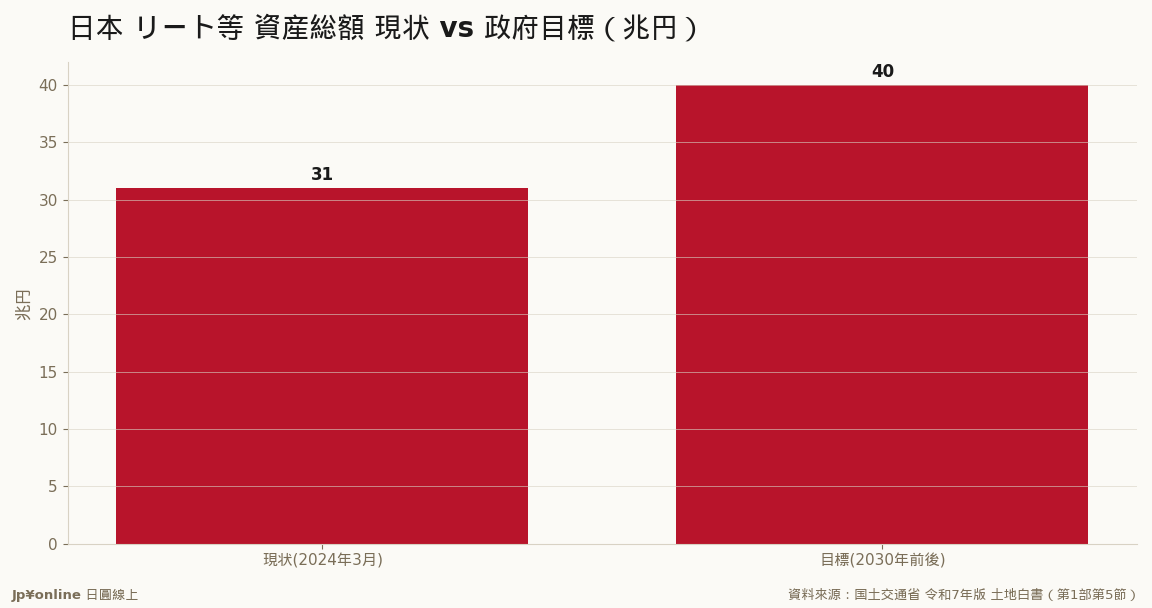
- Total assets of Japanese REITs and similar funds at around 31 trillion yen by March 2024
- MLIT target is to expand the market to approximately 40 trillion yen by early 2030s
- Best option for investors: listed J-REITs with a combined market value of about 14.3 trillion yen by December 2024
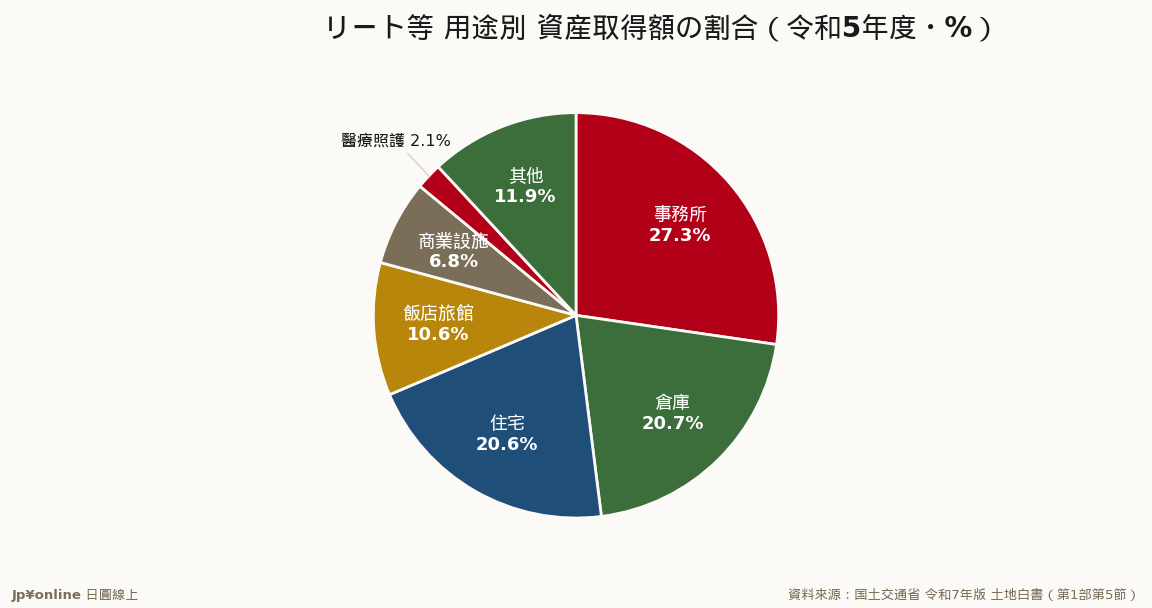
- Asset utilization breakdown: Office properties (27.3%), warehouses (20.7%), residential (20.6%)
- Tokyo REIT Index underperforms Nikkei average in recent years, reflecting market dynamics
Chapter 9 of the 'Land White Paper' 2023 edition offers insights into Japan’s real estate investment trust (J-REIT) market for those interested in participating in property appreciation without owning a physical asset. By March 31, 2024, the total assets under J-REITs and other similar funds stood at approximately 31 trillion yen; the Ministry of Land, Infrastructure, Transport, and Tourism (MLIT) aims to expand this market to around 40 trillion yen by the early 2030s. The best option for investors is listed J-REITs — as of December 31, 2024, there were 57 listings on the Tokyo Stock Exchange with a total market value of about 14.3 trillion yen.
Summary: For those interested in participating in Japan’s real estate appreciation without owning physical property, Chapter 9 of the 'Land White Paper' 2023 edition provides valuable insights into the J-REIT market. By March 31, 2024, total assets under J-REITs and other similar funds stood at approximately 31 trillion yen (acquisition cost); MLIT aims to expand this market to around 40 trillion yen by the early 2030s. The government intends to grow the securitization market.
Key Points: 'Real estate securitization' involves packaging individual properties into tradeable financial products, allowing general investors to participate in rental income and property appreciation without buying entire assets. Among these options, listed J-REITs are the best entry point. By December 31, 2024, there were 57 listings on the Tokyo Stock Exchange with a combined market value of about 14.3 trillion yen. The asset breakdown shows that J-REITs account for approximately 23.1 trillion yen, private J-REITs around 6.4 trillion yen, and real estate specific business operations around 1.3 trillion yen.
Breakdown by Asset Utilization: As of the fiscal year 2023, office properties still accounted for 27.3%, but warehouse (logistics facilities) increased to 20.7% while residential properties followed closely at 20.6%. Hotels and resorts made up 10.6%, commercial facilities 6.8%, and healthcare facilities 2.1%. Money is flowing towards logistics and residential assets, which offer stable cash flow supported by e-commerce and demographic changes.
Another notable signal: The Tokyo REIT Index, reflecting overall J-REIT performance, has underperformed the Nikkei average in recent years — while the stock market hit highs, REIT indices were relatively ignored. Reasoning: Rising interest rates have pressured REITs (which rely on borrowing to purchase properties and whose dividends are inversely related to rates), but improving occupancy rates and higher underlying asset yields provide a fundamental support. Setting 40 trillion yen as the target aims to attract more private capital through regulatory measures.
For Taiwanese investors: First, J-REITs offer low entry barriers and high liquidity; through broker sub-delegation, you can easily enter this market. Second, consider assets like logistics and residential REITs that provide relatively stable cash flow in adverse economic conditions. Third, the Tokyo REIT Index has lagged behind the Nikkei average — with interest rates as the key variable (rising rates reduce valuations while higher rents support fundamentals), monitor J-REIT market values and index responses as interest rate trends evolve.