Japan Inbound Spending Q2 2026: JPY 2.51 Trillion, Up 0.2% as Per-Visitor Spend Rises 3.3%A · FULL TRANSLATION
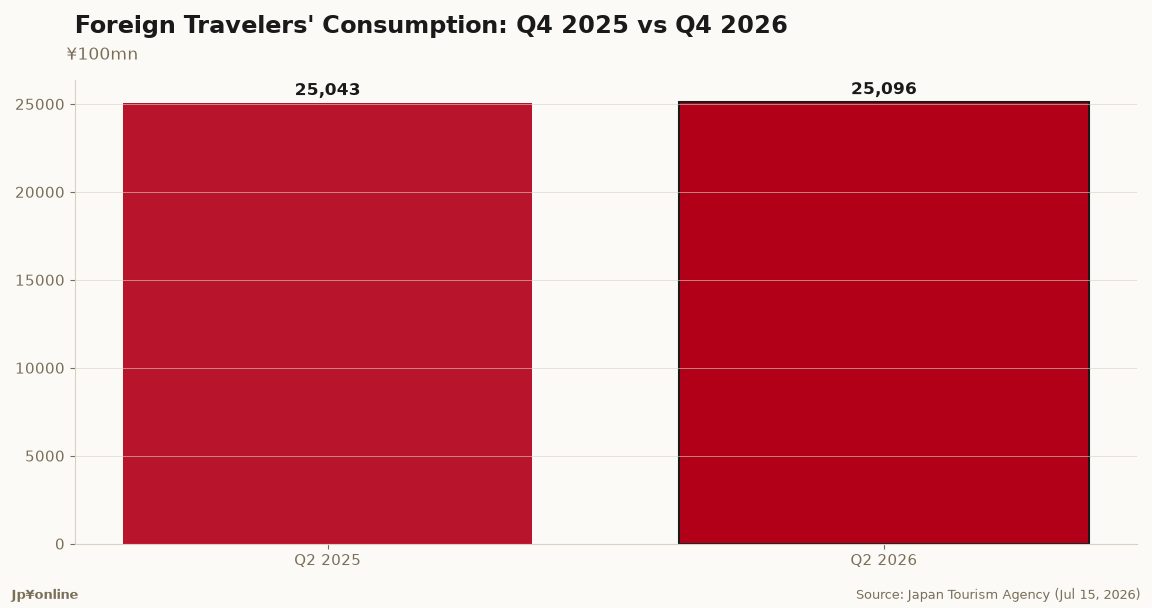
- Inbound travel spending reached JPY 2,509.6 billion in April-June 2026, up 0.2% from JPY 2,504.3 billion a year earlier.
- Per-visitor spending for non-cruise travellers hit JPY 244,457, up 3.3%, while total arrivals fell 5.3% to 10.401 million.
- Non-cruise arrivals were 10.254 million, down 2.7%; their spending totalled JPY 2,506.6 billion, up 0.5%.
- Cruise passengers dropped 67.1% to 147,000 and their spending fell 72.3% to JPY 3.0 billion, at JPY 20,366 per head.
- Average length of stay was 8.7 nights, down 0.7 nights year on year.
The Japan Tourism Agency released its first preliminary estimate for April-June 2026 on 15 July. Total inbound travel spending came to JPY 2,509.6 billion, JPY 5.3 billion more than a year earlier, a gain of 0.2%. The flat headline hides two offsetting movements.
Arrivals fell. Including cruise passengers, 10.401 million people visited Japan, down 5.3%; excluding cruise, 10.254 million, down 2.7%. At the same time each visitor spent more: JPY 244,457 per non-cruise traveller, up 3.3%. Fewer people paying higher amounts produced a flat total.
Cruise traffic moved the most. Cruise passengers numbered 147,000, down 67.1%, spending JPY 3.0 billion, down 72.3%, at JPY 20,366 per person, under a tenth of the non-cruise figure. The agency notes that for the first and second quarters of 2026 it could not secure sufficient survey voyages or port-level responses for cruise, so those numbers carry lower confidence.
Average stay length fell to 8.7 nights from 9.4. Shorter stays alongside higher per-visitor spending means daily spending intensity is rising: more revenue per guest, spread across fewer days.
For reference, the previous quarter (January-March 2026, second preliminary) was JPY 2,337.3 billion, up 2.5%. This site begins regular quarterly tracking of this series with the current release.
Summary translation of the Japan Tourism Agency release, Inbound Consumption Trend Survey, April-June 2026 (first preliminary estimate).
Total: inbound travel spending for April-June 2026 is estimated at JPY 2,509.6 billion, up 0.2% year on year.
By nationality and region: the United States is largest at JPY 384.8 billion (15.3% share), followed by Taiwan at JPY 363.9 billion (14.5%), China at JPY 259.2 billion (10.3%), South Korea at JPY 258.9 billion (10.3%) and Hong Kong at JPY 145.2 billion (5.8%).
Per-visitor spending: travel spending per non-cruise visitor is estimated at JPY 244,457, up 3.3% year on year. By nationality the highest are Mexico (JPY 514,925), the Middle East (JPY 482,836) and the United Kingdom (JPY 456,493).
Visitor numbers: non-cruise arrivals were 10.254 million, down 2.7%; cruise passengers were 147,000, down 67.1%; the combined total was 10.401 million, down 5.3%. Non-cruise spending was JPY 2,506.6 billion, up 0.5%. Cruise spending was JPY 3.0 billion, down 72.3%, at JPY 20,366 per passenger, down 15.8%.
Average nights: 8.7 nights across all nationalities, down 0.7 nights year on year.
Notes: foreign visitors include those travelling for business and to visit relatives or friends as well as for leisure, and exclude foreign residents of Japan. Cruise passengers are estimated by the agency from Ministry of Justice landing permit data. The survey was renamed the Inbound Consumption Trend Survey from the April-June 2024 quarter; survey items and estimation methods were unchanged, so comparison with data up to January-March 2024 remains possible. For the first and second quarters of 2026, cruise vessel coverage was insufficient and the figures should be treated with care. Mexico, the Nordic countries and the Middle East were added as survey targets from the 2026 survey.