Japan June CPI Rose 1.7 Percent on Fading Fuel Subsidies While Underlying Core-Core Inflation Cooled for a Fifth MonthA · FULL TRANSLATION
- Total CPI +1.7% (up from 1.5% in May), Core +1.6% (up from 1.4%)
- Primary driver is energy, with gasoline year-on-year decline narrowing to -0.7%
- Fresh food excluded core index +3.1%, down from previous month's impact of 0.87
- Private high school tuition -68.8% (due to fee-free policy) single-handedly reduced overall by 0.18 points
- Upstream CGPI +7.1% at a three-year-high, while downstream core-core remains at 1.7%
The total CPI rose to +1.7% in June from 1.5% in May—accelerating but driven by policy changes rather than underlying inflation trends. The narrowing of the gasoline subsidy led to a significant shift, explaining the entire acceleration. However, the core-core index continued its fifth consecutive month of cooling at +1.7%. This report suggests that while surface-level inflation is rising, the underlying trend remains stable. Market expectations for the BoJ's next move will hinge on July energy subsidies and total CPI readings.
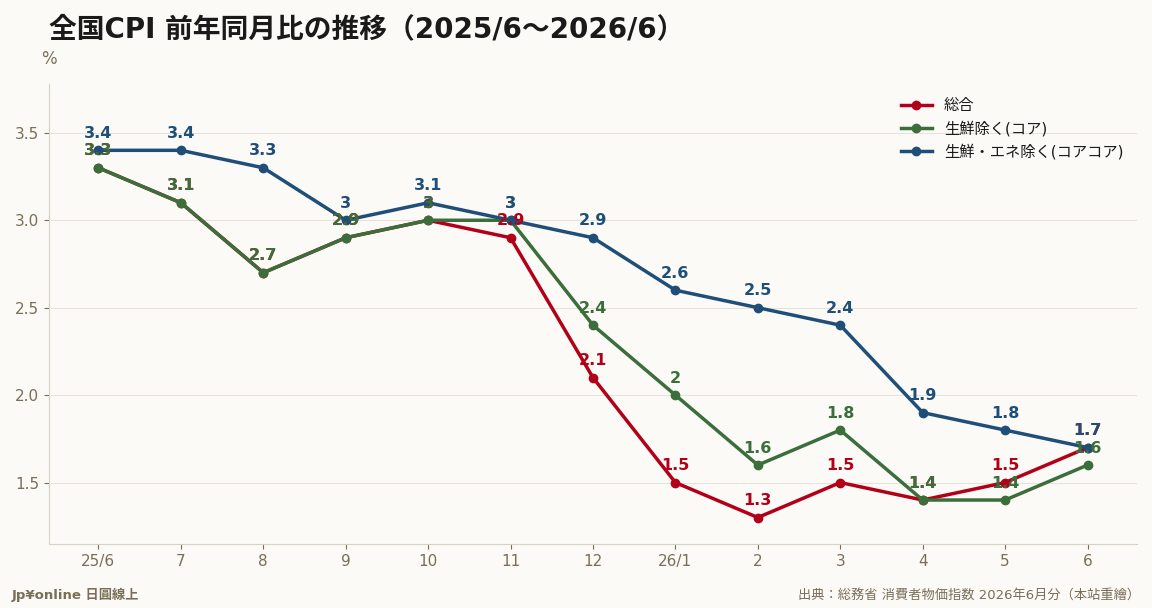
**Decoding the Indicators**: The three indices serve different purposes—total CPI includes all items and reflects immediate consumer experience; core excludes fresh food, used as a 'core CPI' in media reports; core-core further excludes energy, focusing on underlying inflation trends. Over the past six months, these lines have been swapping positions, with total CPI and core-core aligning at +1.7% in June, while the core index is at +1.6%. Energy's impact has normalized, leaving food as the primary driver of inflation.
**Who Pushes, Who Pulls**: Beyond energy, food items like rice substitutes (+3.1%) and chocolate (+8.8%) are driving prices higher, but their contributions have been cooling down. New factors include medical expenses (+1.7%) and durable goods (+3.0%). On the downward side, private high school tuition (-68.8%), communication charges (-4.6%), and hotel rates (-3.1%) are pulling the overall index lower.
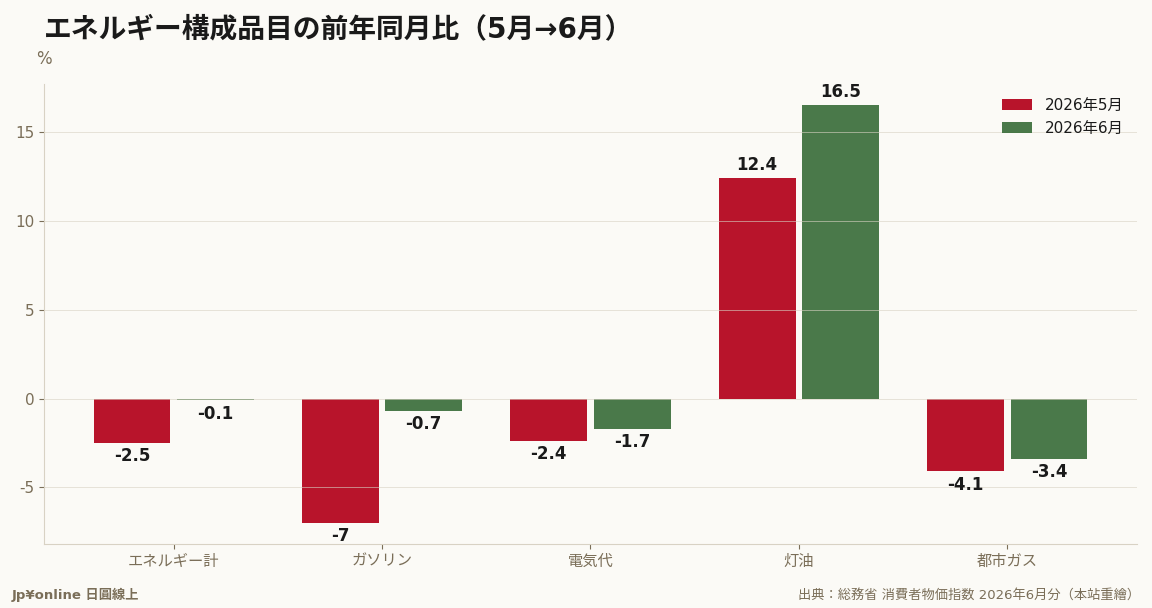
**Energy Breakdown**: Electricity (-1.7%) and gas (-3.4%) remain negative but narrowing. Gasoline's impact has nearly normalized, while kerosene prices have risen by 16.5%. This reflects government subsidies decreasing and rising oil import costs due to geopolitical tensions in the Middle East.
**Top Ten Categories**: Food (+3.2%) remains the main driver (contribution of 0.94), followed by housing (+1.0%), furniture and household items (+2.4%), clothing (+1.7%), education (-6.0%). Utilities have returned to a neutral position, while healthcare and durable goods show mixed trends.
**Counterarguments**: Reading June's report as 'inflation harmless' is equally dangerous. The core-core index remains below 2%, but the impact on household budgets from food price increases could be significant. Real wages are just starting to recover (up 1.4% in May), and another round of energy-driven inflation could reverse this progress. Upstream prices continue to rise, with domestic producer prices at a three-year-high and import prices soaring.
**Historical Context**: The first wave of imported inflation in 2022-23 saw the total CPI hit 4%, but the BoJ was cautious. This time, nominal wages are rising, service prices are sticky, and business sentiment is optimistic. The CPI report has become a direct driver of policy rates and mortgage rates. With core-core cooling for five months, the BoJ's next move will be closely watched.
**Practical Advice**: For travelers: with total CPI still below 1%, purchasing power remains strong, but hotel prices are higher than last year. For investors: focus on core-core inflation rather than total CPI, which is heavily influenced by energy subsidies. The report suggests a neutral to dovish stance from the BoJ, keeping the yen carry trade environment stable. For property owners: fixed-rate mortgages and policy rates are linked, so cooling in core-core inflation gives more time for interest rate hikes.
**Next Steps**: Watch July's energy impact on total CPI, food price trends, hotel rates, and BoJ's next outlook report to gauge the direction of monetary policy.