Foreign Investors Turned Net Sellers of ¥258.7bn in Japanese Stocks in Mid-July as Individuals Bought the DipA · FULL TRANSLATION
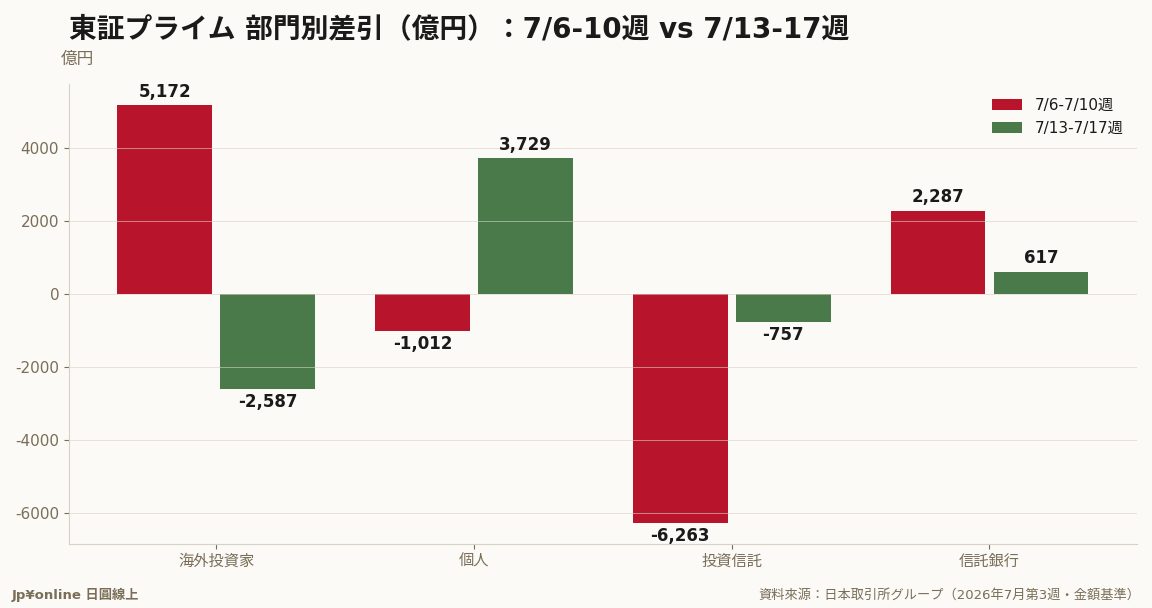
- In the week of July 13-17, foreign investors net sold ¥258.7bn of TSE Prime stocks (value basis), reversing from ¥517.2bn net buying the week before — a ¥775.9bn swing in one week
- Individual investors net bought ¥372.9bn the same week after net selling ¥101.2bn the week prior, taking the exact opposite side of foreign flows
- Investment trusts stayed net sellers for a second week but the pace shrank from ¥626.3bn to ¥75.7bn; trust banks, the main pension conduit, remained net buyers for a second week
- Foreigners accounted for 66.6% of brokerage trading value that week, individuals 28.6% — foreign investors still set the price of Japanese equities
This weekly series tracks one question with JPX's investor-type data: who is buying Japanese stocks and who is selling. The week of July 13-17 delivered a clean reversal sample on the TSE Prime value basis — foreign investors net sold ¥258.7bn after net buying ¥517.2bn the week before, a ¥775.9bn swing in one week. Individuals did the mirror image: net buyers of ¥372.9bn after net selling ¥101.2bn. Stacked together, it is the textbook counter-trade — retail takes profits when foreigners chase, and buys the dip when foreigners trim. The supporting cast matters too: investment trusts stayed net sellers for a second week but the pace collapsed from ¥626.3bn to ¥75.7bn, and trust banks — the main conduit for pension money — remained slow, steady net buyers. The structure is unchanged: foreigners accounted for 66.6% of brokerage trading value that week against 28.6% for individuals, so foreign flows still set the direction of Japanese equities; retail buying cushions volatility rather than reversing it. For readers holding Japanese stocks or yen assets, the practical rule for this series: a single week of ¥200-300bn foreign net selling is routine position-trimming. Three or more consecutive weeks, combined with trust banks stepping back, is what a trend signal looks like. Neither has happened yet. Next instalment: the fourth week of July.
This week marks a regular tracking by Jp¥online of the investment sector's buying and selling activities at JPX to focus on one thing: who is buying Japanese stocks, and who is selling. In the third week of July (July 13-17), the Tokyo Prime Market's amount benchmark shows a clean reversal—foreign investors sold 258.72 billion yen, compared to buying 517.2 billion yen in the previous week—a swing of 775.9 billion yen within one week. At the same time, individuals bought 372.9 billion yen, compared to selling 101.2 billion yen the previous week—acting as counterplayers to foreign investors.
The movements of the supporting players also provide valuable information. Investment trusts have sold for two consecutive weeks, with a reduction from 626.3 billion yen to 75.7 billion yen, indicating a significant decrease in redemption or portfolio adjustment pressure; trust banks bought for two consecutive weeks (from 2,287 billion yen to 617 billion yen), showing steady pension fund inflows. The overall structure remains unchanged: foreign investors accounted for 66.6% of trading volume and individuals made up 28.6% in commission transactions this week, indicating that foreign investors still hold the pricing power in Japanese stocks, while individual counterplay affects only the buffering of volatility; direction is still determined by foreign investors.
For readers holding Japanese stocks or yen assets, this weekly trend can be used as follows: a single-week sell-off of 200-300 billion yen by foreign investors is considered a common adjustment level. A continuous three weeks or more of selling and simultaneous reduction in trust bank activity would indicate a trend signal. Neither of these conditions has occurred yet in this period. The next update will track the fourth week of July to see if this sell-off is just a single-week adjustment or the first step towards a shift.
Japan Exchange Group's weekly Trading by Type of Investors (TSE Prime, value basis, all 51 trading participants) for the third week of July 2026 (July 13-17), summary translation: total trading value (sales plus purchases) was roughly ¥110.7tn. Within brokerage trading, institutions sold ¥2.29tn and bought ¥2.35tn for net purchases of ¥58.1bn; individuals sold ¥14.49tn and bought ¥14.87tn for net purchases of ¥372.9bn; foreign investors sold ¥34.24tn and bought ¥33.98tn for net sales of ¥258.7bn; securities companies were net buyers of ¥4.4bn. Within institutions, investment trusts net sold ¥75.7bn, business corporations net bought ¥113.9bn, and financial institutions net bought ¥33.7bn, of which trust banks net bought ¥61.7bn. Prior week (July 6-10) comparison: foreigners net bought ¥517.2bn, individuals net sold ¥101.2bn, investment trusts net sold ¥626.3bn, trust banks net bought ¥228.7bn. Note: the survey covers trading participants with capital of at least ¥3bn, domestic common stocks only, including ToSTNeT trades; minus denotes net sales.