Duty-Free Spend Per Shopper in Japan Reached Roughly ¥102,000 in June 2026, Up 30.4%, as Big-Ticket Buying Replaced Bulk Buying
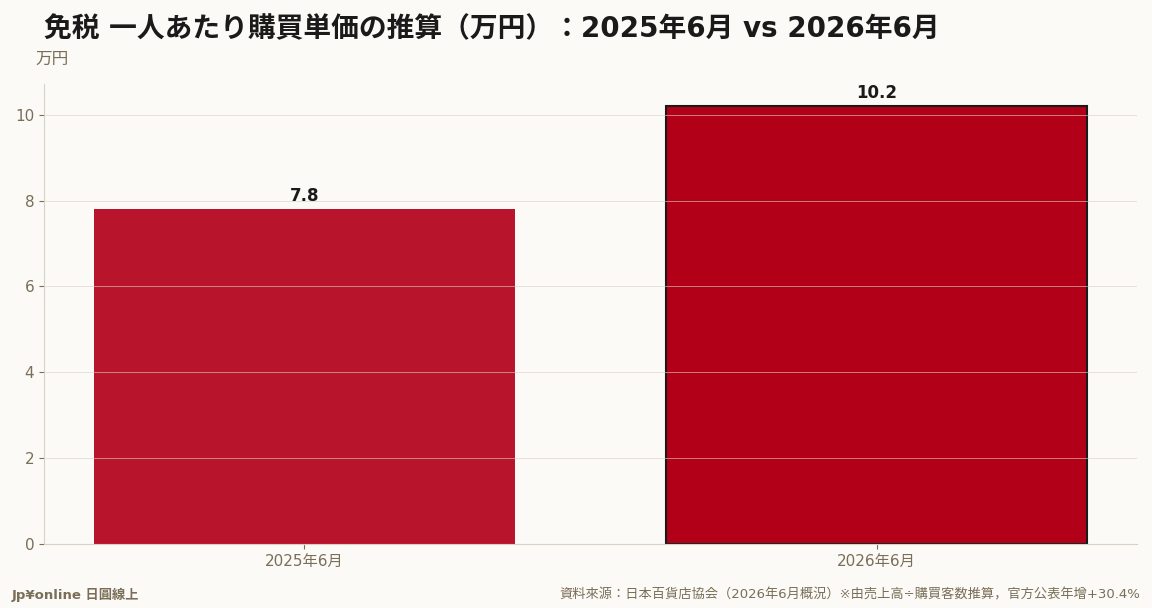
- Spend per duty-free shopper rose 30.4% y/y in June (official figure); dividing ¥50.9bn sales by 498,000 shoppers gives roughly ¥102,000 per head, versus about ¥78,000 a year earlier
- The mix is watches, jewellery and luxury goods, a different structure from the consumables-driven bulk buying of the mid-2010s
- Chinese visitors illustrate the shift: about 25% fewer shoppers spending about 16% more in total
- The general-goods vs consumables split is published in a supplementary sheet not publicly available this month; the 2019 comparison is likewise unavailable
This series tracks one number each month: how much the average duty-free shopper spends at Japanese department stores. June's answer to 'is the buying spree over?' — the money hasn't left, the crowds have. The association reports spend per head up 30.4% y/y; dividing published sales of ¥50.9bn by 498,000 shoppers gives roughly ¥102,000 per person, against about ¥78,000 a year earlier. What fills that figure is watches, jewellery and luxury goods, with Japanese-made cosmetics and timepieces singled out as favourites of foreign visitors. This is a different business from the mid-2010s bulk-buying era, when Chinese tour groups cleared shelves of consumables: today fewer customers buy far more expensive items. Chinese visitors capture the shift in one line — roughly 25% fewer shoppers, 16% more spending. Two gaps this month, stated plainly: the split between general goods and consumables, and the 2019 pre-pandemic comparison, are published in a supplementary sheet we could not obtain publicly this period. The thing to watch from here is whether six-figure spend per head survives any yen strengthening; big-ticket duty-free demand is far more exchange-rate sensitive than everyday tourist spending. Next instalment covers July, due late August.
Starting this period, Jp¥online will regularly track the average spending per visitor in department store tax-free sales to answer one question: has the 'buying spree' cooled down? The answer for June is clear—money spent remains high, but visitors are fewer. The association reported a 30.4% year-on-year increase in average spending; calculated by dividing the total sales of 509 billion yen by the number of visitors at 498,000 people, each visitor spent approximately 102,800 yen, compared to about 78,000 yen in June last year. Each tax-free visitor spent an additional 24,000 yen on average over the past year.
What drove this 30% increase? The report details that high-value items such as watches, jewelry, and luxury goods continue to perform well, while cosmetics and watches have gained significant support from visitors. This contrasts with the 'buying spree' of the early 2015 period, which relied on Chinese tourists buying large quantities of consumer goods. Chinese tourists are a prime example of this shift: visitor numbers dropped by about 25%, while sales rose by approximately 16%, indicating a significant increase in average spending per person.
This report is missing two pieces of data for June 2026: the breakdown of general merchandise and consumer goods sales, as well as the comparison with June 2019. These will be provided in future issues. The key takeaway moving forward is whether this trend can hold up if the yen strengthens—high-value purchases are much more sensitive to exchange rates than everyday spending at convenience stores or pharmacies. We will continue to track this in our next issue, due out late August.