Domestic Travel Still 71.9% of Japan's Travel Spending in Q1 2026, Inbound 28.1%A · FULL TRANSLATION
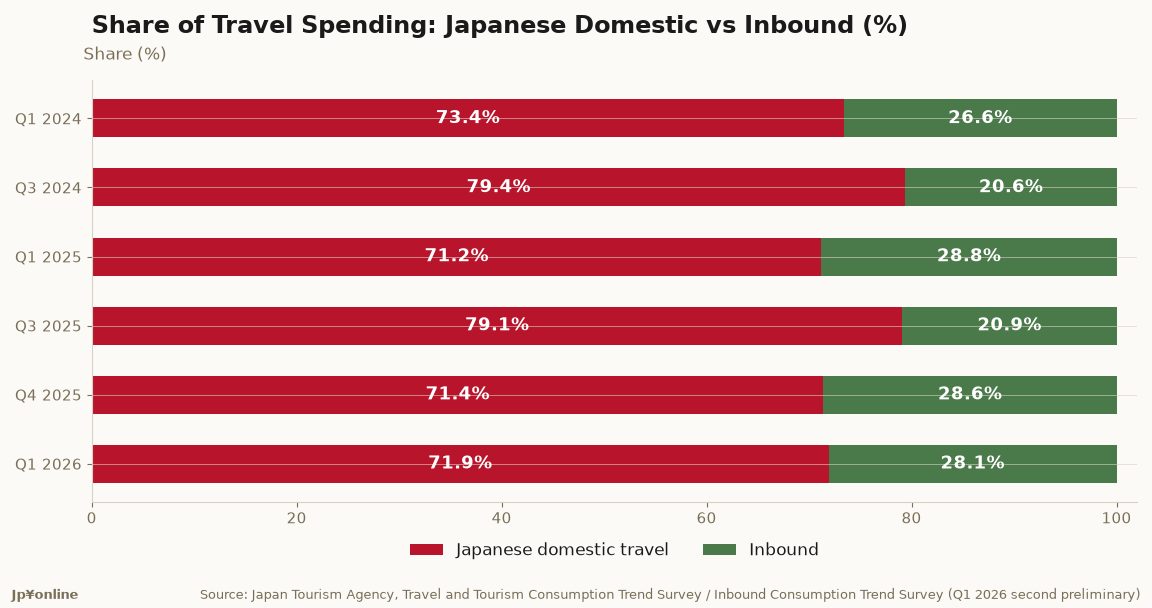
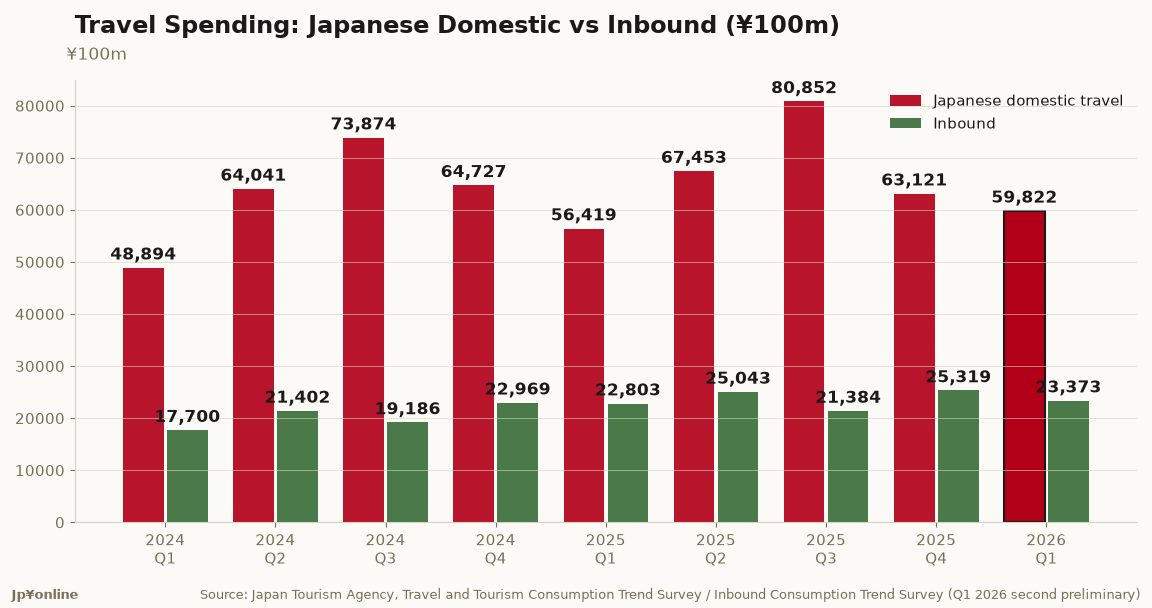
- First instalment of our fixed quarterly series on the domestic-versus-inbound split. Q1 2026: domestic travel ¥5,982.2bn and inbound ¥2,337.3bn, a combined ¥8,319.5bn
- Shares were 71.9% domestic and 28.1% inbound, against 71.2% / 28.8% a year earlier
- Inbound grew 2.5% while domestic grew 6.0% — a rare quarter where domestic outpaced inbound
- Strong seasonality: the inbound share drops to around 21% in July-September when Japanese travel most (20.9% in Q3 2025), and runs near 29% in Q1 and Q4
- Inbound spending is still setting records in absolute terms, but the ¥57bn year-on-year gain is the smallest since the 2023 recovery began
This is the first instalment of our fixed quarterly series putting Japanese domestic travel spending and inbound spending on the same chart.
In the January-March 2026 quarter, domestic travel spending was ¥5,982.2bn (+6.0% year on year) and inbound spending ¥2,337.3bn (+2.5%), for a combined ¥8,319.5bn. Domestic held 71.9% of the total and inbound 28.1%.
The first assumption worth dismantling is that Japanese tourism runs on foreign visitors. Domestic spending is 2.6 times inbound, and even at its peak inbound has never taken more than three-tenths of the market. Headline coverage tracks inbound growth rates, which are high because the base was low.
The second is seasonality. The inbound share sits near 29% in the first and fourth quarters and falls to around 21% in July-September — not because foreign visitors stay away, but because Japanese holiday travel inflates the denominator.
The third is what actually changed: the inbound share slipped from 28.8% to 28.1%, not because inbound fell but because domestic grew faster, 6.0% against 2.5%. Inbound spending of ¥2,337.3bn is still a record for the quarter, but the ¥57bn year-on-year gain is the smallest since the recovery began, against a 28.8% increase in the same quarter of 2025.
For lodging and retail investors, the single-engine inbound growth assumption of the past three years needs revisiting. Domestic volume is flat but unit price is rising, producing 6% value growth; inbound is entering a phase of slower arrivals growth with spend per visitor already high. Both lines now converge on price, not volume.
This article combines two Japan Tourism Agency releases. Summary translation:
1. Travel and Tourism Consumption Trend Survey, January-March 2026 (second preliminary), released 31 July 2026. Japanese domestic travel spending was ¥5,982.2bn (+6.0% year on year), comprising ¥4,884.8bn in overnight travel (+6.8%) and ¥1,097.4bn in day trips (+2.9%). Domestic trips totalled 121.0 million (+0.9%).
2. Inbound Consumption Trend Survey, January-March 2026 (second preliminary), released 30 June 2026. Inbound travel spending is estimated at ¥2,337.3bn, up 2.5% on the same quarter of 2025. By origin, Taiwan was largest at ¥388.8bn (16.6% share), followed by South Korea ¥317.9bn (13.6%), China ¥274.0bn (11.7%), the United States ¥260.0bn (11.1%) and Hong Kong ¥148.2bn (6.3%). For reference, inbound spending in the same quarter of 2025 was ¥2,280.3bn, when China led with ¥547.8bn (24.0%).
3. Quarterly series for inbound spending: Q1 2024 ¥1,770.0bn, Q2 2024 ¥2,140.2bn, Q3 2024 ¥1,918.6bn, Q4 2024 ¥2,296.9bn; Q1 2025 ¥2,280.3bn (+28.8%), Q2 2025 ¥2,504.3bn (+17.0%), Q3 2025 ¥2,138.4bn (+11.5%), Q4 2025 ¥2,531.9bn (+10.2%); Q1 2026 ¥2,337.3bn (+2.5%), Q2 2026 first preliminary ¥2,509.6bn (+0.2%).
Survey notes: from the April-June 2024 quarter the former Consumption Trend Survey for Foreign Visitors to Japan was renamed the Inbound Consumption Trend Survey. Survey items and estimation methods were unchanged, so comparison with data up to the January-March 2024 quarter remains valid. Cruise passenger figures for the first and second quarters of 2026 should be treated with caution because sufficient sailings and port-level responses were not secured.