Japanese Domestic Guest Nights 41.10 Million in July 2026, Down 3.1% as Decline EasesA · FULL TRANSLATION
- Japanese domestic guest nights in July 2026 were 41.10m, down 3.1% year on year — a clear improvement on June's -6.3% (second preliminary)
- June's first preliminary of 34.26m (-4.4%), reported here last month, was revised down to 33.60m (-6.3%): domestic demand was weaker than the flash suggested
- Japanese guests were 75.2% of all guest nights; lifted by the summer peak, July was one of the milder domestic declines this year
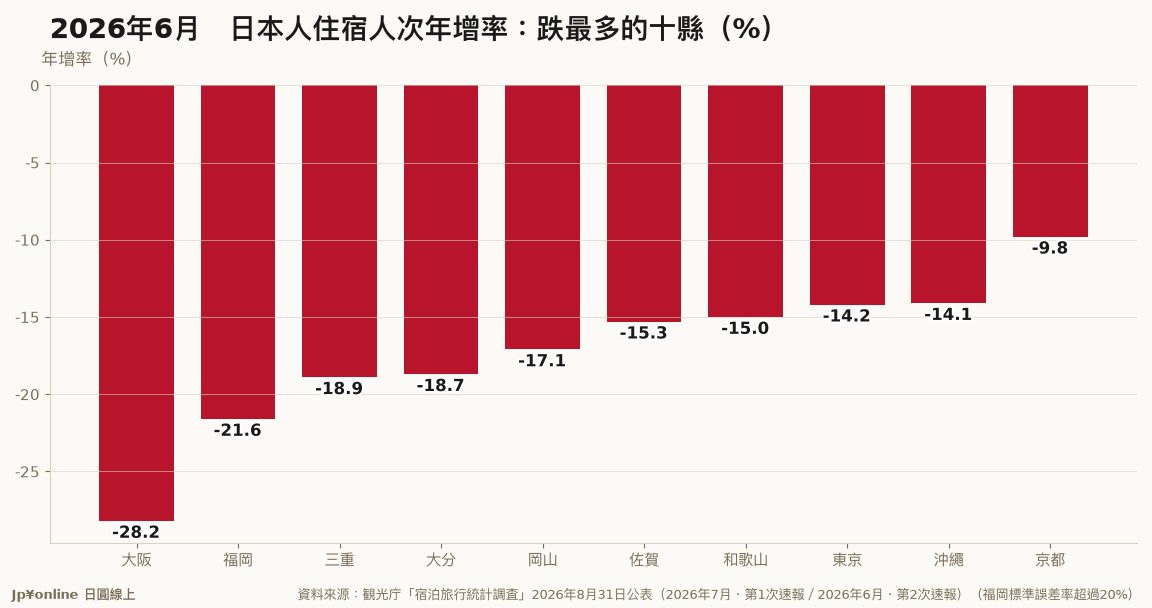
- June prefectures (second preliminary): steepest falls in Osaka -28.2%, Fukuoka -21.6%, Mie -18.9%, Oita -18.7%; biggest gains in Akita +35.1%, Kochi +30.5%, Toyama +29.2%
- Persistent domestic softness reflects prices and real-wage pressure; break in series from January 2026 as the stratification variable changed to room count
Last month this series reported Japanese domestic guest nights at 34.26m (-4.4%) on June's first preliminary; the second preliminary has revised June down to 33.60m (-6.3%) — domestic demand was weaker than the flash implied. The newly added July first preliminary is 41.10m (-3.1%), roughly half the revised June decline.
This line tracks domestic demand — whether Japanese residents themselves are staying in hotels. July's -3.1% is one of the milder declines this year, as the summer peak pulled families back into ryokan and resorts (the occupancy line shows ryokan up 3.4 points, turning positive) — the two signals agree. But July is only a first preliminary; if the 30 September second preliminary is revised down as June was, the apparent domestic recovery will shrink.
On the benchmarks: versus the June second preliminary (33.60m) July is up 22.3%, a seasonal move; versus a year earlier it is down 3.1%; the release did not carry a July 2019 Japanese figure, so we do not estimate one. The reason for persistent softness is structural — prices and real-wage pressure are holding down the frequency of domestic trips, and a single peak month does not reverse that.
June's prefecture pattern (second preliminary) shows the regional spread in domestic demand: the steepest falls were Osaka -28.2%, Fukuoka -21.6%, Mie -18.9%, Oita -18.7% and Okayama -17.1%, with big metros and some tourist prefectures shedding Japanese guests; the biggest gains were Akita +35.1%, Kochi +30.5%, Toyama +29.2%, Ibaraki +27.6% and Ehime +22.5%, mostly smaller-base prefectures with events or a news hook. For lodging investors, domestic demand swings less than inbound but varies sharply by region — which prefecture you choose determines how thick the domestic floor is.
Japan Tourism Agency, released 31 August 2026 — Overnight Travel Statistics Survey, Japanese guest-nights section. Summary translation:
1. Guest nights. Total guest nights in July 2026 were 54.67 million (-3.5% year on year), of which Japanese guest nights were 41.10 million (-3.1%). June 2026 (second preliminary) total was 45.82 million (-8.4%), of which Japanese 33.60 million (-6.3%).
2. By prefecture (June 2026 second preliminary). By year-on-year growth in total guest nights, the strongest prefectures were Akita, then Kochi, Ibaraki, Toyama, Yamaguchi and Tottori. National Japanese guest nights were 33.60 million (-6.3%).
3. Basis. 2007-2025 are final values, January-June 2026 second preliminary, July 2026 first preliminary, estimated from questionnaires collected by 12 August 2026 (32.9% response rate), to be revised on 30 September 2026.
Note: some prefectures carry higher standard errors and should be read with caution.
(Full prefecture-level detail is available in the original Japanese release.)