Where Occupancy Beats the Nation and Foreign Demand Still Grows: Aomori, Miyagi, Akita in June 2026A · FULL TRANSLATION
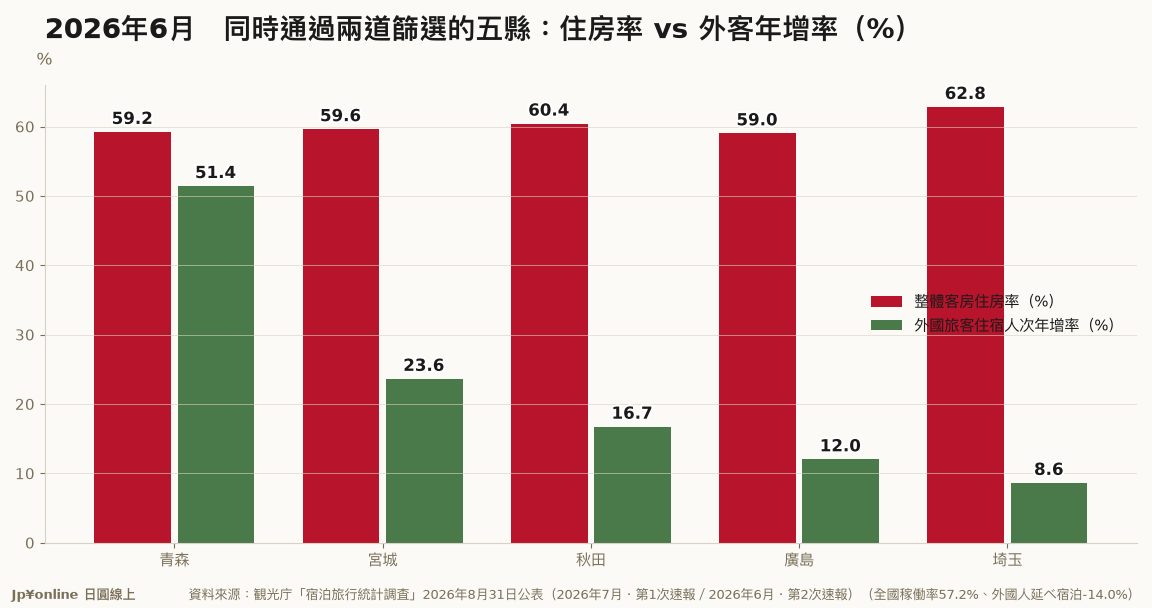
- Screen: overall room occupancy above the national 57.2% and positive year-on-year foreign guest nights — eight prefectures passed in June 2026 (second preliminary)
- Top five by foreign growth: Aomori (occ 59.2% / foreign +51.4%), Miyagi (59.6% / +23.6%), Akita (60.4% / +16.7%), Hiroshima (59.0% / +12.0%), Saitama (62.8% / +8.6%)
- Three more passed: Ishikawa (58.4% / +4.1%), Kanagawa (64.4% / +0.4%), Fukuoka (70.3% / +0.3%, though Fukuoka's standard error exceeds 20%)
- The flip side — high occupancy but falling foreign demand: Tokyo (75.4% / -17.0%), Osaka (65.3% / -18.0%), Kyoto (61.7% / -19.2%), Chiba (60.3% / -21.6%)
- National benchmarks: occupancy 57.2% (-1.6pt) and foreign guest nights -14.0%; see the note on the series break at the end
This line does the same thing every period: two objective screens to locate lodging opportunities. Screen one — overall occupancy above the national rate (57.2% in June's second preliminary); screen two — positive year-on-year foreign guest nights (national -14.0%). Prefectures that pass both have rooms already relatively full and inbound demand still heading their way — a tailwind pocket inside a headwind.
Last month (May second preliminary) the passers were Ehime, Saitama, Toyama, Kanagawa and Ishikawa; in June eight prefectures passed, and the top five by foreign growth are now Aomori, Miyagi, Akita, Hiroshima and Saitama. Aomori stands out at 59.2% occupancy and +51.4% foreign — the Tohoku region was clearly lifted by pre-summer events and cruise/charter traffic; Miyagi (+23.6%) and Akita (+16.7%) sit in the same belt. Saitama (62.8% / +8.6%) is the only metropolitan prefecture to pass in two consecutive periods, on business and overflow demand from Tokyo.
The flip side matters too: Tokyo's 75.4% is still the highest occupancy in the country, but foreign stays fell 17.0%; Osaka 65.3% / -18.0%, Kyoto 61.7% / -19.2%, Chiba 60.3% / -21.6%. These large markets hold occupancy on existing volume and domestic guests while inbound momentum drains away — high occupancy does not mean rising foreign demand, and an investment call cannot rest on occupancy alone.
For actual positioning: to capture inbound growth, this period's signal points to Tohoku (Aomori, Miyagi, Akita) and Hiroshima rather than the already-full big-three metro cores where foreign demand is retreating. A caveat, though — this is a single month, and some prefectures (Fukuoka) carry standard errors above 20%; the large gains in smaller-base prefectures like Aomori and Miyagi count as a trend only if they persist for two or three periods, so recheck after the 30 September second preliminary.
Caveat: from January 2026 the survey's stratification variable changed from employee count to room count, so year-on-year comparisons spanning 2025 and 2026 carry a methodology effect.
Japan Tourism Agency, released 31 August 2026 — Overnight Travel Statistics Survey (June 2026 second preliminary), prefecture occupancy and foreign guest-nights section. Summary translation:
1. Prefecture occupancy by facility type. Tokyo recorded the highest overall occupancy nationwide at 75.4%. In June 2026 the prefectures above 80% occupancy were: business hotels 1 (1 a year earlier), city hotels 0 (1 a year earlier). National overall occupancy was 57.2% (-1.6 points year on year).
2. Foreign guest nights. Foreign guest nights were 12.22 million (-14.0%), or 26.7% of the total. The big-three metros fell 16.8% and the regions 7.4%. By year-on-year growth, regional prefectures such as Aomori, Yamaguchi, Kochi and Tottori posted the largest gains, while large markets such as Tokyo, Osaka and Kyoto fell double digits.
Note: Tochigi, Gunma, Chiba, Toyama, Fukuoka and Miyazaki carry standard errors above 20%. The two screening conditions used above (occupancy above the national rate; positive year-on-year foreign guest nights) are set by this site, not by the source.
(Full prefecture-level detail is available in the original Japanese release.)