Land White Paper 2025: Behind the Glittering NumbersA · FULL TRANSLATION
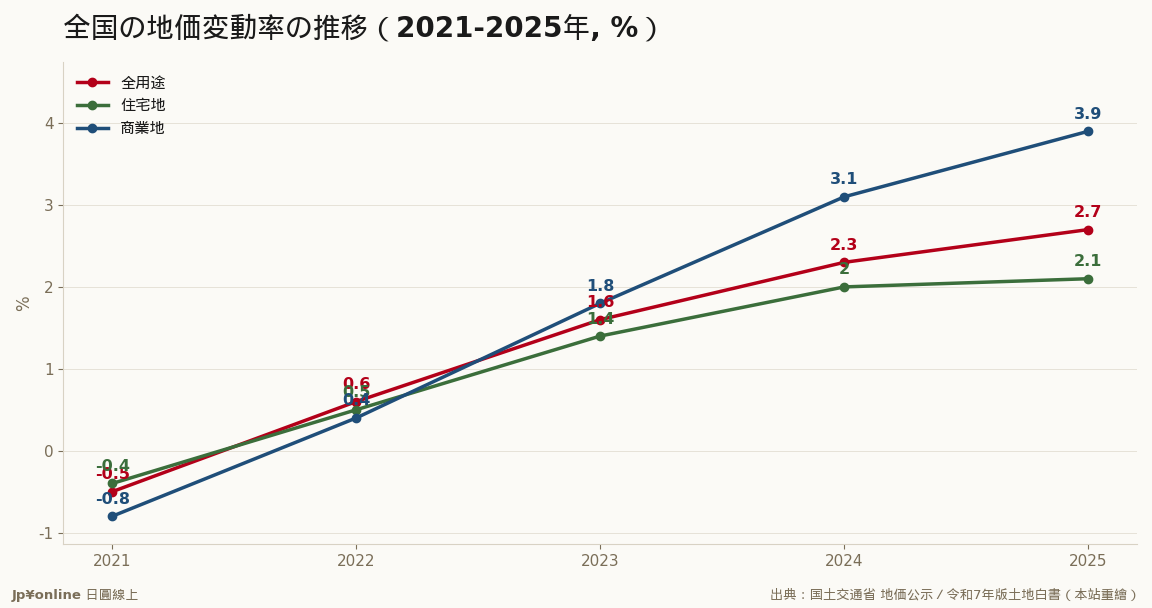
- Land White Paper R7: All purposes +2.7%, residences +2.1%, commercial +3.9% (four consecutive years)
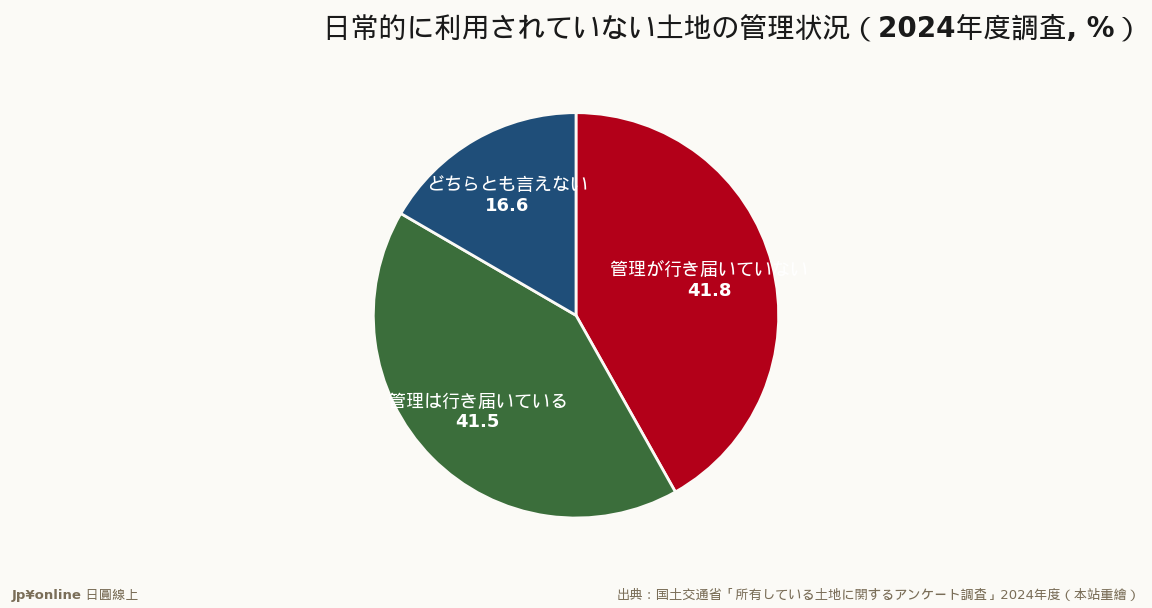
- 41.8% of owners admit poor management on idle lands vs 41.5% well-managed
- Special focus on leveraging private investment for regional revitalization
- Selective success stories highlight government intentions to awaken underused land through market mechanisms
- Polarized growth—core cities and tech hubs see high values, but non-metropolitan regions remain stagnant
The Land White Paper is Japan's annual account of land policies. The 2025 edition presents a rosy picture—national land values up across all purposes (2.7%), residences (2.1%), and commerce (3.9%) for four consecutive years, with transactions flat. But the reverse side reveals that 41.8% of owners acknowledge poor management on idle lands, as found in an official survey. Special features highlight successful cases like Ota in Takaichi (700,000 visitors within a year) and F Village in Nihonmatsu (direct economic effect of 50 billion yen per year), signaling government intentions to awaken slumbering land through market mechanisms.
【Conclusion】Each year, the Land White Paper, decided by Cabinet and reported to Parliament, serves as Japan's annual account of land policies. The 2023 decision for the R7 edition shows a prosperous front—national land values up across all uses (2.7%), residences (2.1%), and commerce (3.9%) for four consecutive years with expanding gains; however, behind this is a stark reality: government surveys show that owners of idle lands admit poor management in 41.8% of cases, nearly equal to those managed well at 41.5%. While the heart of major cities beats with high land values, over 40% of idle lands remain underutilized. The White Paper's special focus on leveraging private investment for regional revitalization underscores government efforts to awaken slumbering lands through market forces.
【Breaking Down the Numbers: Growth Logic and Idle Realities】On the value front, the report confirms four key drivers: robust residential demand amid low interest rates, especially in Greater Tokyo and Kansai; strong commercial demand, including office vacancy declines; increased inbound tourism boosting real estate values; and high land values due to semiconductor investments. Transaction volumes remain stable—price increases without volume gains, concentrated on specific locations rather than across the board. The numbers regarding idle lands reveal a grim picture: 41.8% of owners admit poor management, indicating substantial unused lands in Japan that are 'owned but not operated.' These long-term issues persist due to low utilization and high management costs, leading many places to simply put land aside.
【Special Focus Cases and Their Signals】The special section includes common themes: public-private collaborations on idle or publicly-owned lands. Successful cases like the Ota project in Takaichi showcase how combined efforts can revitalize underused areas. Other examples include F Village's economic impact of 50 billion yen annually, and SUIDEN TERRASSE in Yamagata increasing accommodation numbers through tourism. These cases signal government support for leveraging private investment to awaken idle lands.
【Counterarguments】While these success stories are highlighted, they cannot be directly extrapolated. Entry into the White Paper is selective, and behind successful cases lie failures of third-sector initiatives. The success or failure of mixed-use facilities depends heavily on operational talent, a scarce resource in localities. Additionally, while national land values have been rising for four years, the data also show increased polarization—areas like Sendai continue to decline, and non-metropolitan regions see minimal growth.
【Historical Context】The Land White Paper began in 1969 amid soaring land prices, initially tasked with monitoring price hikes. Post-bubble era saw its mission shift from 'pressing down on land values' to 'saving land.' The current edition focuses on private investment-driven revitalization as a continuation of policy shifts toward 'attracting investors rather than regulating.' Despite high-profile case studies, the reality is that unused land remains significant—900,000 vacant houses and ownerless lands equivalent to an entire Kyushu island.
【Practical Implications for Taiwanese Investors】Three key insights: 1) Understand polarization before entering; foreign capital can capitalize on residential and commercial hubs but must also consider exit strategies for inherited properties. 2) Idle lands present opportunities; local governments are eager for public-private partnerships, making it easier for operational experts to secure low-cost land in exchange for long-term management rights. 3) Keep an eye on new policies introduced in the third section, which will likely become funding targets next year.
【Next Steps】Watch three key areas: 1) Sentiment shift in next year’s edition of the White Paper regarding price forecasts; particularly, whether lower growth expectations for secondary markets spread. 2) Enforcement data on ownerless land measures, such as the implementation rate of compulsory registration in 2024, which will influence market dynamics. 3) Financial flows under 'Social Impact Real Estate' initiatives—whether institutional capital truly enters to transform these concepts into real assets or whether they remain mere concepts on paper.