Analysis: The Tale of Rising Land Prices in Japan’s Regions Is Changing—Fukuoka and Sapporo Shift to Rent Yield, Ski Resorts and Semiconductors Lead the ChargeA · FULL TRANSLATION
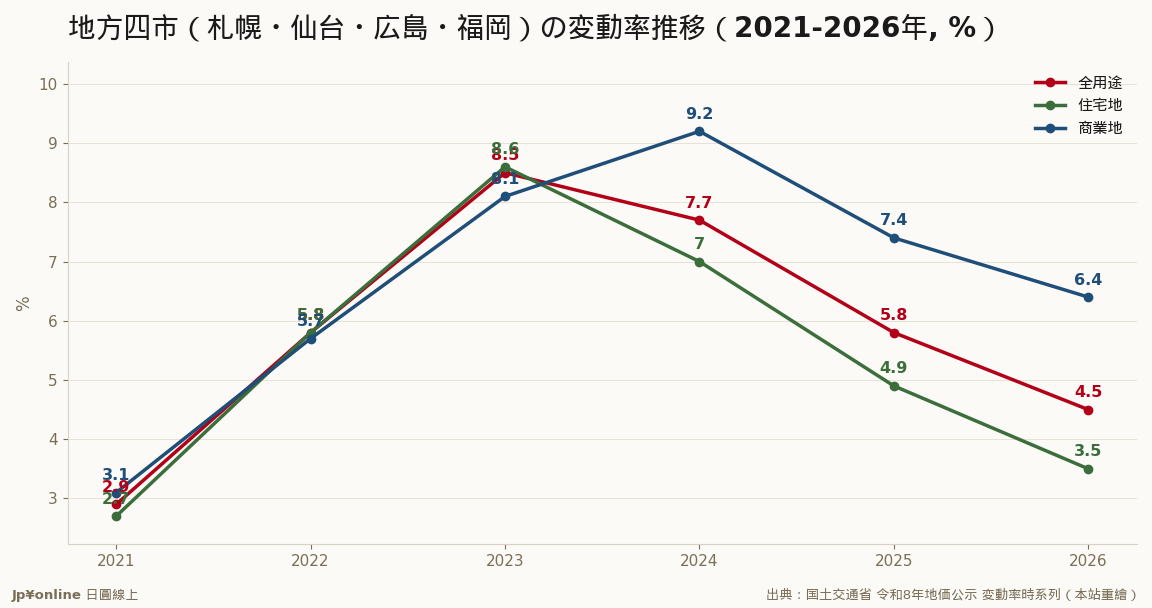
- Fukuoka and Sapporo land prices slowed from 8.5% peak to 4.5% in 2026
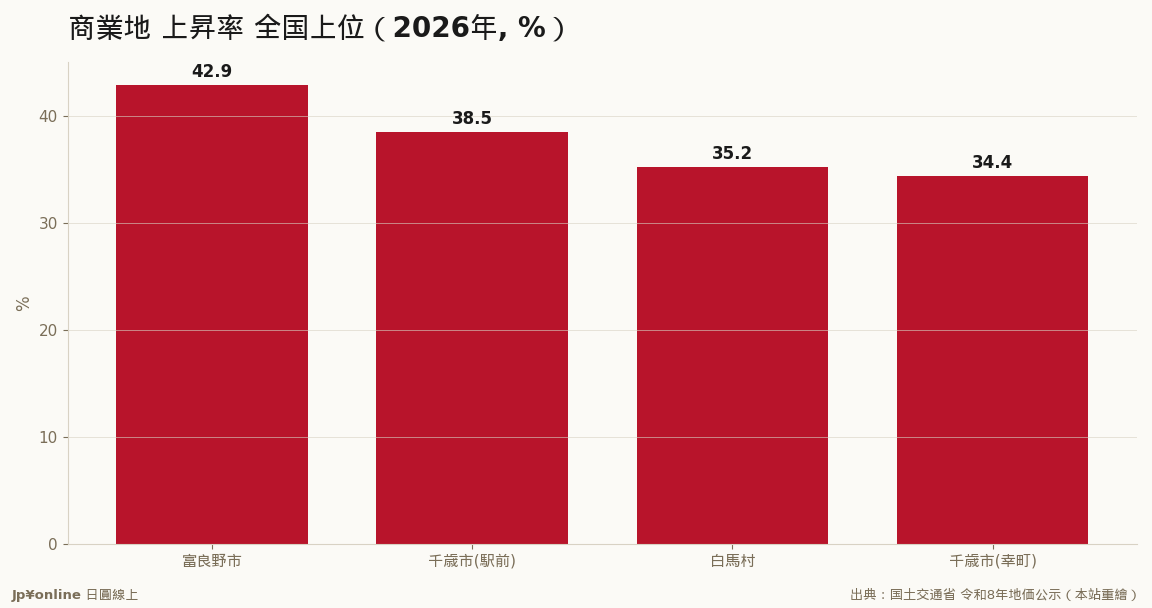
- New leaders: Roppongi Hills (42.9%) and Hakuba (35.2%) for ski resorts; Kasuga (+38.5%) for semiconductors
- Reduced growth does not mean collapse, still 1.7x national average in Fukuoka
- Risks: Currency fluctuations for ski resorts; single-enterprise risks for Kasuga
- Taiwanese investors should focus on rental yields and long-term population attraction
The main actors have changed in the rising land prices of Japanese regional cities. Fukuoka and Sapporo, which once drove the narrative of 'rural appreciation,' saw a 4.5% increase in all purposes in 2026 after three consecutive years of slowing growth—residential land fell from 8.6% to 3.5%. Ski resorts (Roppongi Hills +42.9%, first nationwide; Hakuba +35.2%) and semiconductor towns (Kasuga +38.5%, due to Rapidus effect) have taken the lead in rising prices. The script of regional land values has shifted from 'core urban areas attracting domestic population' to 'point-driven growth supported by international capital or national strategy.' For Taiwanese investors, understanding this change is more crucial than memorizing single figures.
Conclusion: In 2026, Japan’s regional cities saw a shift in the main actors driving land price appreciation. Fukuoka and Sapporo, which had previously driven the narrative of 'rural appreciation,' saw an overall 4.5% increase but this was after three consecutive years of slowing growth—from a peak of 8.5% in 2023. Residential land dropped from 8.6% to 3.5%, while commercial land maintained at 6.4%. Ski resorts (Roppongi Hills +42.9% nationwide; Hakuba +35.2%) and semiconductor towns (Kasuga +38.5%, due to Rapidus effect) have taken the lead in rising prices. The narrative of regional land values has shifted from 'core urban areas attracting domestic population' to 'point-driven growth supported by international capital or national strategy.'
Fukuoka and Sapporo saw a significant increase in land prices over the past decade, with residential property prices increasing up to 10 times local income levels. As a result, investment demand fell after the real estate market cooled, while commercial land remained more resilient due to tourism, redevelopment, and office demand.
The new actors operate on different engines: ski resorts burn international fuel (foreign wealthy individuals' villa and apartment development demands, hotels, and commercial facilities), which is boosted by a weak yen. Semiconductor towns are fueled by national strategy (Rapidus's presence bringing related companies, employee housing, and supporting services). Both do not rely on local population or income levels.
New challenges for these new actors include the risk of exchange rates in ski resorts and single-enterprise risks in semiconductor towns. For Fukuoka and Sapporo, while growth has slowed, underlying demand structures remain intact, with future developments planned that could support continued appreciation if real estate returns to fundamentals.
Historical Context: The peak period for these four cities (2021-2023) coincided with the end of the Bank of Japan's unconventional monetary easing. Lower interest rates attracted more funds to high-yield regional core areas, which were primarily financial phenomena rather than real economic ones. Since 2024, as funding costs increased, these capital gains-driven buyers began to leave.
Practical Advice for Taiwanese Investors: For Fukuoka and Sapporo, the focus should now be on rental yields and long-term population attraction. Adjust expectations in calculations from a 5% annual appreciation rate down to 2-3%. Ski resorts are suitable for dual-purpose funding (self-use holidays combined with long-term holding) but financial investors should view the 33% increase in Hakuba as a warning sign rather than an invitation.
Next Key Points: The next key points of focus will be whether Fukuoka and Sapporo fall below national averages in 2027, progress updates on Rapidus's production milestones, and the expansion of ski resort influence into secondary resorts like Myoko and Zao.