Japan’s December Core CPI Down to +2.4%, But Core Core Still at +2.9% - Don’t Mistake Reduced Subsidies for Lower InflationA · FULL TRANSLATION
- December Core CPI (excluding fresh food) +2.4%, down significantly from November's +3.0%; driven by government subsidies on energy
- Core-Core still at +2.9%, showing underlying demand-driven inflation remains sticky; December's low numbers are due to subsidy reductions, not natural cooling
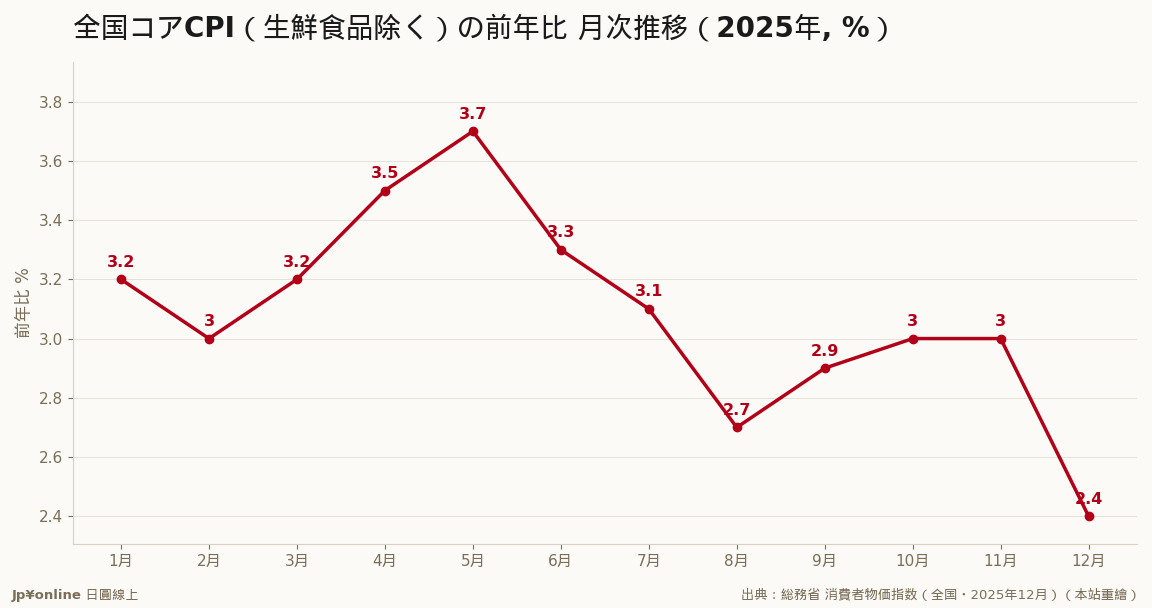
- Core monthly 2025 ranged above 3% until May, peaking at 3.7%, then fell by year-end; Yoshiki Shiojiri expects it might fall below 2% in February or March 2026 but warns of weak yen risks after April
- Impact on wallets: reduced rate hike expectations mean weaker yen and postponed pressure for variable-rate mortgage holders, but core-core near 3% means interest rates remain a concern
- Practical implications for Taiwanese readers: focus on Core-Core over Core; weak yen window still open short-term, but monitor food price increases and subsidy withdrawals post-April; use Tokyo’s central ward CPI as an early indicator
The Ministry of Internal Affairs and Communications released Japan's national consumer price index (CPI) for December 2025, showing a significant slowdown in year-over-year growth to +2.4%, from +3.0% in November. However, stripping out energy prices, core-core CPI remained at +2.9%. The reduction is mostly due to government subsidies on energy, while underlying demand-driven inflation remains sticky. For Taiwanese readers watching the yen and Japanese mortgages, this slowdown is partly an illusion created by subsidy reductions, with true domestic inflation still high.
【Conclusion First】The Ministry of Internal Affairs and Communications released Japan's national consumer price index (CPI) for December 2025 on January 23, 2026, showing a significant cooling in inflation. The key metric—the core CPI excluding fresh food (CPIコア)—declined to +2.4% year-over-year from +3.0% in November. However, don't mistake this for deflation—core-core CPI (excluding energy) remained at +2.9%. True domestic demand-driven inflation persists.
【Cracking the Numbers】The three metrics are: Total (including all items) +2.1%; Core (excluding fresh food; key reference for BOJ and market) +2.4%; Core-Core (excluding energy, focusing on core inflation) +2.9%. The divergence is telling—core fell sharply while core-core barely budged.
【Breaking Down the Numbers: Subsidies Masking, Demand Persisting】The drop from November's +3.0% to December's +2.4% in core CPI was mainly due to government subsidies on energy. Meanwhile, core-core CPI only dropped slightly from +3.0% to +2.9%, indicating persistent underlying demand-driven inflation. First Life Economic Research Institute’s Yoshiki Shiojiri estimates that by February or March 2026, the core CPI might fall below 2%. However, weak yen could boost imported food prices after April, raising concerns about sustained deflation.
【Why This Matters for Yen and Mortgages】The sole justification for BOJ rate hikes is stable, ongoing 2% inflation. Core falling to +2.4% and expected short-term drops below 2% would lower the urgency for rate hikes, temporarily weakening the yen (interest rate differential hard to narrow) but providing respite for adjustable-rate mortgage holders. However, core-core near 3% remains key: as long as domestic demand-driven inflation persists, BOJ won't abandon its path of interest rate hikes. Good news for mortgage holders has a limited window.
【Practical Takeaways for Taiwanese Readers】First, don’t read December’s +2.4% as the end of inflation—reduced subsidies will likely reverse with their removal. Core-core CPI is more reflective (+2.9%). Second, the weak yen window remains open: reduced rate hike expectations weaken the yen temporarily, offering benefits to travelers, remitters, and importers for a short period. However, monitor food price increases and subsidy withdrawals starting in April. Third, use Tokyo’s 23 wards CPI as an early indicator—it releases one month earlier.
【What to Watch Next】First, whether core CPI falls below 2% by February or March 2026 will determine BOJ’s next move. Second, the timing of energy subsidy withdrawals will dictate when suppressed energy prices rebound. Third, can core-core inflation move away from near 3%—only then will rate hike concerns diminish.