Weekly Report: Foreign Investors Sell $487.1 Billion, Individuals Turn Negative—Who Is Backfilling the Market?A · FULL TRANSLATION
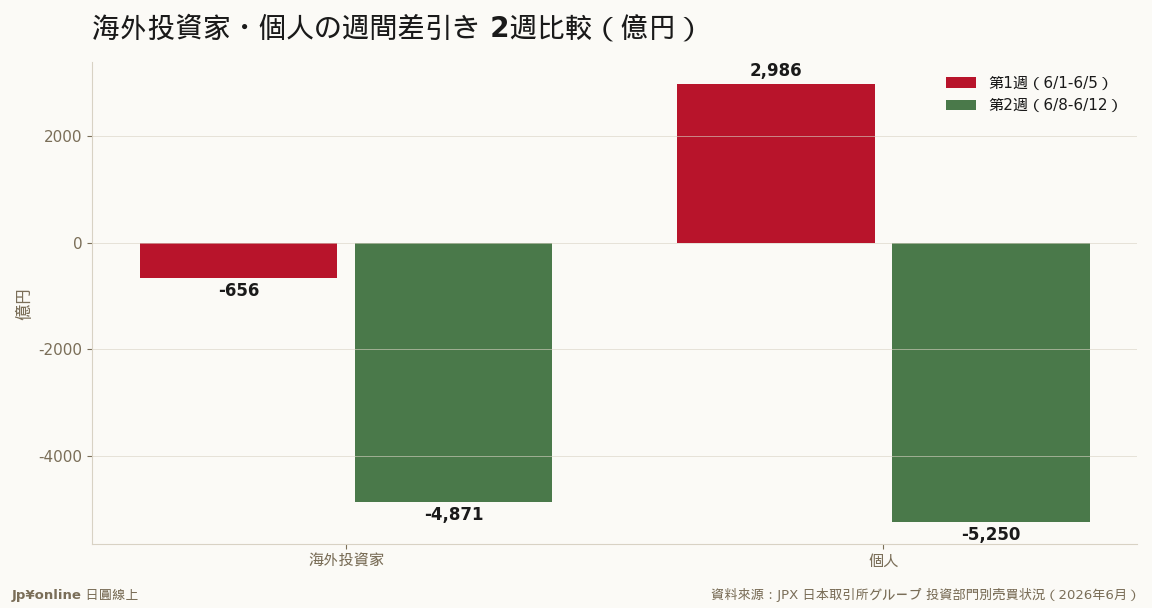
- Foreign investors sold $487.1 billion (up from $656 billion) in net terms for the week of June 8-12, 2026
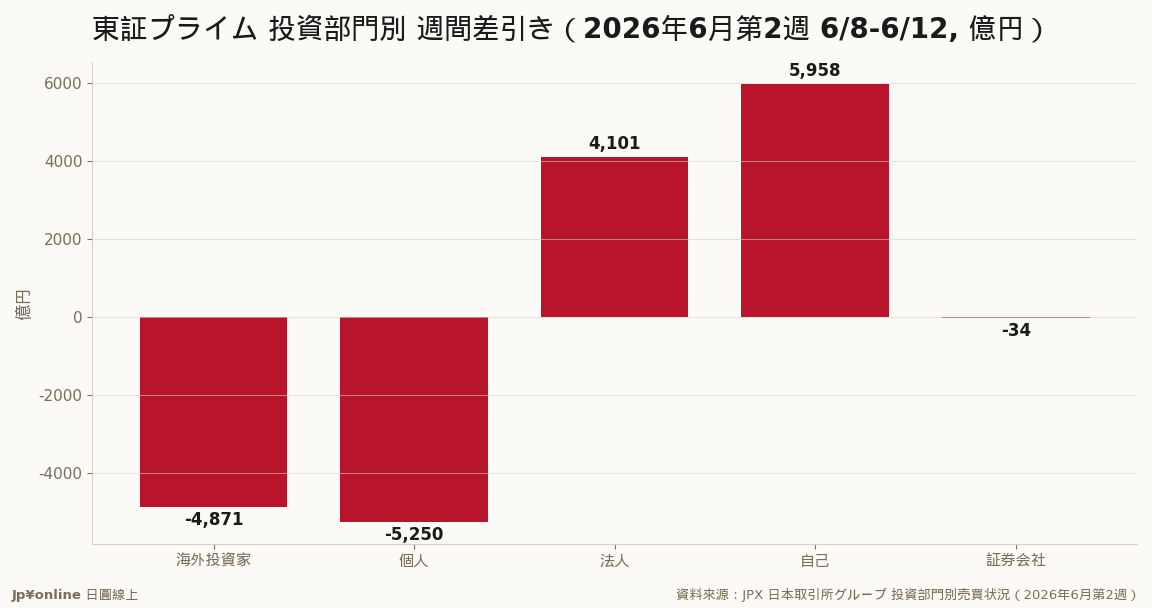
- Individuals shifted to selling for a net sale of $525 billion; self-operated trading and institutional investors stepped in to support (+$59.58 billion and +$410.1 billion respectively)
- Corporate share buybacks ($317 billion), investment trusts, and life insurance companies made significant purchases (life insurance companies buying a record $12.327 billion in one week)
- When the index doesn't fall but foreign investors are selling, the key is to determine who is backfilling—this week it was self-operated trading and corporate share buybacks
- For Taiwanese readers: use this report as a capital flow map, be cautious when chasing gains if backed by share buybacks, and consider both stock flows and yen trends for exchange rate predictions
The Japan Exchange Group (JPX) publishes weekly investment sector buying and selling data that breaks down the capital flow of the Tokyo Stock Main Board: For the week of June 8-12, 2026, foreign investors sold $487.1 billion in net terms (up from $656 billion the previous week by nearly seven times). Individuals also shifted to selling for a net sale of $525 billion; however, buying support came from self-operated trading (+$59.58 billion) and institutional investors (+$410.1 billion), preventing a market collapse. Foreign investors' withdrawal of funds was partially a yen selling pressure but not in one-to-one correlation with the overall yen trend. For Taiwanese readers: This weekly report is crucial for understanding which market forces are supporting or pressuring the Nikkei and yen.
【Why Taiwanese Readers Should Care】The Japan Exchange Group (JPX) publishes a weekly 'Investment Sector Buying and Selling Status,' breaking down the capital flows of the Tokyo Stock Main Board: who is buying, and who is selling. For the week of June 8-12, 2026, foreign investors (foreigners) sold $487.1 billion in net terms compared to $656 billion in the previous week—an increase nearly sevenfold; individuals also shifted from buyers to sellers for a net sale of $525 billion. While buying support was withdrawn significantly, the market did not collapse—because self-operated trading (+$59.58 billion) and institutional investors (+$410.1 billion) stepped in.
【Key Figures】The net buying and selling figures (net difference, positive for buy, negative for sell, unit: billions of yen) for the second week are as follows: foreign investors -$487.1, individuals -$525, institutional investors +$410.1, self-operated trading +$59.58, securities companies -$34, totaling approximately -$96 billion, which aligns with the overall total of -$98 billion for that week. Thus, foreign and individual investors collectively withdrew about 1 trillion yen in the week, nearly fully absorbed by self-operated trading (+$59.58) and institutional investors (+$410.1). Institutional internal operations were dominated by corporate entities—buying back their own shares (self-share purchase), amounting to $317 billion, with significant contributions from investment trusts ($88.8 billion) and life insurance companies ($83.5 billion), which bought a record high of $12.327 billion in one week.
Across weeks, there's more drama: foreign investors: -$656 billion in the first week and -$487.1 billion in the second, with selling pressure expanding sevenfold; individuals: buying +$29.86 billion in the first week and shifting to selling -$525 billion in the second, a complete reversal. The largest free-buying market participants pulled out of both markets in one week.
【A Unique Methodology Perspective】When the index doesn't fall but foreign investors are selling, it's crucial to ask who is backfilling. This week, the backfillers were self-operated trading and corporate share buybacks (self-share purchase). Share buyback represents a planned, relatively stable buying force that provides support when foreign funds withdraw but is constrained by cash and repurchase limits. Unlike foreign investors, they can't push up significantly. In other words, markets supported by share buybacks and self-operated trading fall less but lack the momentum to rise further. To predict market moves beyond index performance, look at which buying forces are dominant—this week it was defensive support from corporate share buybacks, indicating a tug-of-war between foreign investors' observation and corporate protection.
【Impact on the Yen】Foreign investors’ transactions in Japanese stocks often involve currency swaps; selling Japanese stocks with net outflows can increase yen selling pressure but isn't always one-to-one. This week’s significant selling needs to be analyzed alongside the overall yen trend, making it impossible to predict exchange rate movements solely based on stock flows.
【Taiwanese Reader Practical Tips】First, use this JPX weekly report as a capital flow map—look at foreign investor buying and selling first, then who is backfilling. This gives better insight than just looking at the Nikkei index performance. Second, if support comes from share buybacks (as in this week), the market is defensively trading, so be cautious when chasing gains; a reversal of foreign buying is needed for trend confirmation. Third, foreign stock flows and yen movements are not one-to-one, so using them to predict exchange rates requires considering both simultaneous trends in yen and the U.S.-Japan interest rate differential.