Tokyo Core Office Market: 2.22% Vacancy Rate for 10 Consecutive MonthsA · FULL TRANSLATION
- December 2025 vacancy rate of 2.22% (down 1.78 percentage points from last year, down 0.22 percentage points from previous month, ten consecutive months decrease); average rental rate per square meter at 21,409 yen (up 1,113 yen from last year, twenty-three consecutive months increase)
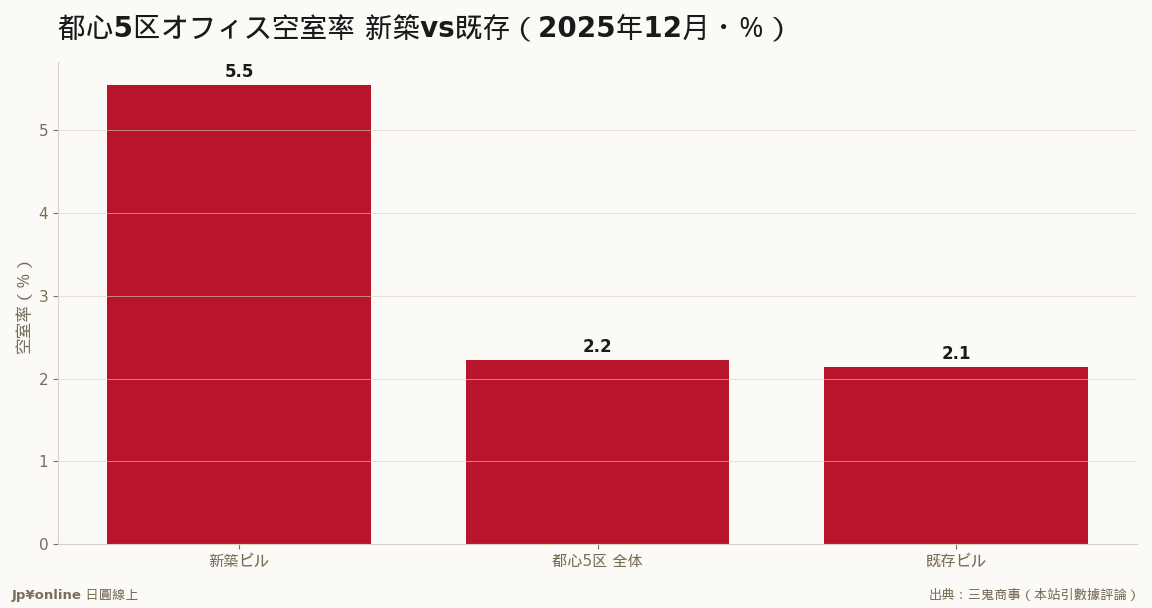
- Breaking new and existing office rates to understand market structure: new construction vacancy rate of 5.55% vs existing 2.14%; almost all available space in newly completed buildings; existing market nearly full
- New construction rental at 31,881 yen per square meter vs existing 21,172 yen, new constructions pushing overall average higher by about 10,000 yen per square meter
- Unique approach: separate office into ‘new construction absorption’ and ‘existing stock full occupancy’ markets; decreasing new construction vacancy rate signals overheating, increasing rate earlier warning than total vacancy rate
- Taiwan operational advice: use new construction vacancy rate as leading indicator for office REITs, early layout for difficult-to-find existing stock in central areas, not solely relying on average rental rates
Sankei Shoji reported in December 2025 that the vacancy rate of office spaces in central Tokyo’s five areas (Chiyoda, Chuo, Minato, Shinjuku, Shibuya) was 2.22% (down 1.78 percentage points from last year and down 0.22 percentage points from the previous month), marking a continuous ten-month decrease. The average rental rate per square meter reached 21,409 yen (up 1,113 yen from last year and up for 23 consecutive months). For Taiwanese investors focusing on office real estate in Japan, this data tells the same story: Tokyo’s core office market is extremely tight with rent still rising.
Why Should Taiwanese Readers Care? Sankei Shoji reported that in December 2025, the vacancy rate for office spaces in central Tokyo's five areas (Chiyoda, Chuo, Minato, Shinjuku, Shibuya) dropped to 2.22%, down by 1.78 percentage points from last year and 0.22 percentage points from the previous month, marking a continuous ten-month decrease; the average rental rate per square meter was 21,409 yen (up 1,113 yen from last year and up for 23 consecutive months). For Taiwanese investors monitoring office real estate in Japan, this data indicates that Tokyo’s core office market is experiencing extremely tight supply and demand with rent still rising.
Breaking Down the Numbers: The vacancy rate can be broken down into new and existing buildings to understand the market structure. At a 2.22% overall rate (5% is generally considered equilibrium, 2% or less means landlords have the upper hand), this low point isn’t evenly distributed—newly built office spaces have a 5.55% vacancy rate while existing ones have only 2.14%. In other words, almost all available space is concentrated in newly completed buildings that are still being occupied; the existing market is nearly fully rented.
A Unique Methodological Perspective: Office spaces should be divided into two markets—new construction absorption and existing stock full occupancy. Many investors only look at overall vacancy rates, which can lead to misjudgments. The correct approach is to split it into two independent markets: the progress of new building absorption (tracked through new construction vacancy rate) and the level of existing space occupancy (indicated by 2.14% existing vacancy). In December 2025, one market tightened while the other loosened, indicating that demand was strong enough to absorb new supply and push existing stock closer to full occupancy.
What It Means for Investors and Users: The continuous ten-month decrease in vacancy rates and the 23 consecutive months of rising rental rates are favorable for landlords and REITs holding central office assets. For companies looking for office space, especially those setting up in Tokyo (including Taiwanese firms), a 2.14% existing stock means difficulty finding good spaces with limited negotiation power, requiring early planning before lease renewals.
Taiwanese Operational Advice: Firstly, when evaluating Japanese office REITs, use the new construction vacancy rate as an economic leading indicator; it provides earlier signals of supply-demand shifts compared to overall vacancy rates. Secondly, with existing stock nearly fully rented, rental rate growth will depend on whether future new supplies can be absorbed by demand—the more new buildings and faster absorption, the stronger landlords' position. Lastly, companies considering setting up in Tokyo should not solely rely on average rent; the difference of about 10,000 yen per square meter between new construction and existing spaces means deciding between ample space at higher prices or harder-to-find but cheaper options.
What to Watch For Next: Look for signs that a ten-month decline in vacancy rates may reverse, typically seen first in new construction vacancy rates; monitor the rental rate increases over 23 consecutive months to see if they start stabilizing; and keep an eye on new supply volumes expected in central Tokyo in 2026 as this will determine how long the tight market conditions can continue.