January 2026 Domestic and Foreign Visitor Accommodation Plummets? Official Note Reveals the Real Story - Statistical Adjustment and High Base Year ImpactA · FULL TRANSLATION
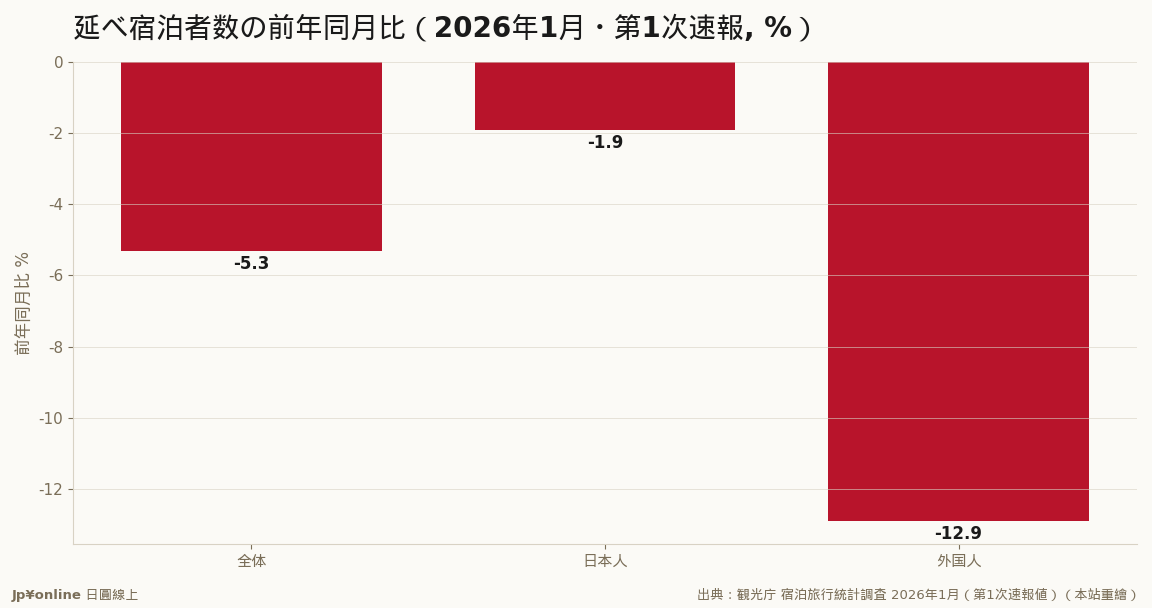
- January 2026 First Estimate: Total overnight stays at 46,280,000 (-5.3%)/ Domestic visitors at 33,080,000 (-1.9%)/ Foreign visitors at 13,200,000 (-12.9%)/ Occupancy rate at 53.1%
- ★Official Note★ Statistical adjustment from 'number of employees' to 'room count' from January 2026 onwards, affecting year-over-year comparisons — cannot be directly extrapolated
- Three forces: statistical adjustment (new and old statistical bases not comparable)+ first estimate least precise + high base year (January 2025 peak at 15,150,000 foreign visitors) + seasonal factors (normal winter off-peak occupancy rate of 53.1%)
- Do not be overly optimistic: foreign visitor stays in the double digits negative growth still indicate concerns; if sustained into February-March, re-evaluate as slowdown; domestic visitors -1.9% extension indicates weak domestic demand during off-season
- Taiwan Operational Implications: Look at absolute numbers (foreign visitors at 13,200,000 still high off-peak levels) rather than percentage changes; conservative cash flow scenario using winter-off-peak occupancy rate of 53.1%; monitor February-March and second estimates for technical adjustment vs true slowdown
The Ministry of Tourism's preliminary January 2026 accommodation statistics are alarming: total overnight stays nationwide at 46,280,000 (-5.3%) and foreign visitors at 13,200,000 (-12.9%). However, these figures should not be read literally — the ministry also noted that from January 2026 onwards, the stratification benchmark for statistics changed from 'number of employees' to 'room count,' affecting year-over-year comparisons. Adding a high base year from January 2025 (15,150,000 foreign visitors), this -12.9% is due to both statistical adjustments and a high base year, not market collapse.
【Conclusion First】The Ministry of Tourism's preliminary January 2026 accommodation statistics show a significant decline: total overnight stays at 46,280,000 (-5.3%) and foreign visitors specifically at 13,200,000 (-12.9%). However, these numbers should not be taken at face value — the ministry warns that from January 2026 onwards, the stratification benchmark for statistics changed from 'number of employees' to 'room count,' affecting year-over-year comparisons due to statistical adjustments. Adding a high base year from January 2025 (15,150,000 foreign visitors), this -12.9% is due to both statistical changes and a high base year, not market collapse. For Taiwanese readers monitoring the Japanese accommodation sector, understanding this note is more important than being alarmed by single-month figures.
【Breaking Down the Contradictions】January 2026 statistics show significant declines: overall -5.3%, domestic visitors at 33,080,000 (-1.9%), foreign visitors at 13,200,000 (-12.9%), and an occupancy rate of 53.1%. However, the full-year 2025 data shows a record-breaking high of 177,870,000 overnight stays for foreign visitors, up 8.2% year-on-year. A single month's decline does not indicate reduced demand; it is more likely due to changes in statistical methods. The ministry changed the stratification benchmark from 'number of employees' to 'room count,' effectively changing the measurement scale and introducing noise from the adjustment.
【Breaking Down the Numbers: Three Forces】The -12.9% decline is influenced by three factors. First, statistical adjustments: changes in stratification benchmarks make new and old comparisons difficult; first estimates are least precise, with corrections expected in subsequent reports. Second, a high base year from January 2025 (15,150,000 foreign visitors), which skews the denominator. Even if this month remains at a high level, year-over-year figures can still show declines due to the high base year. Third, seasonality: January is typically an off-peak period for inbound tourism and mixed with domestic travel needs; 53.1% occupancy rate is normal during winter slack periods.
【Counterarguments】One should not be overly optimistic either. Foreign visitor stays in the double digits negative growth in a single month are still concerning, especially if sustained into February-March. The decline of domestic visitors by -1.9% also indicates weak domestic demand, a significant structural concern for the off-season. First estimates have high volatility; definitive conclusions require second estimate and final reports.
【Operational Implications for Taiwanese Readers】First, do not be misled by single-month figures: understand that statistical adjustments are in place, so year-over-year comparisons from this month cannot be directly extrapolated. Comparing absolute numbers (foreign visitors at 13,200,000 still indicate high off-peak levels) is more accurate than percentage changes. Second, for cash flow projections in the accommodation sector, use winter-off-season occupancy rates as a conservative scenario: 53.1% is the true January benchmark, not full capacity during peak seasons like cherry blossoms and fall foliage. Third, monitor February-March data and second estimates to determine whether technical adjustments or actual slowdowns are at play.
【Next Steps】First, check the corrections in the second estimate of January 2026 statistics to gauge the impact of statistical adjustments. Second, observe if foreign visitor stays stabilize in February-March; this will indicate whether the decline is due to temporary factors or a trend shift. Third, wait for consistent comparable series after the new stratification benchmark stabilizes before re-evaluating year-over-year comparisons.