Japan’s May Exports Surge 17% but Trade Deficit Widens by 378.6 Billion YenA · FULL TRANSLATION
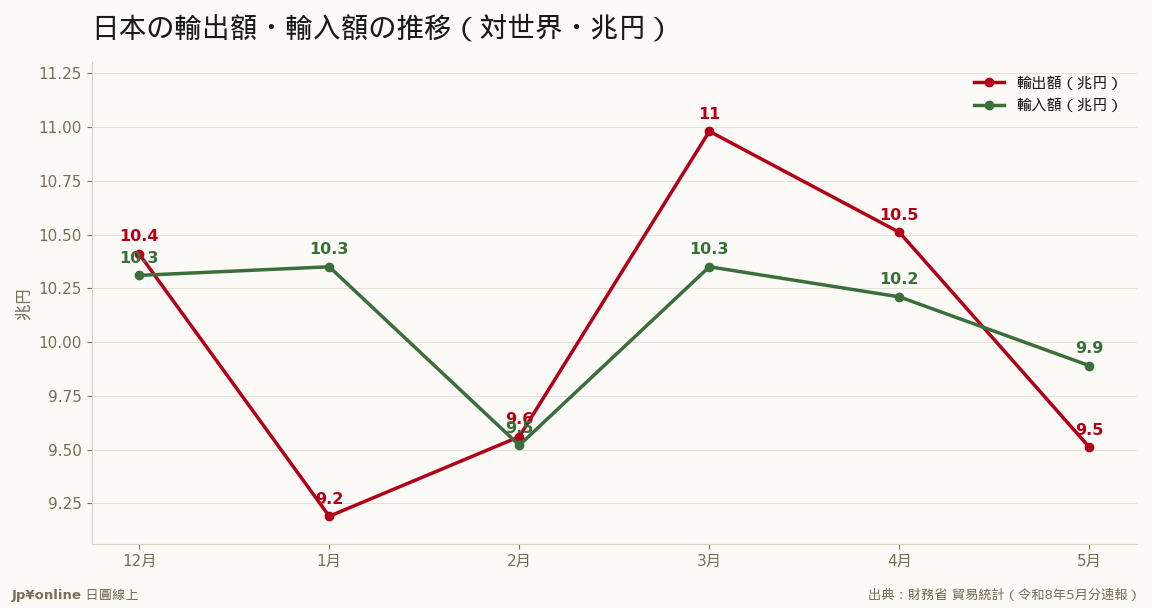
- May 2026 trade: Exports up 9.516 trillion yen (+17.0%), imports up 9.8902 trillion yen (+12.5%); deficit of -378.6 billion yen (first in four months)
- Export value increase masks minimal quantity growth; import quantities fall, values rise due to weaker yen and higher prices
- U.S. trade surplus shrinks 19.9%, 6 consecutive months down with accelerating decline; China deficit persists for 62 months
- Analysis shows export volume stagnation while nominal increases driven by weak yen; U.S. tariff concerns intensify as surpluses narrow
- Export growth of double digits for all major markets, but seasonality may have played a role in May's deficit
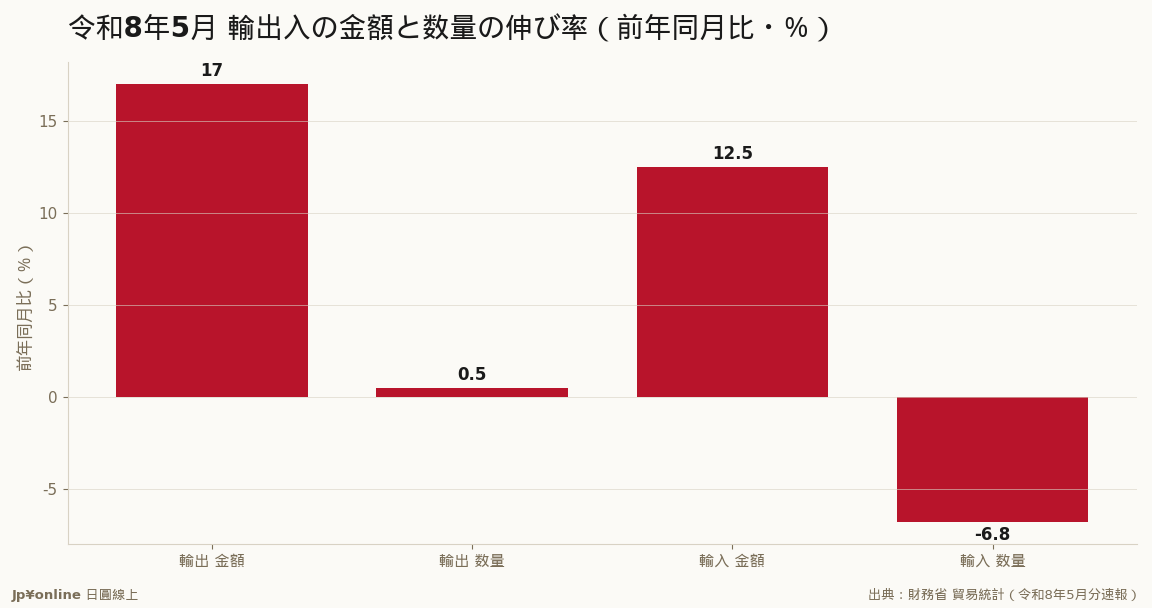
The Ministry of Finance announced the May trade statistics for the fiscal year 2026, showing a 17.0% increase in exports to 9.516 trillion yen over nine consecutive months but a 378.6 billion yen deficit (-3,786 billion yen). The data suggests that while export values increased due to weaker yen effects, the actual volume barely changed (+0.5%). Imports rose significantly as well with a 12.5% increase in value but a 6.8% decrease in quantity, indicating rising import costs and weak yen pressures.
【Conclusion】The May trade statistics from the Ministry of Finance for fiscal year 2026 show that while exports surged by 17.0%, the trade deficit widened to -378.6 billion yen (the first deficit in four months). The key takeaway is that much of the export growth was due to a weaker yen rather than increased volume, suggesting that the economy's real output has stagnated.
【Breaking Down the Numbers】Export values increased by 17.0% but the quantity index only rose by 0.5%, indicating a 16 percentage point difference between price increases and weak yen effects versus actual output growth. Import values also surged, up 12.5%, while import quantities fell by 6.8%. This indicates that while imports of goods declined in volume, their cost increased due to the weaker yen and rising prices.
【Why the Trade Deficit Occurred】Unadjusted for seasonality, exports stood at 9.5148 trillion yen, up from 9.0237 trillion yen the previous month, while imports were higher still at 9.6052 trillion yen. Seasonally adjusted figures showed a deficit of -904 billion yen. The data reveals that trade is driven by increased prices and weaker yen effects rather than actual volume increases.
【Exclusive Methodology: Reading Trade Statistics Beyond Simple Surpluses and Deficits】First, analyzing export value growth versus quantity change shows how much of the increase is due to currency depreciation (17.0% vs 0.5%). Second, examining the trend in U.S. trade balances reveals a decline that may signal the waning of pre-tariff surge effects combined with rising tariffs.
【Opportunities and Risks】For those watching the yen's performance, this data suggests challenges as both nominal exports and imports have risen but actual economic output has not. For Japanese exporters and their supply chains (including Taiwanese companies), weaker yen effects offset lower volumes, creating volatility in reported growth should the yen strengthen.
【Counter Argument】While exports are up for nine consecutive months and all major markets grew double digits, May's deficit may be partly due to seasonality as April was still showing a surplus of 29.93 billion yen. The overall export volume increase is modest at only +0.5%, but remains positive.
【Historical Context】Japan’s trade with China has been in continuous deficit for 62 months, reflecting long-term structural imbalances. With the U.S., trade surpluses are tightening as tariffs continue to impact bilateral commerce.
【Scenario Analysis: What Will Happen When the Weak Yen Tides Fade?】If the yen remains weak, nominal export values will rise but real economic contributions may be limited if actual volumes do not keep up. A stronger yen could reverse this trend, affecting Japanese exporters and their supply chains negatively. The weakening of U.S. trade surpluses may shift focus to Europe and Asia.
【Taiwanese Insights】Monitor the quantity index and seasonally adjusted surpluses for clearer economic signals rather than just overall numbers. Watch semiconductor parts closely as they are a key indicator.