Analysis: Japan's Exports to Taiwan Up 15.1%, Surplus Near 3 Trillion Yen – A Major Buyer in Asia, China StagnatesA · FULL TRANSLATION
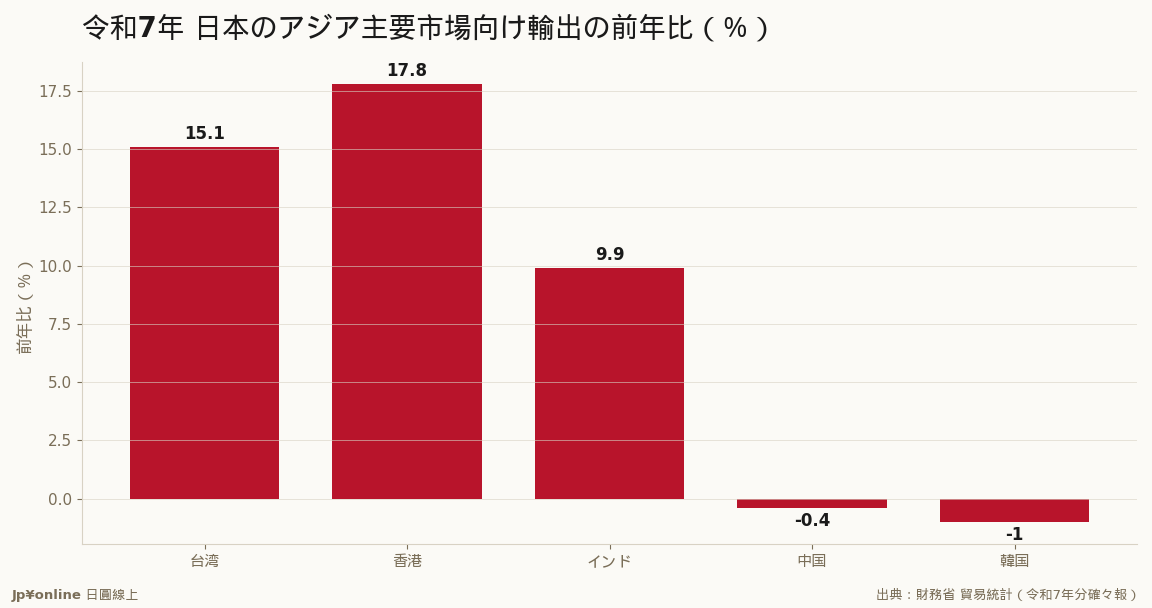
- Fiscal Year 2025 (Reiwa 7): Japanese exports to Taiwan reached ¥7.907 trillion, a 15.1% increase (one of the highest in Asia), with a trade surplus of ¥2.9053 trillion; over the same period exports to Hong Kong rose 17.8%, to India 9.9%, while exports to China fell 0.4% and to South Korea fell 1%
- Comparison: China's imports from Japan fell by 0.4%, nearly stagnant, while South Korea declined by 1%; across all of Asia, Japanese exports were ¥59.9 trillion, up 5.3%, with a surplus of ¥4.146 trillion = Japan's most important export destination
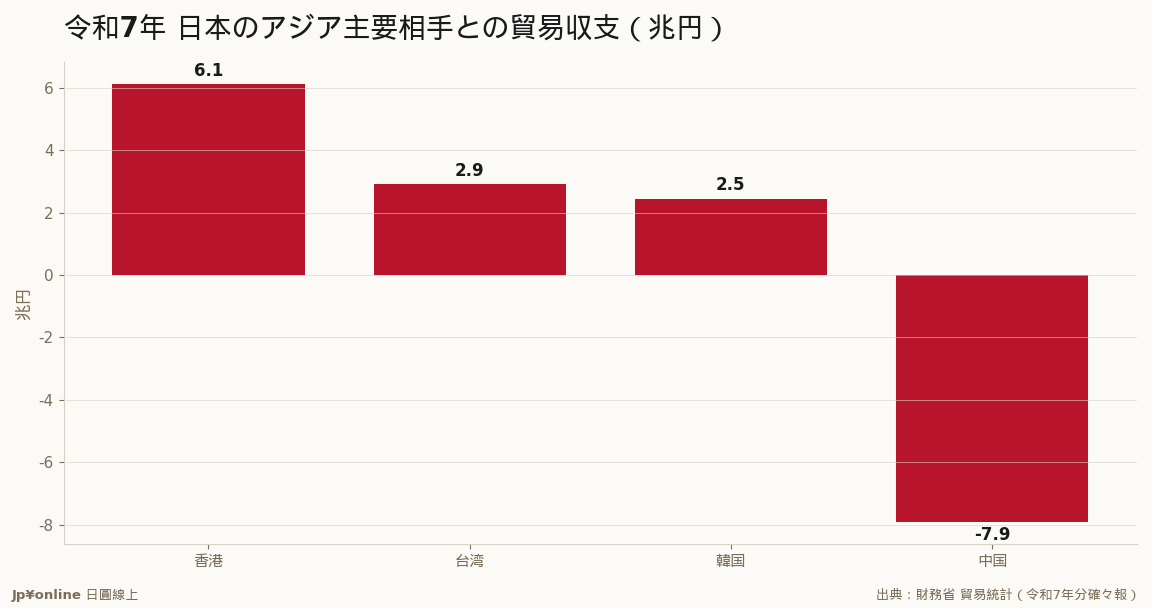
- Trade structure: Surpluses with Hong Kong at ¥6.1349 trillion and Taiwan at ¥2.9053 trillion, Korea at ¥2.4528 billion; China's deficit of ¥7.9218 trillion (long-term trade deficit)
- Exclusive Approach: Read Taiwan-Japan dynamics in two layers – growth rate (reflects strong demand for electronics/machinery) and trade surplus structure (Taiwan is a net buyer, upstream supplier for Japan’s electronics industry); use year-on-year increase in Japanese exports to Taiwan as an indicator of the health of the Taiwan-Japan semiconductor supply chain
- Practical Application: Use 'year-on-year increase in Japanese exports to Taiwan' as an indicator of the health of the Taiwan-Japan semiconductor supply chain (acceleration usually corresponds to expansion of Taiwanese electronics industry); Taiwan-Japan cooperation mainly on semiconductors and electronics, China’s stagnant imports highlight shifts in Japan’s Asian export landscape
In the fiscal year 2025 (Reiwa 7), Japanese exports to Taiwan reached ¥7.907 trillion, a 15.1% increase from the previous year—among the highest growth rates in Japan's major markets in Asia. The trade surplus with Taiwan was ¥2.9053 trillion. Over the same period, exports to Hong Kong rose 17.8% and to India 9.9%, while exports to China fell 0.4% and to South Korea fell 1%. On the trade-balance side, Japan ran surpluses with Hong Kong of ¥6.1349 trillion, with Taiwan of ¥2.9053 trillion, and with South Korea of ¥2.4528 trillion—all in the black; but it ran a huge deficit of ¥7.9218 trillion with China, the result of Japan's long-standing structural trade deficit with China. Across all of Asia, Japanese exports grew 5.3% to a total of ¥59.9 trillion.
Why Should Taiwanese Readers Care: This analysis focuses directly on the dynamics between Japan and Taiwan. In fiscal year 2025, Japanese exports to Taiwan reached ¥7.907 trillion, growing by 15.1%, one of the highest growth rates among Japan's major markets in Asia; with a trade surplus of ¥2.9053 trillion (Japan selling much more to Taiwan than it buys from there). Over the same period, exports to Hong Kong rose 17.8% and to India 9.9%, while exports to China fell 0.4% and to South Korea fell 1%. Within Japan's map of Asian markets, Taiwan and Hong Kong are among the few buyers still accelerating their purchases, while the largest market, China, has stalled.
Breaking Down the Numbers: Who is buying from Japan? Taiwan's imports from Japan increased by 15.1% (approaching ¥8 trillion) and Hong Kong saw a 17.8% increase, representing double-digit growth in Asian markets; India added another 9.9%. By comparison, China's imports from Japan fell by 0.4%, nearly stagnant, while South Korea declined by 1%. In terms of trade balance (who is making money), Japan had surpluses with Hong Kong at ¥6.1349 trillion, Taiwan at ¥2.9053 trillion, and South Korea at ¥2.4528 trillion—all profitable; but a huge deficit of ¥7.9218 trillion against China—Japan buys much more from China (computers, communications equipment, various products) than it sells to them, reflecting Japan's long-term trade deficit with China. The combined Asian total saw Japanese exports grow 5.3% to ¥59.9 trillion and a surplus of ¥4.146 trillion, making Asia the most important export destination for Japan.
An Exclusive Methodological Approach: Reading Taiwan-Japan Dynamics – Growth Rate vs. Trade Surplus Structure. First, looking at growth rates: the 15.1% increase to Taiwan and 17.8% to Hong Kong reflects strong demand in these markets (including through Hong Kong's re-exports and semiconductor-related needs) for Japanese electronics and machinery; secondly, the trade surplus structure indicates that Japan is a net buyer from Taiwan—Taiwan receiving semiconductors, electronic components, materials, are upstream suppliers in Japan’s electronics industry. This relationship means that when Japan exports to Taiwan increase, it often signals expansion of the Taiwanese electronics/silicon supply chain. Conversely, if Taiwan's economy cools down, this double-digit growth line with Japan will be among the first to wane. Using the year-on-year increase in Japanese exports to Taiwan as a gauge for the health of the Taiwan-Japan semiconductor supply chain is particularly useful for Taiwanese readers.
Opportunities and Risks: For Taiwan's electronics/silicon-related industries, double-digit growth in Japan’s exports to Taiwan reflects robust demand for upstream equipment and materials; for those doing business with Japanese goods in Taiwan, a solid trade surplus structure means that the basic demand for Japanese goods in the Taiwanese market is strong. For those watching China’s market, stagnant imports from China (down 0.4%) plus a large deficit of ¥7.9218 trillion, indicate long-term trading temperature.
Taiwanese Reader's Practical Application: First, use the year-on-year increase in Japanese exports to Taiwan as an indicator for the health of the Taiwan-Japan semiconductor supply chain; second, the strong trade surplus with Hong Kong and Taiwan indicates that Taiwan is a net buyer from Japan, with Taiwan-Japan cooperation mainly focused on semiconductors and electronics. Third, China's stagnation in imports from Japan contrasts sharply with double-digit growth in Taiwan and Hong Kong, highlighting shifts in Japan’s Asian export landscape.
What to Watch Next: First, whether the double-digit growth in exports to Taiwan can continue as Taiwan's electronics cycle cools down; second, if China's stagnant imports turn into a recession or if the trade deficit widens further; third, whether Hong Kong’s role and high growth of exports to Hong Kong will be sustained.