Japanese Apartment Price Index Hits Twice the Level of 2010 – Resale Land Down 3% in a MonthA · FULL TRANSLATION
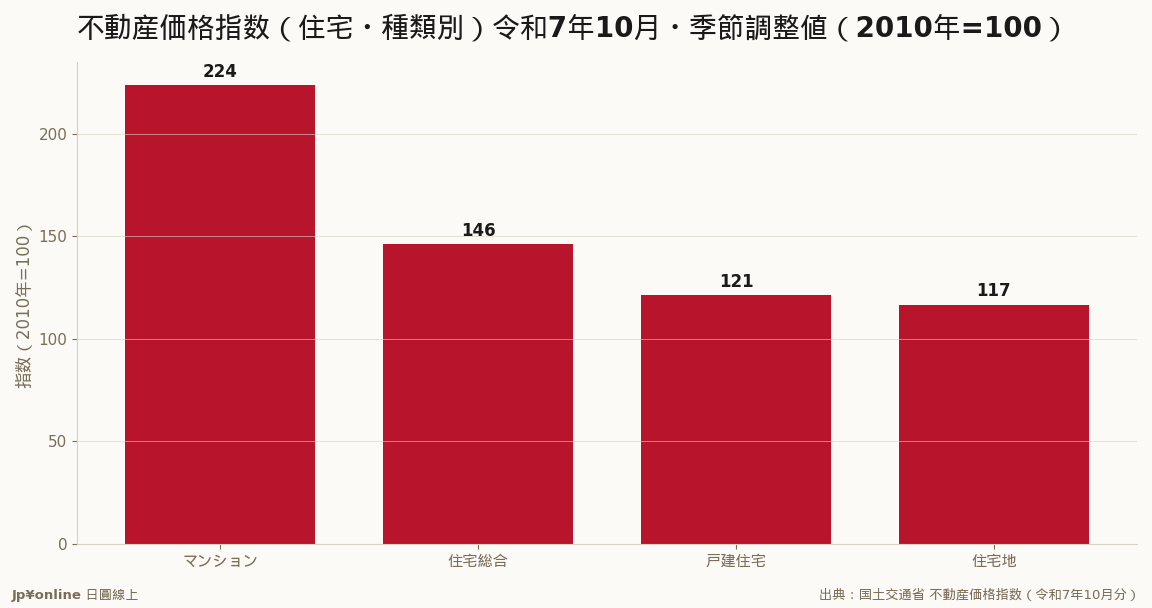
- MLIT Residential Property Price Index for October 2022 (seasonally adjusted with base year as 2010 = 100): Apartment at 223.7 (twice 2010)
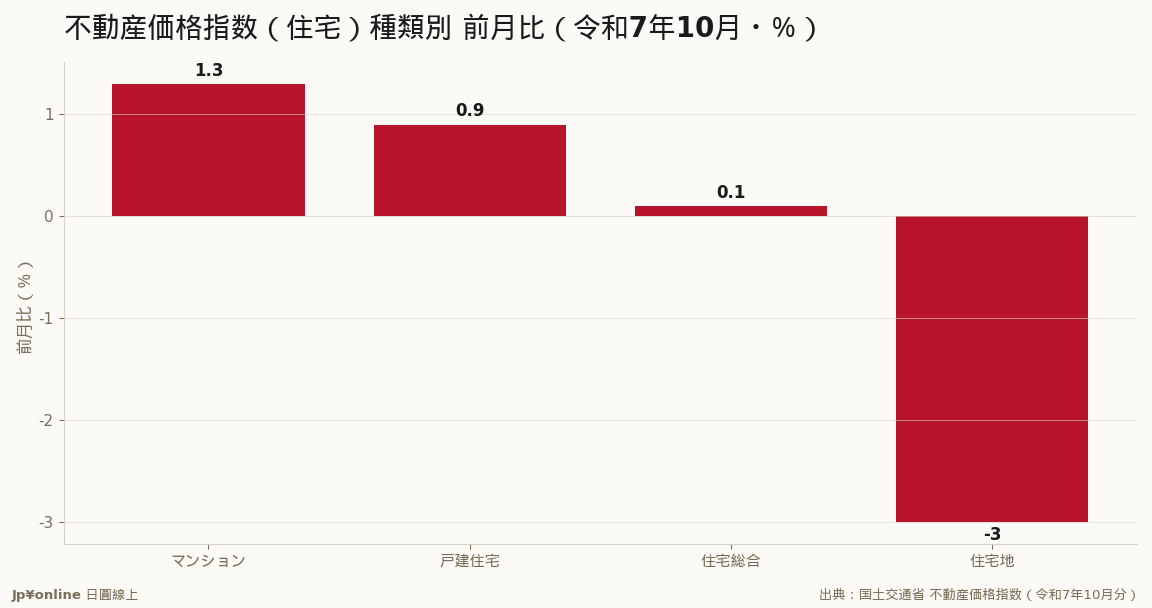
- Monthly comparison: Apartments +1.3%, Detached Houses +0.9%, Total Residential +0.1%, but Land -3.0%
- Cross-referencing official index as a 'long lens' with REINS monthly reports' 'short lens' — REINS resale square meters have increased for 72 consecutive months, aligning with the long-term result from this index
- Conclusion reliability: When both the long-term (MLIT) and short-term (REINS) perspectives point to apartment dominance, land, and office underperformance, the conclusion is more credible than relying on a single report
- Taiwanese practice: Use MLIT's index for long-term levels (apartments at 223.7 = double 2010), REINS/REI reports for recent trends; recognize that apartment gains are concentrated rather than across the board
The Ministry of Land, Infrastructure, Transport and Tourism (MlIT) Residential Property Price Index for October 2022 (seasonally adjusted with base year as 2010 = 100, announced on January 30, 2023): Apartment (split ownership) at 223.7 (twice 2010), Total Residential at 146.0, Detached House at 121.2, and Land at 116.7. The increase is almost entirely driven by apartments. Monthly comparison: Apartments +1.3%, Detached Houses +0.9%, Total Residential +0.1%, but land -3.0% = apartment prices up, land down in the same month. Commercial properties (third quarter over previous year): Total at 147.9 (+1.4%), Shops +4.4%, Single Building +1.0%, Offices -5.3%. Retail is recovering while office space remains weak.
【Why Taiwanese Readers Should Care】The Ministry of Land, Infrastructure, Transport and Tourism’s (MLIT) Residential Property Price Index for October 2022 (seasonally adjusted with base year as 2010 = 100), encapsulates the long-term gains in Japan's residential market: Apartment (split ownership) index at 223.7, which is more than double 2010; over the same period, detached houses stand at only 121.2, land at 116.7, and total residential at 146.0. This table quantifies the common refrain that 'apartments in Japan (especially Tokyo) are expensive' with a long-term official index. For those considering property investment or understanding the Japanese housing market, this index serves as a 'long lens' when cross-referenced with REINS and Real Estate Economic Institute (REI) monthly reports.
【Explanation of Key Indicators】The Residential Property Price Index is compiled by MLIT based on approximately 300,000 actual transaction prices annually. Its value lies in its long-term perspective, comparability across categories: Measuring apartments, detached houses, and land under the same yardstick shows the disparities in price growth. A 223.7 index means that apartment transactions have risen to over twice their 2010 levels; a composite total of 146.0 reflects the weighted average; 116.7 for land and 121.2 for detached houses indicate that this decade's growth in residential properties was largely driven by apartments, with modest gains elsewhere.
【Decoding the Numbers: Apartments are Rising, Diversification Continues】Firstly, looking at levels (long-term): Apartment index at 223.7, total residential at 146.0, detached houses at 121.2, and land at 116.7 – apartments lead significantly, which is the cumulative result over the past decade or so. Secondly, looking at momentum (month-over-month): Apartments +1.3%, Detached Houses +0.9%, Total Residential +0.1%, but Land -3.0% — in the same month, while apartment and detached houses are increasing, land prices are decreasing; diversification is not converging. In the commercial property segment (Q3 of 2022 compared to Q4 of 2021): Total commercial at 147.9 (+1.4%), with Shops +4.4%, Single Building Apartments +1.0%, but Offices -5.3% — retail is recovering, while offices remain weak.
【A Unique Methodology Perspective: Using the Official Index as a 'Long Lens', Cross-referenced with REINS Monthly Reports' 'Short Lens'] Judging the Japanese real estate market requires both short-term and long-term perspectives. Monthly reports like those from East Japan REINS on resale square meters and new building average prices provide immediate insights into recent transactions, while MLIT’s index serves as a longer-term reference point, showing cumulative levels across categories. Cross-referencing is key: REINS’ resale apartment square meter price has risen for 72 consecutive months, surpassing the peak of the bubble period, aligning with this long-term result from the official index — two independent sources confirm the same trend, indicating that the rise in apartments is real and sustained. The -3.0% decline in land and -5.3% drop in offices highlight that price increases are concentrated in apartments, not a broad market rally.
【Opportunities and Risks for Investors】For those considering purchasing Japanese apartments as an investment or residence, the long-term level at 223.7 suggests that this is already a highly appreciated asset class with ongoing gains, requiring long-term investment readiness; for those targeting detached houses or land, the modest increase of 121.2 and 116.7 indicates less extreme price premiums, with varying growth rhythms within the market; for commercial property investors, the -5.3% drop in office indices relative to a +4.4% gain in shops is an indicator of internal real estate dynamics.
【For Taiwanese Readers】Firstly, use MLIT’s index (apartments at 223.7 = 2010's double) to assess long-term levels and REINS/REI monthly reports for recent trends; cross-referencing is most reliable. Secondly, recognize that growth is highly concentrated in apartments with modest increases elsewhere, avoid assuming broad market appreciation. Finally, this seasonally adjusted preliminary value may be revised within three months after initial release – always cite the latest revision.