Tokyo Pre-Owned Terrace Homes See Volume Up, Prices Up in May: REINS ReportA · FULL TRANSLATION
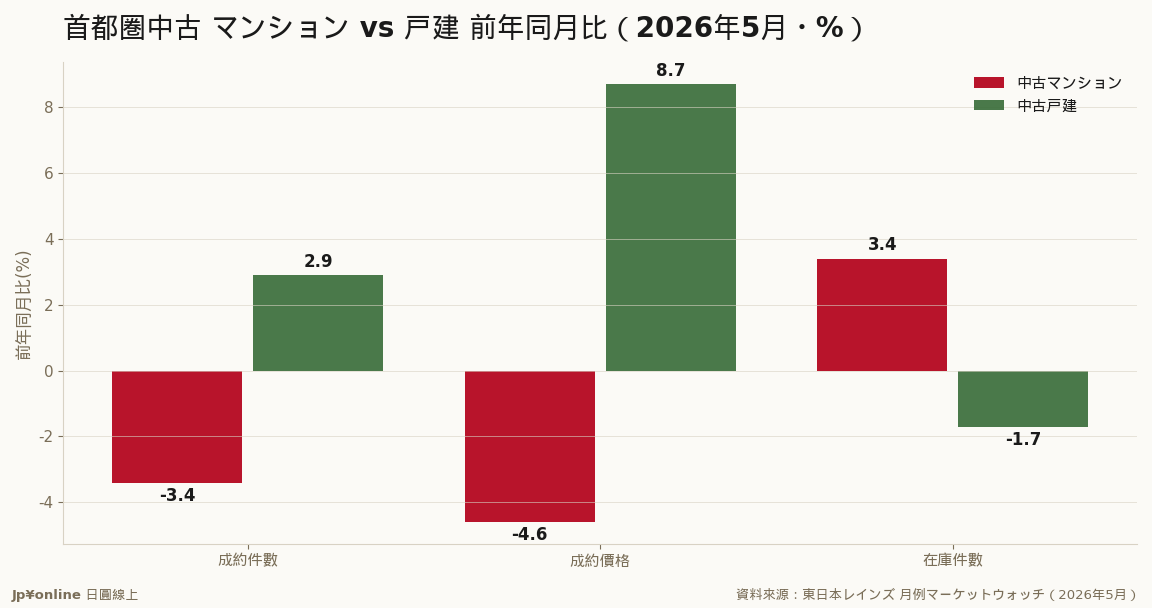
- May 2026 pre-owned terraced houses saw transactions of 1,835 units (up 2.9% year-on-year for two consecutive months); average transaction price was 42.15 million yen (up 8.7% year-on-year for five consecutive months and a 0.9% month-over-month increase)
- Inventory decreased by 1.7% to 23,087 units (a fourth consecutive monthly decrease) while new listings dropped by 0.9% to 6,367 units (a fourth consecutive monthly decline)—fewer sellers, more buyers driving up prices
- Contrary movements: Apartments saw volume contraction and price depreciation alongside increased inventory, while terraced houses experienced an increase in both transactions and prices with a reduction in available inventory
- Reasons: Central apartment prices pushing buyer budgets to extremes + interest rate hikes; self-residential demand shifting towards pre-owned terrace homes that are more cost-controlled and offer land
- Practical advice for Taiwanese buyers: Use terraced houses as an indicator of genuine demand, be aware of reduced negotiation space with less supply, and consider the higher liquidity costs when investing
In the same REINS May report, pre-owned detached homes and apartments have diverged paths. In the Greater Tokyo Area, pre-owned terraced houses saw transactions of 1,835 units (up 2.9% year-on-year for two consecutive months); the average transaction price was 42.15 million yen (up 8.7% year-on-year for five consecutive months, with a month-over-month increase of 0.9%). Meanwhile, inventory decreased by 1.7% to 23,087 units (a fourth consecutive monthly decrease), while new listings dropped by 0.9% to 6,367 units (a fourth consecutive monthly decline). Apartments saw volume contraction and price depreciation alongside increased inventory, while terraced houses experienced an increase in both transactions and prices with a reduction in available inventory.
Conclusion: The May report from the East Japan Real Estate Exchange Association shows pre-owned detached homes and apartments moving in opposite directions. In the Greater Tokyo Area, pre-owned terrace houses saw 1,835 transactions (up 2.9% year-on-year for two consecutive months); the average transaction price was 42.15 million yen (up 8.7% year-on-year for five consecutive months and a 0.9% month-over-month increase). Meanwhile, inventory decreased by 1.7% to 23,087 units (a fourth consecutive monthly decrease), while new listings dropped by 0.9% to 6,367 units (a fourth consecutive monthly decline).
Key indicators: 'transaction count' refers to actual transactions in the current month; 'inventory' indicates the number of properties available for sale on the market; and 'new registrations' are newly listed properties in the current month. The decrease in inventory for terrace houses for four consecutive months, coupled with a fourth consecutive decline in new listings, suggests that fewer sellers are willing to sell, reducing the number of goods available in the market. However, increased buyer demand over two consecutive months means a shortage of properties, pushing prices up. New listing prices were 47.32 million yen (up 9.3% year-on-year for ten consecutive months) and inventory prices at 46.10 million yen (up 4.9% year-on-year for fifteen consecutive months). The opening and closing prices moved in the same direction this time, unlike apartment listings which have a gap between their asking and selling prices.
Reasons: With higher prices for centrally located apartments pushing buyers' budgets to extremes and interest rates on the rise, some self-residential demand has shifted towards pre-owned terraced houses with more affordable total costs and land. Pre-owned terrace homes are particularly sensitive to interest rates (most are self-residential with high loan-to-value ratios), showing an increase in listings and price support first, indicating that rates remain within acceptable levels and real needs persist. When viewed together with the apartment market's structural downward correction, it highlights a shift towards total cost control and secondary locations for buyer demand.
Practical advice for Taiwanese readers: First, use pre-owned terrace houses as an indicator of self-residential real demand—increased transactions and prices suggest healthy genuine demand; separate analysis from apartments' structural downturn. Second, buyers should be aware that the supply has shrunk over four consecutive months with sellers holding firm on pricing, so don't delay when finding a suitable property. Third, for rental or investment purposes, pre-owned terrace houses have tight inventory and stable prices but higher liquidity costs and management expenses compared to apartments; factor in the difficulty of exiting. Next, monitor whether the decrease in terrace house inventory will stabilize, if the consecutive price increases can be sustained, and how interest rate hikes might affect this interest-sensitive buyer segment.