Tokyo Central Office Rental Rates Rebound to 22,000 Yen per Shachihko for First Time in 64 MonthsA · FULL TRANSLATION
- March 2026 average vacancy rate in central Tokyo is 2.22%, rising 0.02 percentage points from February, two consecutive months of slight increases
- Average rental rates hit 22,302 yen per shachihko, up about 8.05% year-over-year for the 26th consecutive month and returned to the 22,000 yen per shachihko range since November 2020
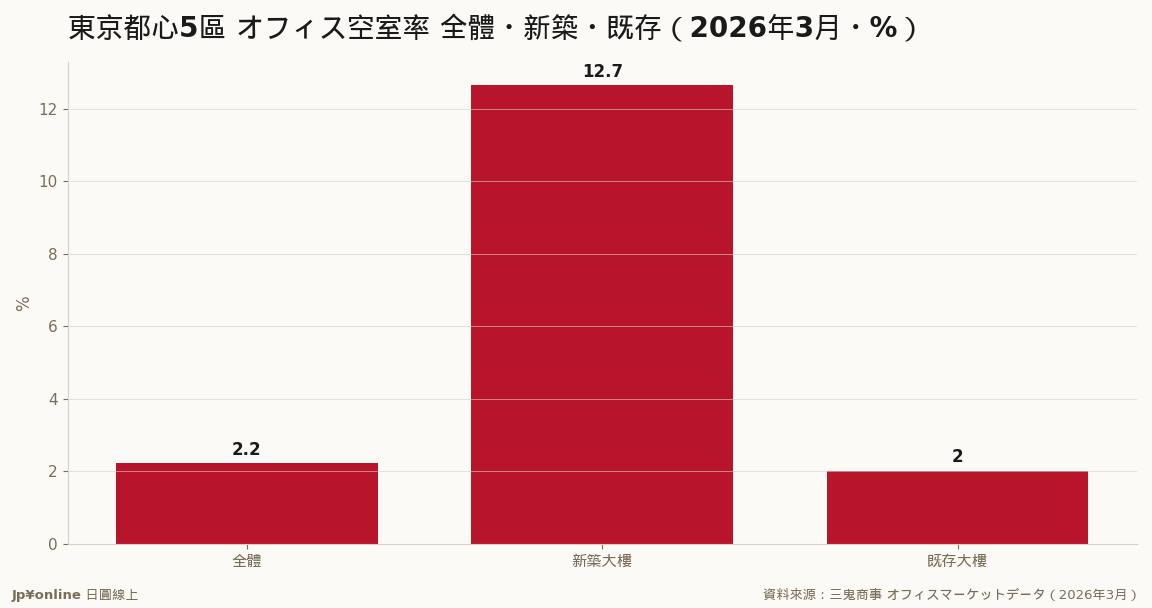
- Splitting new vs existing buildings: New buildings have a 12.65% vacancy rate (up 3.08 percentage points), while existing buildings have only a 2.02% vacancy rate, close to full occupancy—vacancy rates increase due to new supply
- March saw an overall increase of approximately 2,600 shachihko in vacancies mainly due to one large building completing construction with vacant space and expansion-type lease cancellations
- Advice for Taiwan: Break down central Tokyo office market into 'new' and 'existing', limited negotiation room for rent as existing buildings near full occupancy—act early; watch future new supply peaks
In the central Tokyo office market managed by Sankei Shoji’s five areas (Chiyoda, Chuo, Kanto, Shinjuku, Shibuya), March 2026 shows an average vacancy rate of 2.22%, a rise of 0.02 percentage points from February, marking the second consecutive month of slight increases; however, the average rental rates reached 22,302 yen per shachihko, increasing by about 8.05% year-over-year for the 26th consecutive month and returning to the 22,000 yen per shachihko range not seen since November 2020. Despite the rise in vacancy rates, rental prices continue to climb due to new large buildings entering the market with vacancies.
Concluding Analysis: In March 2026, Sankei Shoji’s central Tokyo office market saw an average vacancy rate of 2.22%, a rise of 0.02 percentage points from February and marking two consecutive months of slight increases; however, the average rental rates reached 22,302 yen per shachihko, increasing by about 8.05% year-over-year for the 26th consecutive month and returning to the 22,000 yen per shachihko range not seen since November 2020. The apparent contradiction of vacancy rates rising while rental prices continue to increase can be explained when breaking down new versus existing buildings.
Key Points: 'Vacancy rate' is the ratio of unoccupied space to available rentable space, with a 5% level considered equilibrium in the industry. Central Tokyo’s March 2026 vacancy rate was significantly below this at 2.22%, indicating an extremely low level. However, when splitting the buildings into new and existing: New buildings had a vacancy rate of 12.65%, increasing by 3.08 percentage points from February; whereas existing (pre-owned) buildings had only a 2.02% vacancy rate, decreasing by 0.02 percentage points in March. In other words, the slight increase in the vacancy rate is almost entirely due to new large buildings entering the market with vacancies. The current stock market is close to full occupancy. The overall vacancy area increased by approximately 2,600 shachihko in March, mainly due to one large new building completing construction with vacant space and expansion-type lease cancellations.
Reasons: Large new projects have been concentrated on completion in central Tokyo over recent years, requiring time for them to be absorbed. This has increased the vacancy rate on paper; however, existing buildings are nearly fully occupied, and companies continue moving or expanding their needs. Owners can thus afford to adjust rents upwards. Thus, we see a 'dual track' situation where new projects are being absorbed while existing spaces remain full, with rental prices continuing to rise.
Practical Advice for Taiwanese: First, when looking at central Tokyo office space, don’t just look at the overall vacancy rate; separate it into 'new construction' and 'existing' lines. The former measures new supply absorption, while the latter gauges actual existing demand temperature. Second, with rental rates rising for 26 consecutive months and existing buildings nearly fully occupied, negotiation room for rent is limited in central Tokyo – act early to secure your position. Third, for those investing or managing office space, the near full occupancy of existing properties provides a stable base for rent collection, but watch future large-scale new supply peaks that could temporarily push up overall vacancy rates and compress rental negotiations.