Foreigners Swing From ¥1.2tn Net Sell to ¥366.6bn Net Buy of Japanese Stocks in a WeekA · FULL TRANSLATION
- Foreigners net bought ¥366.6bn of TSE Prime this week vs ~¥1.21tn net sell the prior week
- Domestic individuals net sold ¥637.5bn, extending profit-taking
- Investment trusts +¥64.6bn, business corps +¥100.3bn slightly net buyers; financials -¥48.4bn
- Foreigners' one-week directional swing ~¥1.58tn
- Data is brokerage (client) orders, reflecting real institutional and retail direction
JPX's latest weekly investor-type data (July week 1, 6/29–7/3) shows foreign investors reversing sharply: from a ~¥1.21tn net sell of TSE Prime the prior week to a ¥366.6bn net buy. Foreigners drive Japanese equity swings, and such fast flips usually reflect short-term repricing of currency and offshore risk. Domestic individuals net sold ¥637.5bn, extending profit-taking, so part of the foreign buying was supplied by local retail. It is a weekly tide, not a trend — watch whether foreign buying continues.
[Conclusion] The most direct read on who is moving Japanese stocks short-term is JPX's weekly investor-type data. The July week-1 headline: foreigners changed their minds, from a ~¥1.21tn net sell of TSE Prime the prior week to a ¥366.6bn net buy.
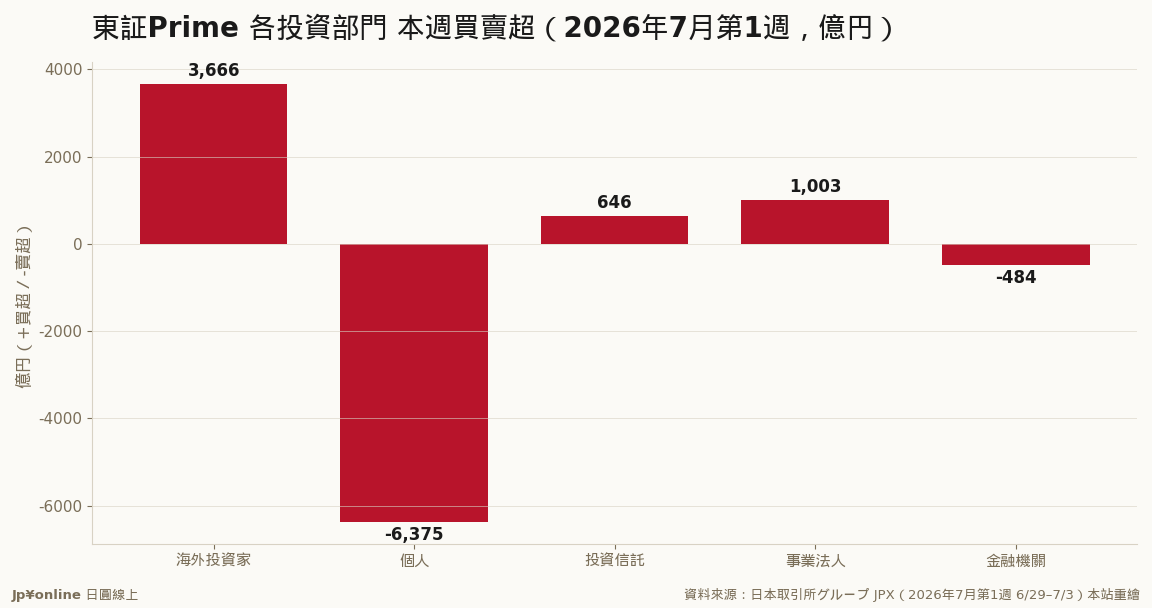
The table splits brokerage (client) orders by investor type. Foreigners are over 60% of Prime turnover — the marginal force the index tends to follow.
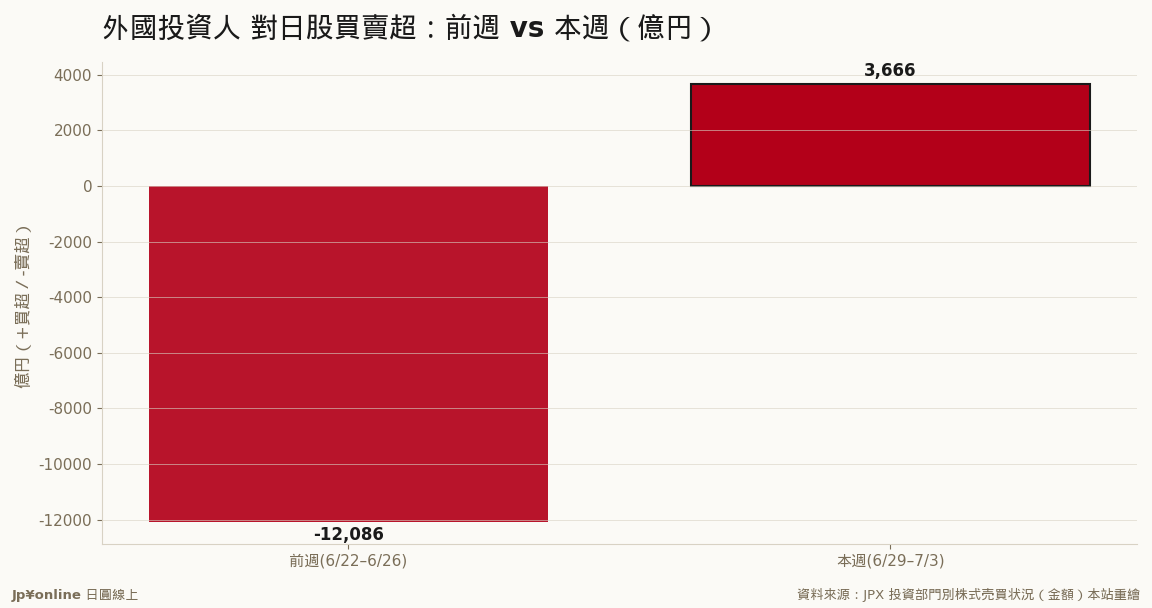
Adding the prior week's -¥1.21tn to this week's +¥0.37tn, the swing is ~¥1.58tn in seven days — less a fundamental shift than a repricing of yen and offshore risk. Domestic individuals net sold ¥637.5bn, the classic 'foreigners buy, retail sells' counterparty structure. One week is a tide, not a trend: continuation over the next two to three weeks is what would signal a genuine flow turn.