Japan Lodging, April 2026: Foreign Stays Down 14.6% in the Big Three Metro Areas, Down Just 2.3% in the RegionsA · FULL TRANSLATION
- Foreign guest-nights totalled 15,362,170 in April 2026, down 10.8% year on year. The three major metropolitan areas fell 14.6% while regional Japan fell just 2.3%.
- By volume, the metro areas accounted for 10,173,040 guest-nights, or 66.2%, and regional Japan for 5,189,130, or 33.8%.
- The steepest declines were in the inbound core: Tokyo 4,829,040 (-13.9%), Osaka 2,092,880 (-16.4%), Kyoto 1,686,170 (-18.8%), Aichi 344,770 (-30.4%) and Hokkaido 527,530 (-18.6%).
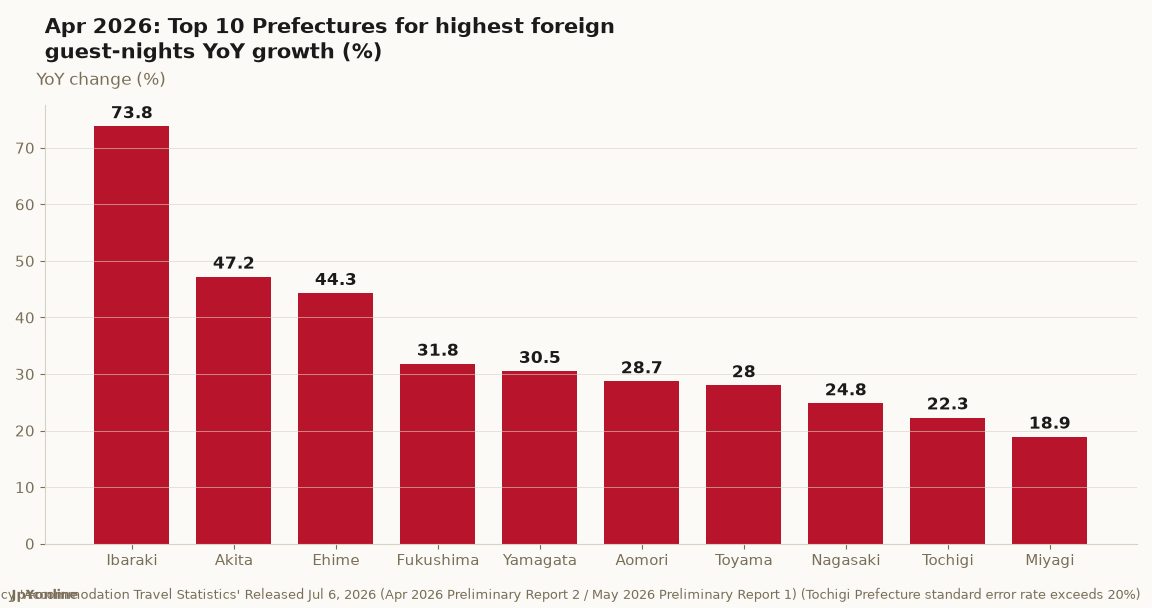
- The largest gains were regional: Ibaraki +73.8%, Akita +47.2%, Ehime +44.3%, Fukushima +31.8%, Yamagata +30.5%, Aomori +28.7%, Toyama +28.0% and Nagasaki +24.8%. Tochigi (+22.3%) carries a standard error above 20% per the agency's own note.
- Prefecture-level data stops at April 2026; the May release is first preliminary and covers national and property-type totals only. Note: from the January 2026 survey the stratification variable changed from number of employees to number of guest rooms (properties with 20+ rooms are now surveyed in full), so year-on-year comparisons spanning 2025/2026 include the effect of this change.
Foreign guest-nights fell 10.8% nationally in April 2026, but the split tells a different story: down 14.6% across the three major metropolitan areas and down only 2.3% across the rest of the country. The decline is concentrated on the Tokyo-Osaka-Kyoto axis.
Volume still sits with the metro areas, at 10.17 million guest-nights, or 66.2% of the national total, against 5.19 million, or 33.8%, for regional Japan. Tokyo alone recorded 4.83 million. But direction has shifted: Tokyo -13.9%, Osaka -16.4%, Kyoto -18.8% and Aichi -30.4%, while Ibaraki gained 73.8%, Akita 47.2%, Ehime 44.3% and Toyama 28.0%.
Base effects deserve caution. Ibaraki recorded only 44,310 foreign guest-nights in April and Akita 21,990, so a single charter or group tour can produce a 70% gain. The more durable signals combine scale with growth: Nagasaki at 99,130 guest-nights (+24.8%), Ehime at 90,000 (+44.3%), Toyama at 80,070 (+28.0%) and Miyagi at 121,600 (+18.9%).
On the other side, several high-volume regional markets are falling: Hokkaido -18.6%, Shizuoka -20.4%, Yamanashi -17.1% and Kumamoto -13.3%, all with concentrated source-market exposure to the 55% drop in Chinese guest-nights.
For site selection, screen on absolute guest-nights first, then on growth.
The Japan Tourism Agency released Accommodation Survey prefecture data on 6 July 2026, covering April 2026 (second preliminary).
Foreign guest-nights. The national total was 15,362,170, down 10.8% year on year. Comparing the three major metropolitan areas with regional Japan, the metro areas fell 14.6% and the regions fell 2.3%. The three major metropolitan areas are defined as Saitama, Chiba, Tokyo, Kanagawa, Aichi, Kyoto, Osaka and Hyogo; regional Japan covers all other prefectures.
Leading prefectures by foreign guest-nights: Tokyo 4,829,040 (-13.9%), Osaka 2,092,880 (-16.4%), Kyoto 1,686,170 (-18.8%), Okinawa 781,100 (+0.1%), Fukuoka 729,550 (-3.2%), Kanagawa 541,930 (+2.7%), Hokkaido 527,530 (-18.6%), Chiba 441,190 (-7.5%), Aichi 344,770 (-30.4%), Hiroshima 277,240 (-3.9%), Ishikawa 270,770 (+3.6%), Yamanashi 260,970 (-17.1%), Gifu 212,410 (-2.6%), Nagano 209,040 (+7.1%), Hyogo 204,760 (+8.2%) and Shizuoka 196,230 (-20.4%).
Largest year-on-year increases: Ibaraki 44,310 (+73.8%), Akita 21,990 (+47.2%), Ehime 90,000 (+44.3%), Fukushima 46,040 (+31.8%), Yamagata 22,230 (+30.5%), Aomori 72,260 (+28.7%), Toyama 80,070 (+28.0%), Nagasaki 99,130 (+24.8%) and Tochigi 62,670 (+22.3%). The agency notes that Tochigi's standard error rate exceeds 20% and should be treated with caution.
Total guest-nights by prefecture. The national total was 49,105,170, down 7.2%. Tokyo recorded 7,900,810 (-14.8%), Osaka 4,157,150 (-17.5%), Kyoto 2,687,110 (-14.4%), Okinawa 2,492,690 (-5.9%), Hokkaido 2,403,260 (-7.8%), Chiba 2,242,420 (-2.5%), Kanagawa 2,070,500 (-13.8%) and Fukuoka 1,809,180 (-13.9%). Notable gains included Ibaraki +29.9%, Toyama +29.0%, Ehime +27.2%, Akita +26.8%, Tottori +24.0% and Yamaguchi +19.7%.
Notes. Year-on-year comparisons are made against final figures. The May 2026 release is a first preliminary estimate covering national and property-type totals only, without prefecture detail. The stratification variable changed from number of employees to number of guest rooms from the January 2026 survey.