Japan Occupancy, May 2026: 60.6% Nationwide as Ryokan Gain 3.2 Points and City Hotels Lose 2.4A · FULL TRANSLATION
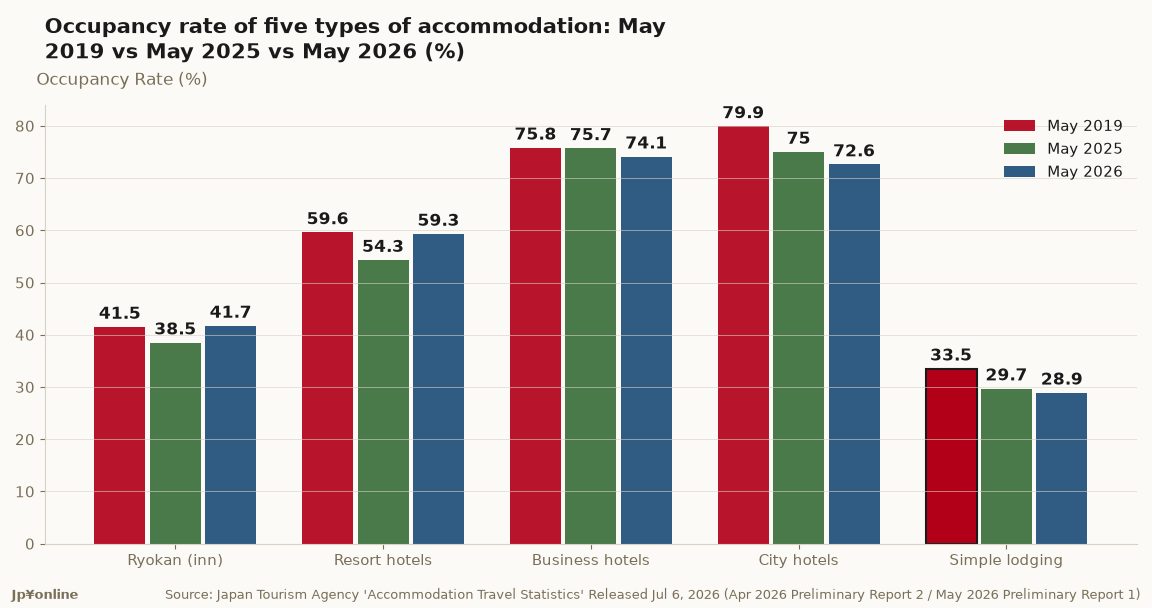
- Nationwide room occupancy was 60.6% in May 2026, down 1.1 points year on year. Ryokan rose to 41.7% (+3.2 points) and resort hotels to 59.3% (+5.0), while business hotels fell to 74.1% (-1.6), city hotels to 72.6% (-2.4) and simple lodgings to 28.9% (-0.8).
- Business hotels remain the largest segment by volume: 23.20 million guest-nights and 17.05 million occupied rooms in May, with the highest occupancy of the five types.
- Against May 2019, city hotels show the widest gap, falling from 79.9% to 72.6%, a loss of 7.3 points. Ryokan are flat at 41.7% versus 41.5%.
- In April, six prefectures exceeded 80% occupancy for business hotels (eight a year earlier) and two for city hotels (seven a year earlier). Tokyo led all prefectures at 78.7% overall.
- May figures are first preliminary estimates; second preliminary figures are due 31 July 2026. Note: from the January 2026 survey the stratification variable changed from number of employees to number of guest rooms (properties with 20+ rooms are now surveyed in full), so year-on-year comparisons spanning 2025/2026 include the effect of this change.
National occupancy came in at 60.6% for May 2026, 1.1 points below a year earlier. The aggregate barely moved, but the five property types moved in opposite directions.
Ryokan rose to 41.7%, up 3.2 points, and resort hotels to 59.3%, up 5.0. Business hotels slipped to 74.1%, city hotels to 72.6% and simple lodgings to 28.9%. That lines up with the demand split: foreign guest-nights fell 13.4% in May while Japanese guest-nights fell only 1.4%. City hotels and simple lodgings carry the highest inbound concentration; ryokan and resort hotels lean on domestic demand.
Measured against May 2019, city hotels sit 7.3 points lower, from 79.9% to 72.6%, the largest gap among the five types. Simple lodgings are 4.6 points lower. Ryokan are effectively unchanged at 41.7% versus 41.5%, and business hotels are 1.7 points below. Heavy room supply added to city-hotel inventory since 2019 has enlarged the denominator, which is why revenue per available room, rather than occupancy alone, is the number to watch for that segment.
The April prefecture data adds a warning. Prefectures clearing 80% occupancy fell from eight to six for business hotels and from seven to two for city hotels. The set of markets that can hold both rate and occupancy is narrowing.
The Japan Tourism Agency released Accommodation Survey occupancy data on 6 July 2026.
National occupancy. April 2026 stood at 59.1%, down 2.3 points year on year. May 2026 stood at 60.6%, down 1.1 points.
By property type, May 2026 (first preliminary): ryokan 41.7% (+3.2 points year on year), resort hotels 59.3% (+5.0), business hotels 74.1% (-1.6), city hotels 72.6% (-2.4), simple lodgings 28.9% (-0.8), and company or association lodging houses 31.9%. For April 2026 (second preliminary): ryokan 37.7% (+2.4), resort hotels 53.7% (+0.5), business hotels 74.1% (-2.3), city hotels 71.7% (-4.4) and simple lodgings 24.6% (-3.1).
By prefecture, April 2026 (second preliminary): six prefectures exceeded 80% occupancy for business hotels, against eight in the same month a year earlier, and two prefectures did so for city hotels, against seven a year earlier. Tokyo recorded the highest overall occupancy at 78.7%, followed by Osaka at 73.2%, Fukuoka at 72.7%, Kanagawa at 70.6% and Kyoto at 69.1%.
Guest-nights and occupied rooms by property type, May 2026 (first preliminary): total guest-nights were 53,387,540, comprising ryokan 7,625,700, resort hotels 7,052,970, business hotels 23,203,610, city hotels 7,794,890, simple lodgings 2,647,860 and company or association lodging houses 630,230. Occupied rooms totalled 31,485,170, comprising ryokan 3,378,180, resort hotels 2,981,870, business hotels 17,052,760, city hotels 4,484,820, simple lodgings 1,171,060 and company or association lodging houses 289,490.
Notes. The May 2026 figures are first preliminary estimates based on valid questionnaires collected by 12 June 2026, with a valid response rate of 34.5%; they may change in the second preliminary release scheduled for 31 July 2026. Year-on-year differences are measured against final figures. From the January 2026 survey the stratification variable was changed from number of employees to number of guest rooms, and year-on-year differences may include the effect of that revision.