Japan Lodging, May 2026: Japanese Guest-Nights at 39.57 Million, Down 1.4% and 5.0% Below May 2019A · FULL TRANSLATION
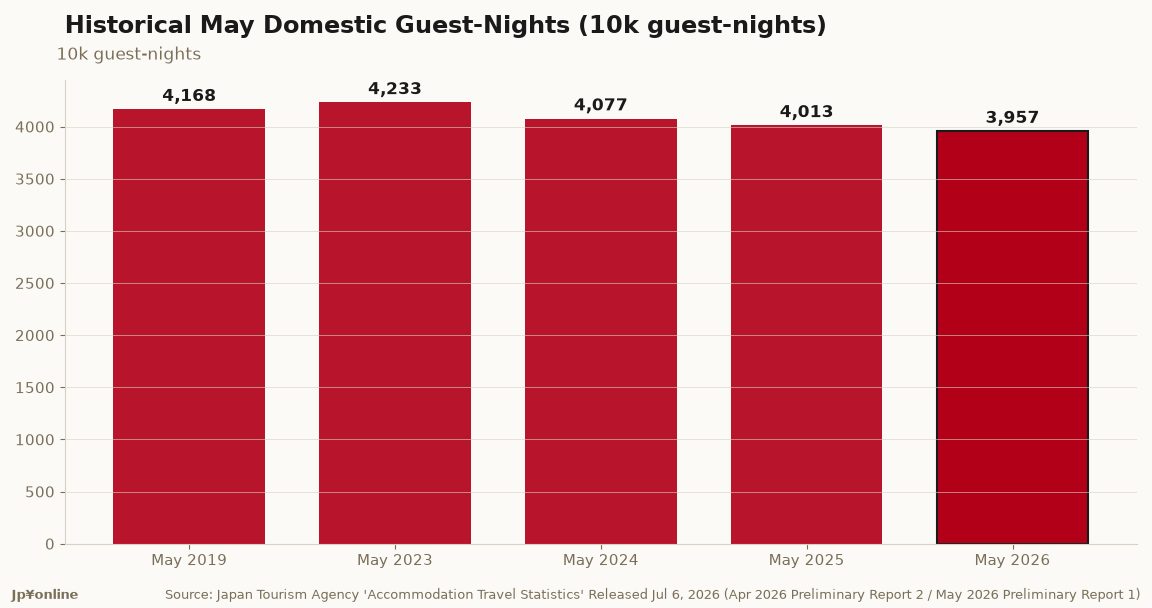
- Japanese guest-nights totalled 39,571,900 in May 2026, down 1.4% year on year, against a 13.4% drop in foreign guest-nights the same month.
- Domestic demand still supplies 74.1% of all guest-nights in Japan.
- May figures have fallen three years running: 42.33 million in 2023, 40.77 million in 2024, 40.13 million in 2025 and 39.57 million in 2026, and now sit 5.0% below May 2019.
- Every month of 2026 so far has been below the prior year: -2.3%, -1.6%, -1.5%, -5.5% and -1.4%, with April the deepest.
- By prefecture in April, the largest gains were Toyama +29.3%, Ibaraki +27.8%, Tottori +26.1%, Akita +25.3% and Ehime +23.6%, while Fukui -25.5%, Saga -20.3%, Fukuoka -19.9%, Osaka -18.7%, Kanagawa -18.5% and Tokyo -16.1% fell hardest. Note: from the January 2026 survey the stratification variable changed from number of employees to number of guest rooms (properties with 20+ rooms are now surveyed in full), so year-on-year comparisons spanning 2025/2026 include the effect of this change.
Inbound numbers get the coverage; the domestic side rarely gets counted. Japanese guest-nights came to 39.57 million in May 2026, down 1.4% year on year, and still account for 74.1% of all guest-nights in the country. Three quarters of Japan's occupied beds are filled by Japanese travellers.
The direction is the issue. May domestic stays have fallen three years running: 42.33 million in 2023, 40.77 million in 2024, 40.13 million in 2025 and 39.57 million in 2026, a cumulative loss of 2.76 million guest-nights. Against May 2019 the figure is 5.0% lower. Annual data agrees: 2025 domestic guest-nights totalled 481.18 million, down 2.7%, almost exactly level with the 480.27 million recorded in 2019. Over the same six years foreign guest-nights rose from 115.66 million to 179.92 million.
Through the first five months of 2026, no month has been positive: -2.3%, -1.6%, -1.5%, -5.5% and -1.4%. April was the deepest, and the April prefecture data shows where: Tokyo -16.1%, Kanagawa -18.5%, Osaka -18.7% and Fukuoka -19.9%. Domestic travellers are being priced out of the metro markets that inbound demand has bid up.
Growth sits elsewhere: Toyama +29.3%, Ibaraki +27.8%, Tottori +26.1%, Akita +25.3% and Ehime +23.6%, all markets where room rates remain within domestic budgets. Domestic demand offers volume stability with a hard ceiling on rate.
The Japan Tourism Agency released Accommodation Survey data on Japanese guest-nights on 6 July 2026.
National figures. Japanese guest-nights totalled 33,743,000 in April 2026, down 5.5% year on year, and 39,571,900 in May 2026, down 1.4%. Total guest-nights over the same months were 49,105,170 (-7.2%) and 53,387,540 (-4.8%).
By prefecture, April 2026 (second preliminary). The highest year-on-year growth was recorded in Toyama, followed by Ibaraki, Tottori, Akita and Ehime. Principal figures: Tokyo 3,071,770 (-16.1%), Osaka 2,064,270 (-18.7%), Hokkaido 1,875,730 (-4.3%), Chiba 1,801,230 (-1.2%), Okinawa 1,711,590 (-8.3%), Kanagawa 1,528,570 (-18.5%), Shizuoka 1,500,500 (+0.9%), Aichi 1,290,600 (-10.4%), Fukuoka 1,079,630 (-19.9%), Hyogo 1,033,780 (-3.8%), Kyoto 1,000,940 (-5.8%) and Nagano 968,440 (-0.9%).
Largest increases: Toyama 343,850 (+29.3%), Ibaraki 687,090 (+27.8%), Tottori 221,270 (+26.1%), Akita 251,960 (+25.3%), Ehime 365,580 (+23.6%), Yamaguchi 332,070 (+20.4%), Kochi 243,170 (+15.9%), Aomori 376,470 (+12.9%), Shimane 265,640 (+11.8%), Yamanashi 537,480 (+11.0%), Nara 244,580 (+10.9%) and Fukushima 742,040 (+9.6%).
Largest decreases: Fukui 223,980 (-25.5%), Saga 144,120 (-20.3%), Fukuoka (-19.9%), Osaka (-18.7%), Kanagawa (-18.5%), Oita 420,090 (-17.3%), Tokyo (-16.1%) and Tokushima 183,750 (-12.5%).
Historical reference. Annual Japanese guest-nights were 481,183,350 in 2025 (-2.7%), 494,601,930 in 2024 (-1.0%) and 480,265,130 in 2019. Monthly figures for 2026: January 32,628,920 (-2.3%), February 33,615,300 (-1.6%), March 40,133,960 (-1.5%), April 33,743,000 (-5.5%) and May 39,571,900 (-1.4%).
Notes. Year-on-year comparisons are made against final figures. The May 2026 figure is a first preliminary estimate, with second preliminary figures due on 31 July 2026. The stratification variable changed from number of employees to number of guest rooms from the January 2026 survey.