Japan Lodging, April 2026: Five Prefectures Beat National Occupancy While Foreign Stays Still GrewA · FULL TRANSLATION
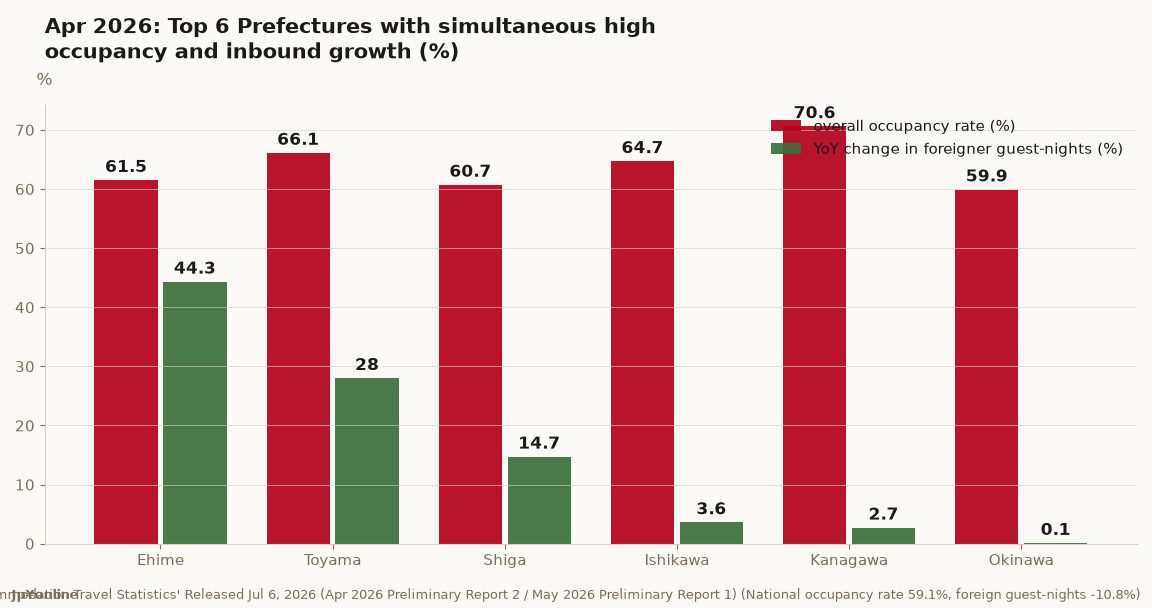
- Screening all 47 prefectures on April 2026 data for both above-national occupancy (over 59.1%) and positive year-on-year growth in foreign guest-nights leaves six: Ehime +44.3% (61.5% occupancy), Toyama +28.0% (66.1%), Shiga +14.7% (60.7%), Ishikawa +3.6% (64.7%), Kanagawa +2.7% (70.6%) and Okinawa +0.1% (59.9%).
- Toyama posted one of the largest occupancy gains nationally, up 6.7 points to 66.1%, with business hotels at 81.7% (3rd nationally) and city hotels at 76.7% (7th).
- The three largest inbound markets still show high occupancy but falling foreign demand: Tokyo 78.7% with foreign stays -13.9%, Osaka 73.2% with -16.4%, and Kyoto 69.1% with -18.8%.
- High-growth prefectures at the top of the table have very small bases: Ibaraki recorded 44,310 foreign guest-nights (+73.8%) and Akita 21,990 (+47.2%), both with occupancy below the national line.
- Prefecture data stops at April 2026; the May release is first preliminary and national only. Note: from the January 2026 survey the stratification variable changed from number of employees to number of guest rooms (properties with 20+ rooms are now surveyed in full), so year-on-year comparisons spanning 2025/2026 include the effect of this change.
Occupancy alone is distorted by existing stock, and growth rates alone are distorted by small bases. Applying both filters to April 2026 leaves six prefectures out of 47: Ehime, Toyama, Shiga, Ishikawa, Kanagawa and Okinawa.
Toyama is the cleanest case. Overall occupancy of 66.1% sits a full 7 points above the national 59.1%, and the 6.7-point year-on-year gain is among the largest in the country. Foreign guest-nights reached 80,070, up 28.0%, and Japanese guest-nights 343,850, up 29.3%, so both sides of demand are rising. By type, business hotels ran at 81.7%, third nationally, and city hotels at 76.7%, seventh.
Ehime and Shiga form the second group. Ehime recorded 90,000 foreign guest-nights, up 44.3%, with occupancy at 61.5% and ryokan occupancy of 56.7%, third nationally. Shiga recorded 49,990 foreign guest-nights, up 14.7%, occupancy of 60.7% and city hotel occupancy of 81.6%, second nationally, consistent with spillover from Kyoto room rates.
Two traps are worth naming. High occupancy with falling inbound demand: Tokyo at 78.7% but -13.9%, Osaka at 73.2% but -16.4%, Kyoto at 69.1% but -18.8%. And high growth without scale: Ibaraki's 44,310 guest-nights and Akita's 21,990 can be rewritten by a single charter series, and both sit below the national occupancy line.
Screen on absolute guest-nights first, then occupancy, then growth.
The following prefecture comparison is compiled from official figures in the Japan Tourism Agency's Accommodation Survey released 6 July 2026 (April 2026, second preliminary).
National benchmarks. Overall room occupancy was 59.1% in April 2026, down 2.3 points year on year. Foreign guest-nights totalled 15,362,170, down 10.8%.
Prefectures meeting both above-national occupancy and positive growth in foreign guest-nights, ranked by growth: Ehime, occupancy 61.5% (+3.9 points), foreign guest-nights 90,000 (+44.3%), with ryokan at 56.7%, resort hotels 48.6%, business hotels 73.2% and city hotels 65.0%. Toyama, occupancy 66.1% (+6.7 points), foreign guest-nights 80,070 (+28.0%), with ryokan 36.3%, resort hotels 29.9%, business hotels 81.7% and city hotels 76.7%. Shiga, occupancy 60.7% (+4.4 points), foreign guest-nights 49,990 (+14.7%), with ryokan 46.0%, resort hotels 61.4%, business hotels 74.5% and city hotels 81.6%. Ishikawa, occupancy 64.7% (+4.9 points), foreign guest-nights 270,770 (+3.6%), with ryokan 46.0%, resort hotels 47.9%, business hotels 78.3% and city hotels 74.9%. Kanagawa, occupancy 70.6% (-0.6 points), foreign guest-nights 541,930 (+2.7%), with ryokan 57.5%, resort hotels 70.6%, business hotels 84.8% and city hotels 77.7%. Okinawa, occupancy 59.9% (-0.6 points), foreign guest-nights 781,100 (+0.1%), with ryokan 39.0%, resort hotels 68.9%, business hotels 74.3% and city hotels 68.6%.
Major markets with high occupancy but falling foreign demand: Tokyo 78.7% occupancy, highest nationally, down 0.7 points, with foreign guest-nights of 4,829,040 (-13.9%); Osaka 73.2% (-7.8 points) with 2,092,880 (-16.4%); Fukuoka 72.7% (-1.1 points) with 729,550 (-3.2%); Kyoto 69.1% (-4.8 points) with 1,686,170 (-18.8%); and Aichi 64.1% (-8.7 points) with 344,770 (-30.4%).
Prefectures with high growth but small volume: Ibaraki 44,310 foreign guest-nights (+73.8%) at 57.5% occupancy; Akita 21,990 (+47.2%) at 50.2%; Fukushima 46,040 (+31.8%) at 48.2%; Yamagata 22,230 (+30.5%) at 40.8%; and Aomori 72,260 (+28.7%) at 52.4%.
Notes. April 2026 figures are second preliminary estimates with a 44.7% valid response rate, compared against final figures for the prior year. May 2026 is a first preliminary estimate without prefecture detail. The stratification variable changed from number of employees to number of guest rooms from the January 2026 survey.