Japan 2030 Tourism Targets: 71% of the Visitor Goal, 63% of the Spending GoalA · FULL TRANSLATION
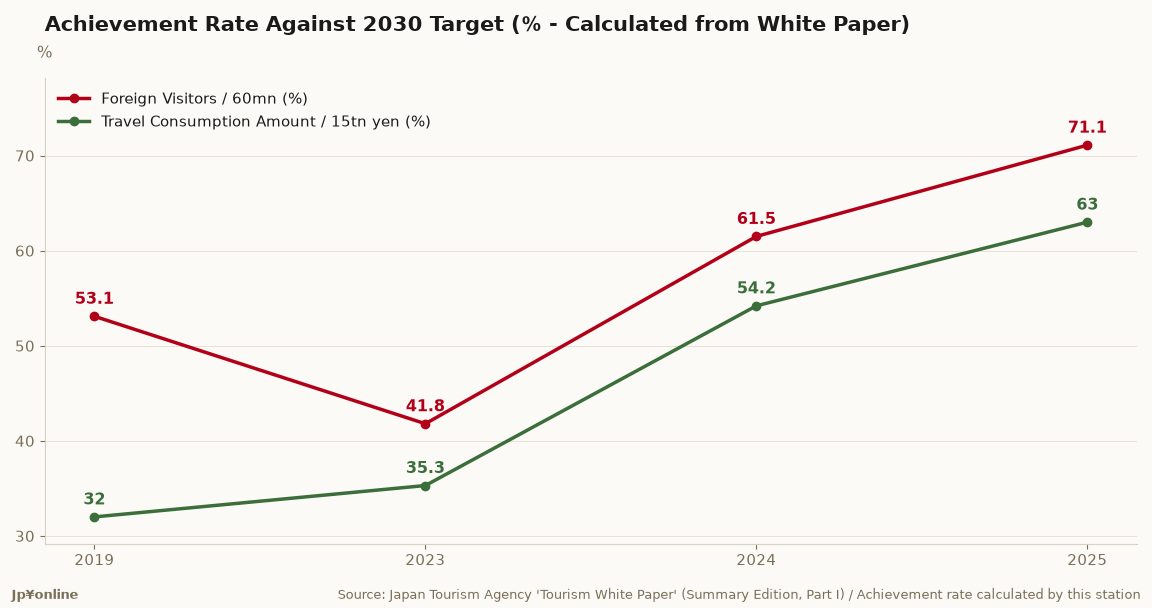
- Government 2030 targets are 60 million inbound visitors and JPY 15 trillion in spending, under the 5th Basic Plan
- 2025 delivered 42.68 million visitors, 71.1% of target, and JPY 9.4549 trillion, 63.0% of target
- In 2024 the equivalent rates were 61.5% and 54.2%, so the gap between volume and value barely narrowed
- Dividing the paper's own figures, spend per visitor was about JPY 222,000 in 2025 versus JPY 220,000 in 2024 and JPY 151,000 in 2019
- Hitting both targets requires JPY 250,000 per visitor, about 13% above the current level
Japan's 2030 targets are 60 million inbound visitors and JPY 15 trillion of inbound spending, set in the 5th Basic Plan for Promoting a Tourism Nation and cited again in the Reiwa 8 white paper on its page covering the international tourist tax. Dividing 2025 results into those targets shows the gap between the two tracks.
Visitors of 42.68 million equal 71.1% of the 60 million goal. Spending of JPY 9.4549 trillion equals 63.0% of the JPY 15 trillion goal, a gap of 8.1 points.
A year earlier the figures were 36.87 million and JPY 8.1257 trillion, or 61.5% and 54.2%, a gap of 7.3 points. Both tracks advanced about nine points, so the gap widened slightly.
Per visitor the picture is clearer. Using the paper's own numbers, average spend was about JPY 222,000 in 2025, JPY 220,000 in 2024 and JPY 151,000 in 2019. The step up from pre-pandemic levels is large, but the last two years are flat. Meeting both 2030 targets requires JPY 250,000 per visitor, about JPY 28,000 more.
If spend per visitor stays near JPY 220,000, then 60 million arrivals would generate roughly JPY 13.3 trillion, short of the target by about JPY 1.7 trillion. Closing that gap runs through room rates, length of stay and regional spending rather than additional headcount.
Outbound remains behind: 14.73 million departures in 2025, or 73.4% of the 20.08 million recorded in 2019.
Compiled from the White Paper on Tourism in Japan 2026 (Reiwa 8). Achievement rates and per-visitor figures are calculated from the paper's published values.
Targets: the page on the international tourist tax states that the increased revenue will be directed toward the goals of the 5th Basic Plan for Promoting a Tourism Nation, namely 60 million inbound visitors and JPY 15 trillion in inbound spending by 2030, together with regional dispersal and measures to prevent congestion and misconduct associated with overtourism.
Results for 2025: inbound visitors 42.68 million, up 15.8% and a record high; inbound spending JPY 9.4549 trillion, up 16.4% and a record high; Japanese departures 14.73 million, up 13.3%; Japanese domestic person-trips 550 million, up 2.4%.
Results for 2024 as published in the Reiwa 7 edition: inbound visitors 36.87 million, up 15.6% on 2019; inbound spending JPY 8.1257 trillion, up 68.8% on 2019; departures 13.01 million, down 35.2% on 2019.
Calculated against the 2030 targets, visitor numbers stood at 53.1% in 2019, 41.8% in 2023, 61.5% in 2024 and 71.1% in 2025. Spending stood at 32.0% in 2019, 35.3% in 2023, 54.2% in 2024 and 63.0% in 2025.
Spending per visitor, obtained by dividing spending by visitor numbers, was about JPY 151,000 in 2019, JPY 211,000 in 2023, JPY 220,000 in 2024 and JPY 222,000 in 2025. Meeting both 2030 targets implies JPY 250,000 per visitor.
The paper notes that cruise passengers were added to the consumption survey from 2018, so comparisons with 2017 and earlier require care, and that annual values for 2020 to 2022 are estimates because some quarterly surveys were suspended.