Japan Tourism White Paper 2026 Theme Chapter: 72% of Hotels Short-Staffed, Productivity at 72% of All IndustriesA · FULL TRANSLATION
- The Reiwa 8 theme chapter covers workforce and productivity in the accommodation sector, replacing last year's chapter on domestic travel
- Of 522 surveyed accommodation businesses, 72.2% report a labour shortage; mid-sized properties are highest at 77.1%
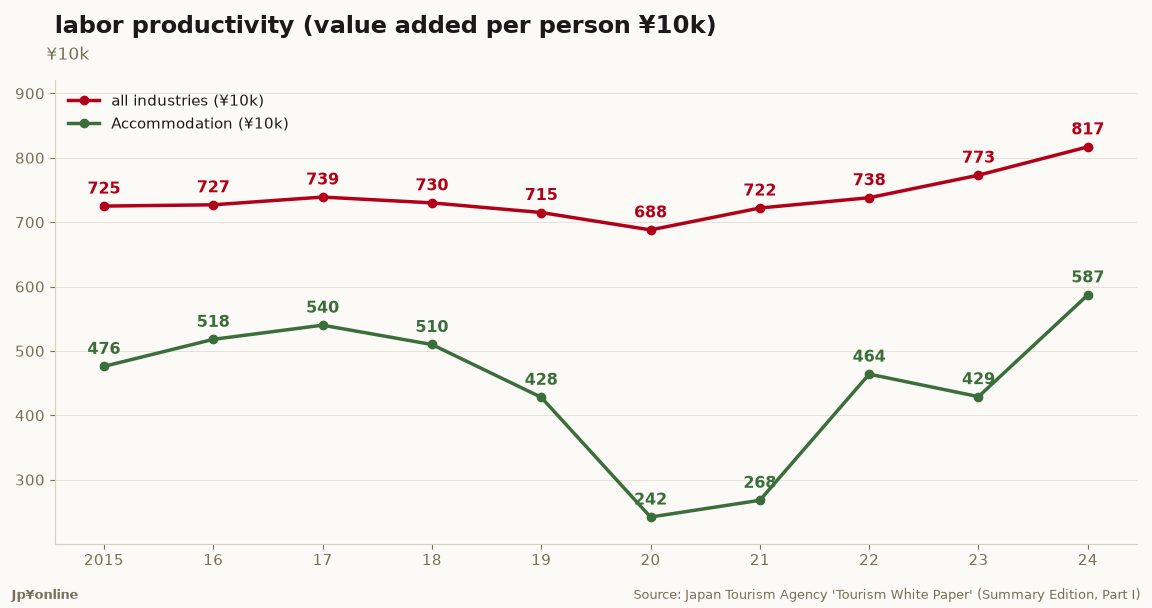
- Value added per worker in accommodation was JPY 5.87 million in FY2024 against JPY 8.17 million for all industries, or 72%, up from 55% in FY2023
- Annual pay in 2025 was JPY 5.46 million across industries and JPY 4.13 million in accommodation, a gap of JPY 1.33 million
- 79.3% of properties say peak-season shortages increase the load on existing staff, 40.6% have cut services and 21.5% abandoned expansion plans
Each edition of the white paper carries one theme chapter. The Reiwa 7 edition covered how to revive domestic travel by Japanese residents. The Reiwa 8 edition turns to the people running the business: workforce and productivity in accommodation.
The Japan Tourism Agency surveyed accommodation providers between December 2025 and January 2026, collecting 522 responses. 72.2% report a labour shortage, rising to 77.1% at mid-sized properties with annual sales of JPY 100 million to JPY 1 billion, against 69.9% for large and 66.0% for small properties.
Productivity is the core of the chapter. Value added per worker in accommodation was JPY 5.87 million in FY2024 against JPY 8.17 million for all industries, or 72%. The previous edition showed FY2023 at JPY 4.29 million against JPY 7.73 million, or 55%.
Pay has not closed at the same speed. Annual pay in 2025 was JPY 5.46 million across industries and JPY 4.13 million in accommodation. Non-regular employment is 45.3% in accommodation against 36.5% across industries. Half of accommodation firms ran no off-the-job training, against 26.1% across industries, and capital spending per worker in FY2024 was JPY 750,000 against JPY 1.24 million.
The shortage now limits trade: 79.3% report heavier loads in peak periods, 50.4% cite the cost and time of hiring, 40.6% have cut services and 21.5% dropped plans to raise occupancy. Asked what worked, 29.4% overall and 47.5% of small properties answered nothing in particular. Among properties with higher net profit, 81.2% credit higher room rates.
Compiled from Part I, Chapter 3 of the White Paper on Tourism in Japan 2026 (Reiwa 8), titled Toward a Tourism Industry That Is Good to Work In: Securing Human Resources and Raising Productivity in the Accommodation Sector.
Current state and issues: labour shortages are widespread in accommodation and food services. In a survey of accommodation providers conducted from December 2025 to January 2026 with 522 responses, 72.2% reported a labour shortage, comprising 66.0% of small properties (annual sales under JPY 100 million), 77.1% of mid-sized properties (JPY 100 million to JPY 1 billion) and 69.9% of large properties (JPY 1 billion or more). Wages in accommodation are lower than the all-industry average and annual days off are fewer: total annual pay in 2025 was JPY 5.46 million for all industries and JPY 4.13 million in accommodation.
Because the sector often needs to flex hours against demand, non-regular employment is high: 36.5% across industries, 45.3% in accommodation and 81.8% in restaurants in 2025.
Labour productivity measured as value added per worker has run at roughly 70% of the all-industry level outside the pandemic years, at JPY 5.87 million against JPY 8.17 million in FY2024, or 72%. Training gaps persist: in 2024, 26.1% of all industries and 50.3% of accommodation firms provided no off-the-job training, while 35.1% and 52.2% respectively conducted no planned on-the-job training. Capital spending per worker in FY2024 was JPY 1.24 million for all industries and JPY 750,000 in accommodation.
Effects of the shortage: 79.3% report that shortages in peak periods increase the burden on existing staff, 50.4% cite cost and time to recruit, 40.6% have had to scale back services and 21.5% have abandoned plans to raise occupancy. Asked which measures were effective, 29.4% overall and 47.5% of small properties answered none in particular. Among properties whose net profit rose above pre-pandemic levels, 81.2% cite higher unit prices, 49.5% more inbound guests and 41.2% more domestic guests; among those whose profit fell, 78.0% cite higher material costs, 70.7% higher personnel costs and 42.3% service cuts caused by understaffing.
Measures: the paper states that resolving shortages requires raising profitability and productivity through tangible and intangible investment and training, strengthening the ability to handle seasonal swings, and passing the results through to wages and conditions. Case studies include a hotel in Gamagori, Aichi, that adopted three fixed closing days a week, cutting sales to about two thirds while raising its profit margin by 15%; Atami, Shizuoka, using generative AI for marketing analysis and cutting analysis workload to about one fifteenth; Kurokawa Onsen in Kumamoto running joint recruitment and training, with 63 graduates over six intakes of its leadership course; and a Nara prefecture pilot sharing staff between regions with offsetting peak seasons.