Japan Tourism White Paper 2026: Foreign Guest Nights Outside Big Cities Back to 33.0%, Still Below 41.0% in 2017A · FULL TRANSLATION
- Foreign guest nights reached a record 177.87 million in 2025, up 8.2% year on year
- Of these, 119.14 million (67.0%) were in the three major metropolitan areas and 58.73 million (33.0%) elsewhere, up from 50.86 million and 30.9% in 2024
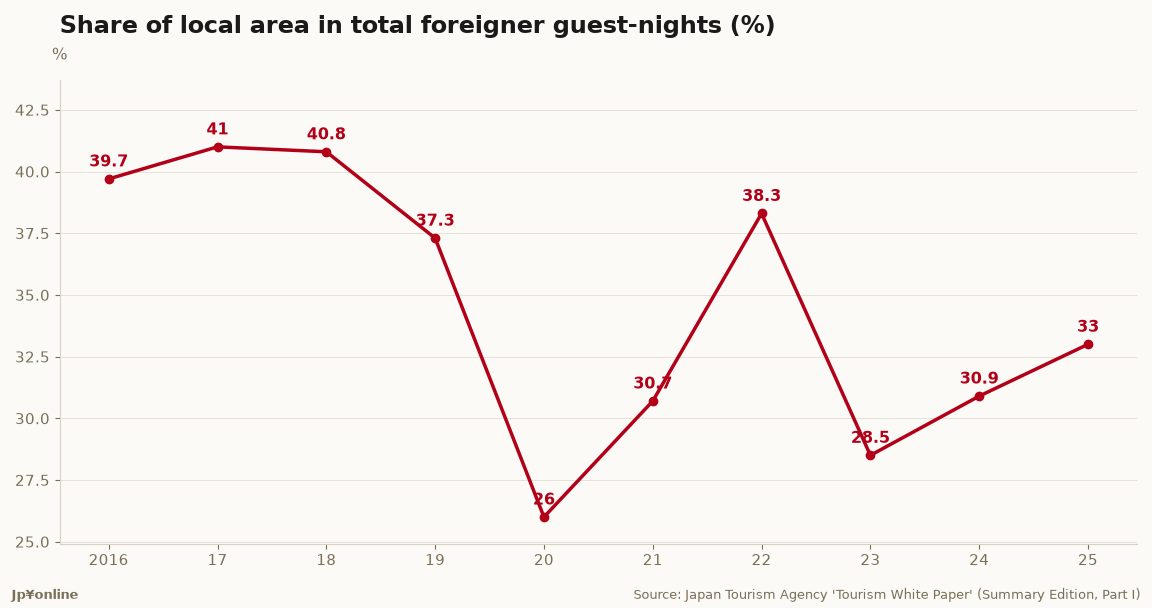
- The regional share peaked at 41.0% in 2017, fell to 26.0% in 2020 and 28.5% in 2023, then recovered for two straight years to 33.0%
- Japanese guests skew the other way: 296.58 million of 475.61 million Japanese guest nights, or 62.4%, were outside the big three areas
- Total guest nights fell 0.8% to 653.48 million as Japanese guest nights dropped 3.8%, outweighing the gain in foreign guests
Spreading visitors beyond the big cities has been a stated policy goal for a decade, and the accommodation statistics in the white paper are the cleanest test of it. Foreign guest nights reached a record 177.87 million in 2025, up 8.2%. Of that, 119.14 million or 67.0% were in the three major metropolitan areas and 58.73 million or 33.0% were elsewhere.
The long series puts that in context. The regional share was 39.7% in 2016, peaked at 41.0% in 2017, then 40.8% and 37.3%. The pandemic drove it to 26.0% in 2020; it was 28.5% in 2023, 30.9% in 2024 and 33.0% in 2025. Two years of recovery still leave it eight points below the 2017 peak.
Japanese guests distribute the opposite way. Of 475.61 million Japanese guest nights in 2025, 179.03 million were in the big three areas and 296.58 million, or 62.4%, were elsewhere. Regional lodging rests on domestic demand, with foreign guests as the increment.
That base is shrinking. Total guest nights were 653.48 million in 2025, down 0.8%, as Japanese guest nights fell 3.8%. Foreign guest nights added about 13.4 million while Japanese guest nights lost about 19.0 million. A record inbound year still produced a decline in total occupancy volume.
Scale still favours the metropolitan areas, where foreign guest nights are double the regional figure. In absolute terms the regions gained 7.87 million guest nights over 2024. Occupancy across all accommodation was 61.8% in 2025 against 60.5% for 2024 in the previous edition.
Compiled from the White Paper on Tourism in Japan 2026 (Reiwa 8), Part I, on accommodation travel. Source: JTA Overnight Travel Statistics Survey; 2025 figures are preliminary.
Totals: guest nights in 2025 were 653.48 million, down 0.8% year on year. Japanese guest nights were 475.61 million, down 3.8%. Foreign guest nights were 177.87 million, up 8.2% and a record high, with the share outside the three major metropolitan areas running at around 30% in recent years. Room occupancy was 61.8% in 2025.
Definitions: the three major metropolitan areas are Saitama, Chiba, Tokyo, Kanagawa, Aichi, Kyoto, Osaka and Hyogo; regional areas are all other prefectures.
Foreign guest nights by area (million guest nights, share in brackets): 2016, 41.86 (60.3%) and 27.53 (39.7%); 2017, 47.03 (59.0%) and 32.66 (41.0%); 2018, 55.80 (59.2%) and 38.48 (40.8%); 2019, 72.57 (62.7%) and 43.09 (37.3%); 2020, 12.20 (74.0%) and 4.30 (26.0%); 2021, 2.99 (69.3%) and 1.33 (30.7%); 2022, 12.55 (61.7%) and 7.79 (38.3%); 2023, 84.17 (71.5%) and 33.58 (28.5%); 2024, 113.60 (69.1%) and 50.86 (30.9%); 2025, 119.14 (67.0%) and 58.73 (33.0%).
Japanese guest nights in 2025 were 179.03 million in the metropolitan areas and 296.58 million in regional areas, a regional share of 62.4%.
Foreign guest nights by year (million): 69.39 in 2016, 79.69 in 2017, 94.28 in 2018, 115.66 in 2019, 16.50 in 2020, 4.32 in 2021, 20.35 in 2022, 117.75 in 2023, 164.46 in 2024 and 177.87 in 2025.
For comparison, the Reiwa 7 edition reported preliminary 2024 figures of 650.28 million total guest nights, 486.68 million Japanese and 163.60 million foreign, with occupancy of 60.5%; metropolitan areas held 297.63 million guest nights and regional areas 352.64 million. The Reiwa 8 edition revises 2024 total guest nights to 659.06 million, so preliminary and revised values differ and should be compared with care.