Japan Tourism White Paper 2026: Departure Tax Tripled to JPY 3,000, Related Budget Jumps to JPY 130 BillionA · FULL TRANSLATION
- The international tourist tax rises from JPY 1,000 to JPY 3,000 per departing passenger on 1 July 2026
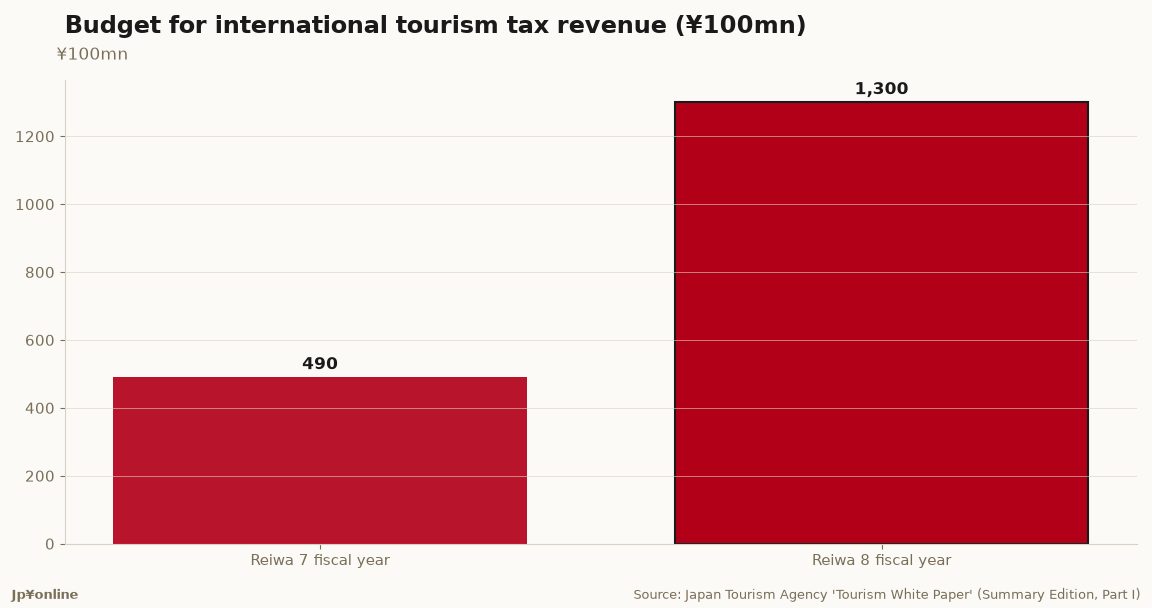
- The related budget rises from JPY 49.0 billion in FY2025 to JPY 130.0 billion in FY2026, about 2.65 times
- FY2026 allocation: JPY 61.2 billion for regional content development, JPY 59.6 billion for travel environment, JPY 9.2 billion for inbound promotion
- The increase is earmarked for the 2030 targets of 60 million visitors and JPY 15 trillion, plus regional dispersal and overtourism prevention
- Policy pillars were rewritten to lead with balancing inbound attraction against residents' quality of life
Parts II and III of the white paper cover where the money and the policy go. The clearest line in the Reiwa 8 edition is the international tourist tax, which rises from JPY 1,000 to JPY 3,000 per departing passenger on 1 July 2026. Travellers flying home from Japan pay it.
With the rate tripled, the budget follows. Related spending rises from JPY 49.0 billion in FY2025 to JPY 130.0 billion in FY2026, about 2.65 times, an increase of JPY 81.0 billion in one year.
The paper lists three uses. The largest is JPY 61.2 billion for developing and using regional assets such as culture, national parks, food and activities. Next is JPY 59.6 billion for the travel environment, covering overtourism measures, smoother immigration, access to and within destinations, and safe overseas travel for Japanese residents. The smallest is JPY 9.2 billion for inbound promotion. The three total JPY 130.0 billion.
The mix is worth noting. The tax has often been criticised for funnelling money into overseas promotion; here promotion is 7% of the total, with regional content at 47% and travel environment at 46%. The weight has moved from attracting visitors to receiving and dispersing them.
The policy framing changed too. The Reiwa 7 edition set out three strategies: sustainable destination management, regionally focused inbound attraction, and expanding domestic exchange. The Reiwa 8 edition uses three pillars: balancing strategic inbound attraction with residents' quality of life, expanding domestic exchange and outbound travel, and strengthening destinations and the tourism industry.
Compiled from the White Paper on Tourism in Japan 2026 (Reiwa 8), covering measures taken in FY2025 and planned for FY2026, and the section on the international tourist tax.
Policy pillars: measures are pursued under the three pillars of the Basic Plan for Promoting a Tourism Nation. First, balancing strategic inbound attraction with residents' quality of life, through responses to localised congestion and misconduct such as smart waste bins, wide-area structures for regional dispersal, training of guides and hospitality staff, richer content with high regional and spending impact such as ecotourism, and stronger transport networks to regional areas including smart lanes. Second, expanding domestic exchange and outbound travel, through holiday dispersal and demand levelling, workation, creation of relations population and dual residence, momentum building for domestic and overseas travel including educational travel abroad, and recovery support such as content using the tourism resources of the Noto Peninsula. Third, strengthening destinations and the tourism industry, through diversification of inbound markets and content, use of natural and historic landscapes in national government parks, productivity gains from tourism DX and labour-saving investment such as automatic check-in machines, sound competitive conditions, and universal tourism including barrier-free guest rooms.
International tourist tax: the rate rises from the current JPY 1,000 to JPY 3,000 on 1 July of this year. Related budget accordingly rises from JPY 49.0 billion in FY2025 to JPY 130.0 billion. The increase is to be directed primarily at new challenges including regional dispersal and the prevention and control of overtourism, in support of the government targets in the 5th Basic Plan of 60 million inbound visitors and JPY 15 trillion in spending by 2030.
The FY2026 budget allocates: JPY 59.6 billion for the environment enabling smooth and comfortable travel by international visitors, covering overtourism measures, smoother immigration, access to destinations and movement within them, and safe overseas travel environments supporting outbound recovery; JPY 9.2 billion for making information on Japan's attractions easier to obtain, including inbound promotion; and JPY 61.2 billion for developing and using tourism resources based on local culture, nature and other characteristics, including content creation using culture, national parks, food and activities.
The paper states that these measures fall within the uses stipulated by the Act on Promotion of International Tourism and related basic policy, and that transparency of the budget process and appropriateness of the measures will be further assured.
For comparison, the Reiwa 7 edition organised measures under three strategies: sustainable destination management, regionally focused inbound attraction, and expansion of domestic exchange.