Japan Guest Nights Fall 6.5% to 46.78 Million in June 2026, Foreign Stays Down 11.9%A · FULL TRANSLATION
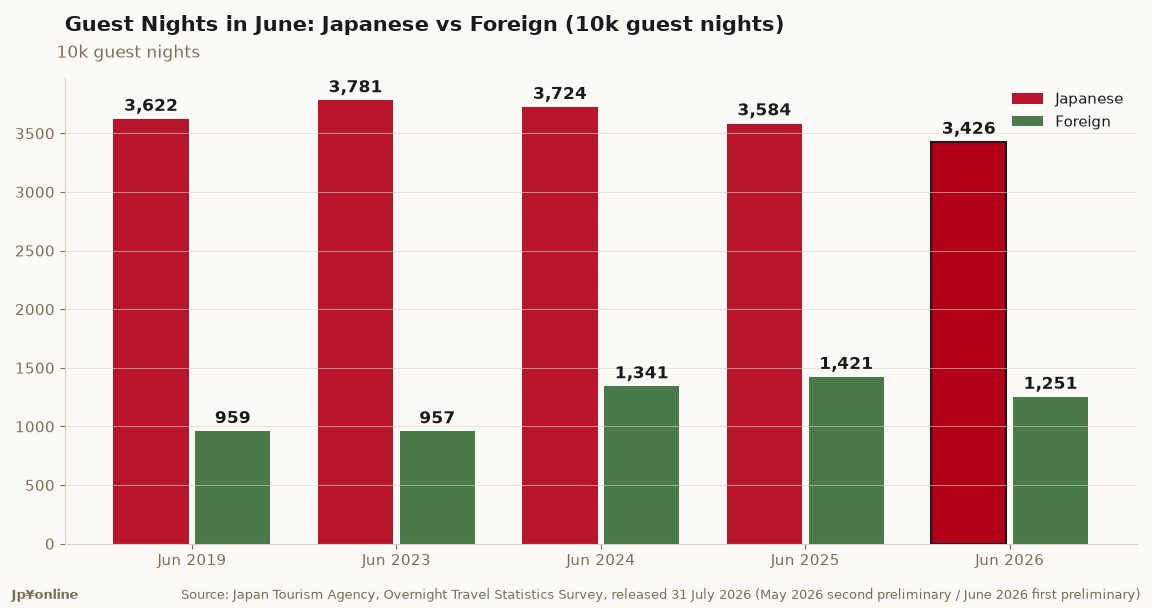
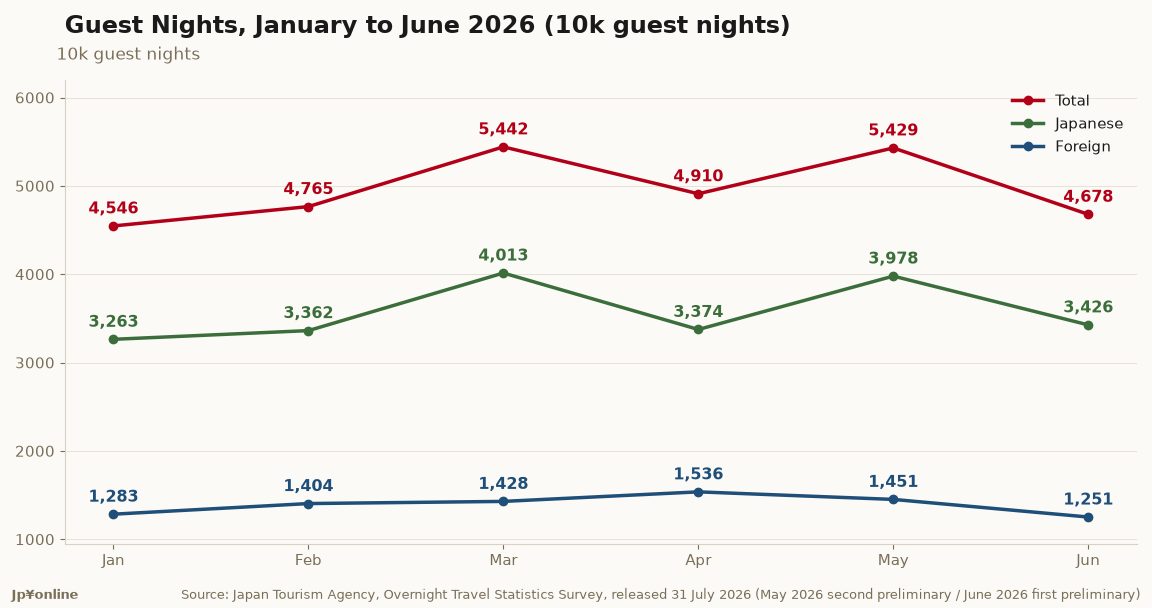
- June 2026 guest nights fell to 46.78m (-6.5% y/y), down 7.52m (-13.8%) from May's 54.29m; Japanese 34.26m (-4.4%), foreign 12.51m (-11.9%)
- May's first preliminary of 53.39m, reported here last month, was revised up to 54.29m (+0.90m); foreign stays alone were revised up 0.69m
- Versus 2019: total is 2.1% above the pre-pandemic June, but foreign stays are 30.5% higher while Japanese stays are 5.4% lower
- Foreign share of guest nights was 26.8% in June, below 28.4% a year earlier but far above 20.9% in June 2019
- Break in series: from January 2026 the stratification variable changed from employee count to room count, so year-on-year figures carry a methodology effect
Last month this series reported May 2026 at 53.39m guest nights on the first preliminary; the second preliminary has revised May up to 54.29m, a gain of 0.90m. The newly added June first preliminary comes in at 46.78m, down 7.52m (-13.8%) from the revised May and down 6.5% year on year. Japanese stays were 34.26m (-4.4%) and foreign stays 12.51m (-11.9%).
The revision itself matters. Foreign guest nights for May were lifted from 13.82m to 14.51m, a 5.0% upward revision, while Japanese stays moved only 0.21m. When the response rate is low (34.5% at first preliminary, 45.9% at second), it is foreign stays that get understated most. June's first preliminary carries a 36.1% response rate, so the -11.9% headline should be treated as provisional until the second preliminary on 31 August.
Against pre-pandemic June 2019, total guest nights are 2.1% higher, but the composition has flipped: foreign stays are 30.5% above 2019 while Japanese stays remain 5.4% below. The foreign share was 26.8% in June, down from 28.4% a year earlier but far above 20.9% in 2019. For lodging investors the structural point stands: more than one in four occupied beds in Japan now belongs to an overseas guest, and that segment swings far harder than domestic demand.
Caveat: from January 2026 the survey's stratification variable changed from employee count to room count, so year-on-year comparisons spanning 2025 and 2026 carry a methodology effect.
Japan Tourism Agency, released 31 July 2026 — Overnight Travel Statistics Survey (May 2026 second preliminary, June 2026 first preliminary). Summary translation:
Change in survey design: to further improve statistical accuracy, from the January 2026 survey the stratification variable was changed from number of employees to number of guest rooms. Year-on-year comparisons and year-on-year differences may therefore include the effect of this revision.
1. Guest nights. Total guest nights in May 2026 were 54.29 million (-3.2% year on year). June 2026 was 46.78 million (-6.5%). Japanese guest nights were 39.78 million in May (-0.9%) and 34.26 million in June (-4.4%). Foreign guest nights were 14.51 million in May (-9.0%) and 12.51 million in June (-11.9%). June figures are first preliminary values and may change in the second preliminary scheduled for release on 31 August 2026.
2. Room occupancy. The overall room occupancy rate was 61.0% in May 2026 and 56.2% in June 2026. In May 2026 the number of prefectures with occupancy above 80% was: resort hotels 1 (0 a year earlier), business hotels 2 (4 a year earlier), city hotels 1 (3 a year earlier). Tokyo recorded the highest overall occupancy nationwide at 77.9%.
3. Summary of results. May 2026 guest nights totalled 54.29 million (-3.2%), of which foreign guest nights were 14.51 million (-9.0%); foreign guests accounted for 26.7% of all guest nights.
4. Survey outline. Survey period: each calendar month. Universe: all accommodation establishments in Japan — hotels, ryokan, simple lodgings, company and organisation lodgings — totalling 75,665 establishments. Surveyed establishments: 20,854 for May 2026 (second preliminary) and 20,826 for June 2026 (first preliminary). Effective response rate for May 2026 (second preliminary): 45.9% overall, 54.0% for establishments with 20 or more rooms and 31.7% for those with fewer than 20 rooms. For reference, the response rate at the time of the May first preliminary was 34.5%.
(Prefecture-level and nationality-level detail is available in the original Japanese release.)