Japan's Big-Three Metro Areas Down 11.5% in Foreign Guest Nights, Rural Areas Down Just 3.4% (May 2026)A · FULL TRANSLATION
- Foreign guest nights totalled 14.51m in May 2026 (-9.0% y/y): the three major metropolitan areas fell 11.5% while rural areas fell only 3.4%
- Rural areas held a 32.7% share, slightly below April's 33.8%; the metro areas accounted for 9.77m guest nights, or 67.3%
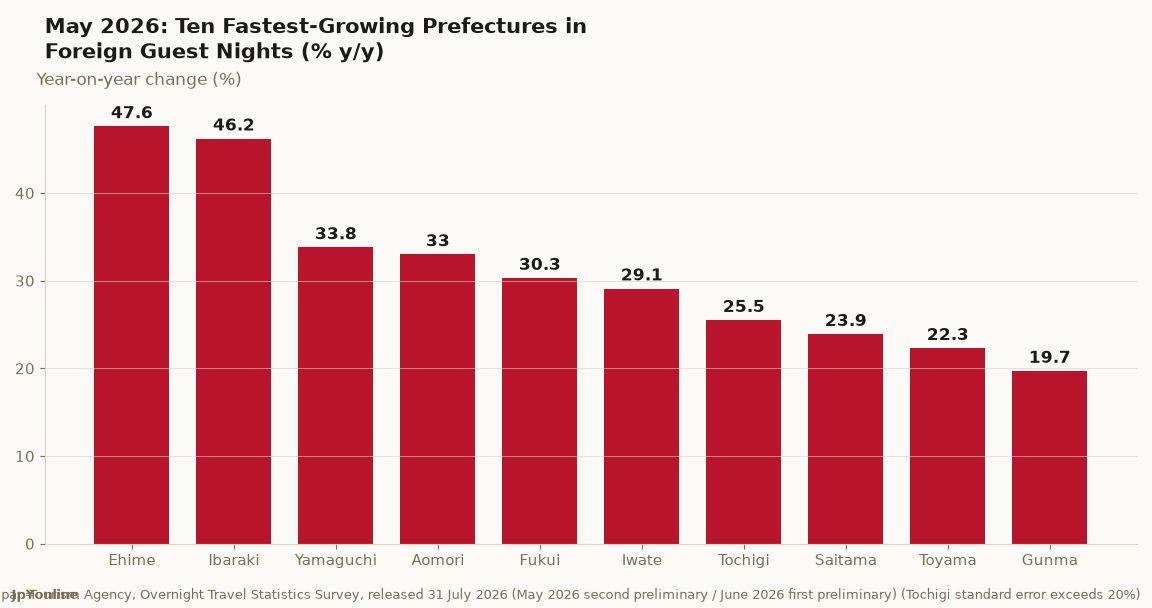
- Fastest-growing prefectures: Ehime +47.6%, Ibaraki +46.2%, Yamaguchi +33.8%, Aomori +33.0%, Fukui +30.3%
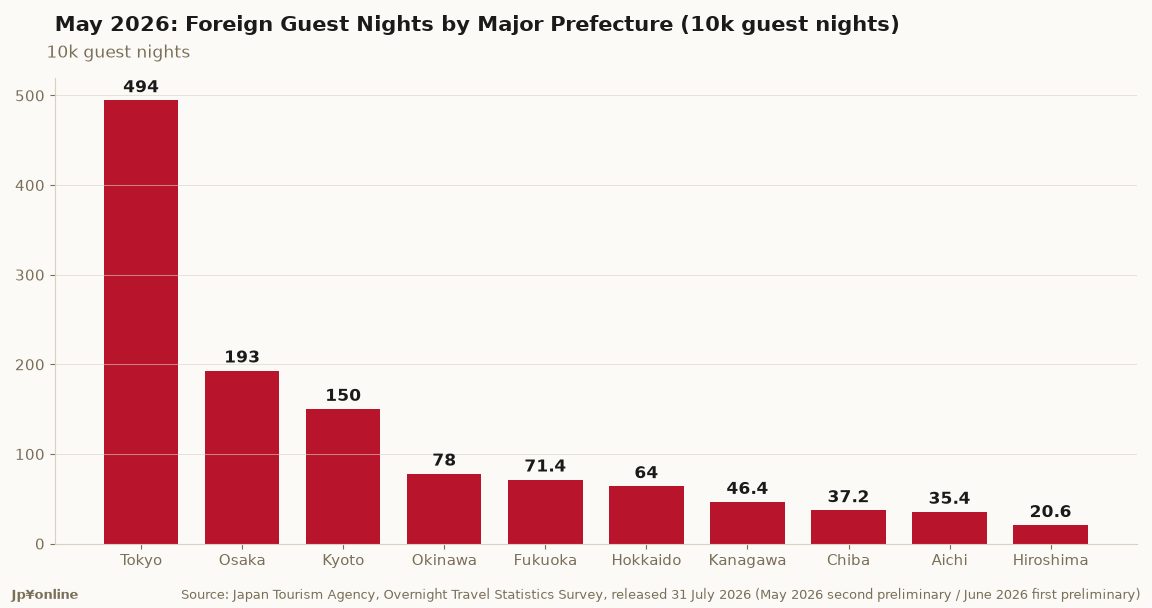
- All five largest markets declined: Tokyo 4.94m (-9.8%), Osaka 1.93m (-16.8%), Kyoto 1.50m (-15.9%), Okinawa 0.78m (-2.2%), Fukuoka 0.71m (-12.7%); Kanagawa +17.1% was the only large market growing
- By nationality (properties with 20+ rooms): US first at 1.72m (+1.9%), Taiwan second at 1.70m (+12.2%), Korea third at 1.60m (+5.7%), China fourth at 1.13m (-53.8%)
Last month, using April's second preliminary, this series reported foreign guest nights down 10.8% nationally, with the three major metropolitan areas at -14.6%, rural areas at -2.3% and a rural share of 33.8%. The May second preliminary now shows -9.0% nationally, metro areas -11.5%, rural areas -3.4% and a rural share of 32.7%. Both sides narrowed their declines, but the rural side slipped from -2.3% to -3.4% and gave back 1.1 points of share.
In absolute terms, foreign guest nights were 14.51m: 9.77m in the metro areas and 4.74m in rural Japan. Over three years the rural figure has run 3.94m (May 2024), 4.91m (May 2025) and 4.74m (May 2026), while its share has risen steadily from 29.0% to 30.8% to 32.7%. Rural Japan lost volume this year, but lost less than the cities.
Ehime led all prefectures at +47.6%, followed by Ibaraki +46.2%, Yamaguchi +33.8%, Aomori +33.0% and Fukui +30.3%. These are small bases — Ehime recorded 74,300 guest nights against Tokyo's 4.94m — and mostly sit off the traditional tourist corridor. The agency flags Tochigi's standard error above 20%.
Every large market fell: Tokyo -9.8%, Osaka -16.8%, Kyoto -15.9%, Okinawa -2.2% and Fukuoka -12.7%. The Kansai pair remain the hardest hit, consistent with Chinese guest nights down 53.8%. Kanagawa, up 17.1%, was the only large market growing. By nationality, the US ranked first at 1.72m guest nights, with Taiwan a close second at 1.70m (+12.2%).
Japan Tourism Agency, 31 July 2026 — foreign guest nights section of the Overnight Travel Statistics Survey (May 2026 second preliminary):
Foreign guest nights totalled 14.51 million. Comparing year-on-year change between the three major metropolitan areas and rural Japan, the metropolitan areas fell 11.5% and rural areas fell 3.4%. The three major metropolitan areas are defined as Saitama, Chiba, Tokyo, Kanagawa, Aichi, Kyoto, Osaka and Hyogo; rural areas are all other prefectures.
By prefecture (guest nights, year-on-year): national 14,507,490 (-9.0%); Hokkaido 639,710 (-10.0%); Aomori 43,030 (+33.0%); Iwate 30,300 (+29.1%); Miyagi 75,330 (+14.6%); Ibaraki 33,460 (+46.2%); Tochigi 49,150 (+25.5%); Saitama 29,160 (+23.9%); Chiba 372,350 (-3.7%); Tokyo 4,944,510 (-9.8%); Kanagawa 463,850 (+17.1%); Toyama 67,300 (+22.3%); Ishikawa 236,060 (+4.6%); Fukui 13,590 (+30.3%); Yamanashi 200,020 (-14.6%); Nagano 193,700 (+9.8%); Gifu 196,320 (+7.7%); Shizuoka 177,720 (-12.5%); Aichi 354,130 (-20.4%); Kyoto 1,501,730 (-15.9%); Osaka 1,930,040 (-16.8%); Hyogo 170,970 (-14.4%); Nara 39,120 (-27.9%); Hiroshima 205,640 (-9.3%); Yamaguchi 18,380 (+33.8%); Ehime 74,300 (+47.6%); Fukuoka 713,850 (-12.7%); Kumamoto 151,240 (+1.7%); Oita 133,530 (-2.9%); Okinawa 779,920 (-2.2%). Year-on-year comparisons are against final values; Tochigi's standard error exceeds 20%.
By nationality (establishments with 20 or more rooms), May 2026: 1st United States 1,721,740 guest nights (13.5% share, +1.9%); 2nd Taiwan 1,698,370 (13.3%, +12.2%); 3rd South Korea 1,596,820 (12.5%, +5.7%); 4th China 1,127,660 (8.8%, -53.8%); 5th Australia 540,350 (4.2%, -2.3%). The top five accounted for 52.4% of the total, which fell 6.7% year on year. Malaysia (+41.1%), Russia (+31.1%) and India (+20.9%) posted the largest gains.
Metropolitan versus rural comparison: rural areas recorded 3.94m guest nights in May 2024 (29.0% share), 4.91m in May 2025 (30.8%, +24.6%) and 4.74m in May 2026 (32.7%, -3.4%). The three major metropolitan areas recorded 9.66m (71.0%), 11.045m (69.2%, +14.3%) and 9.77m (67.3%, -11.5%) respectively.