Tokyo-Area Investment Condo Supply Jumps 28.8% to 2,401 Units in H1 2026, Led by Yokohama
- Investment condominium supply in the Greater Tokyo area came to 46 projects and 2,401 units in the first half of 2026, against 42 projects and 1,864 units a year earlier — up 4 projects (9.5%) and 537 units (28.8%).
- The number of municipalities and wards with new supply widened from 20 to 27. Within Tokyo's 23 wards the count rose from 8 to 13; Kanagawa had 10, Saitama 2, Chiba 1 (zero a year earlier) and western Tokyo 1.
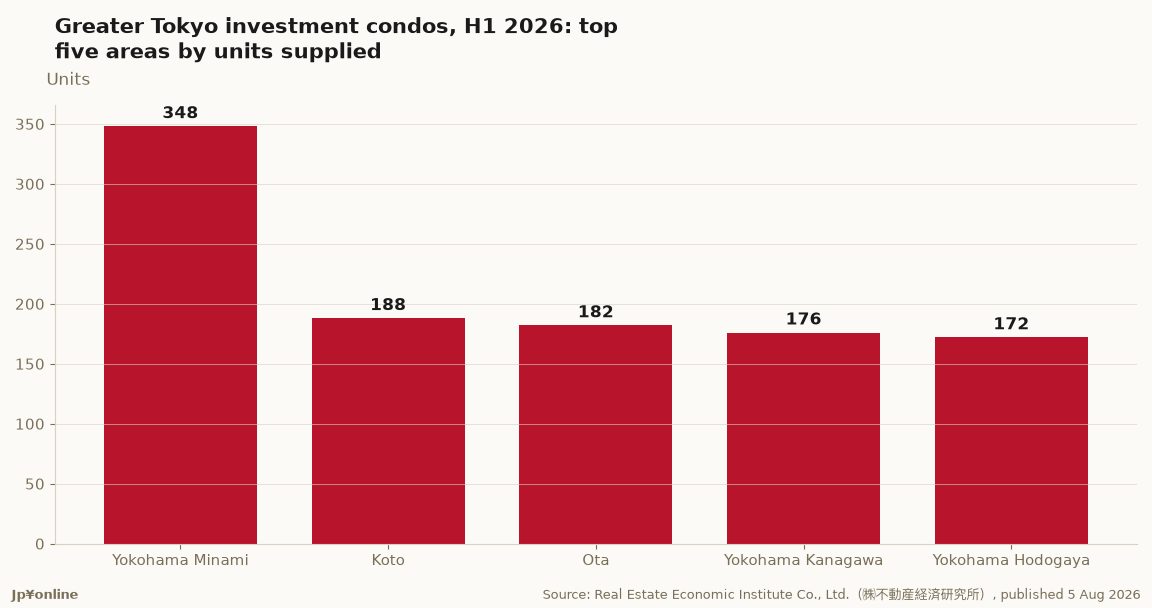
- Yokohama's Minami ward led with 348 units, followed by Koto ward 188, Ota ward 182, Yokohama Kanagawa ward 176 and Yokohama Hodogaya ward 172.
- The top five areas accounted for 44.4% of supply, down 9.7 points from 54.1% a year earlier — supply is spreading out rather than concentrating.
- Yokohama city as a whole supplied 958 units across seven wards and Kawasaki 194 units across three; together the two cities make up 48.0% of the half-year total (our calculation from the published figures).
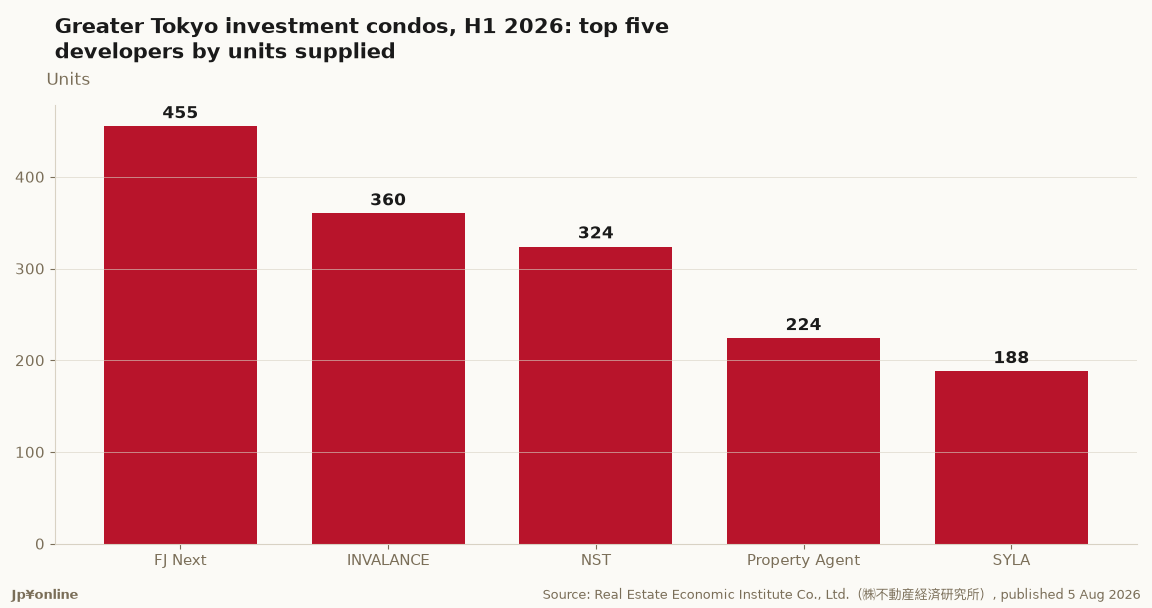
- Top developers: FJ Next 455 units, INVALANCE 360, NST 324, Property Agent 224 and SYLA 188. The top five hold 64.6%, down from 71.6% a year earlier, out of 14 active developers.
- The report's own outlook: land acquisition inside Tokyo's 23 wards remains fiercely contested, so Yokohama and Kawasaki are expected to keep their high share.
This is the first instalment of a line we will now track every half year: investment condominiums in the Greater Tokyo area. These are not the newly built for-sale condominiums we cover monthly — they are roughly 25-square-metre studio units bought to rent out, and they are the most common entry point into Japanese property for overseas buyers.
Supply in the first half of 2026 was 46 projects and 2,401 units, against 42 projects and 1,864 units a year earlier: up 9.5% by project count and 28.8% by units. While the for-sale market is still contracting, this segment is clearly expanding.
The geography matters more than the total. Areas with new supply widened from 20 to 27, and within Tokyo's 23 wards from 8 to 13 — yet the top spot is not in Tokyo. Yokohama's Minami ward led with 348 units, ahead of Koto ward's 188, Ota ward's 182, Yokohama Kanagawa ward's 176 and Yokohama Hodogaya ward's 172. The top five together hold 44.4%, down from 54.1% a year earlier. Add all of Yokohama (958 units across seven wards) to Kawasaki (194 across three) and the two cities account for 48.0% of the half-year total.
The report's stated reason is blunt: land inside Tokyo's 23 wards is fiercely contested, so Yokohama and Kawasaki should keep their high share. For buyers that cuts two ways. New stock inside the 23 wards really is scarce. But budget that simply follows new supply ends up in Kanagawa, where tenant mix, vacancy risk and the eventual resale market all differ from central Tokyo.
Developer concentration is easing too: the top five hold 64.6% against 71.6% a year earlier, across 14 active developers. More competitors usually helps buyers on price, but it also raises the odds of several similar units hitting the same neighbourhood at once.
All figures are from Real Estate Economic Institute Co., Ltd., published 5 August 2026; the two-city share is our own calculation from those figures.