Japan Q2 2026 GDP Grows 1.4% Annualized, a Third Straight Gain — but Net Exports Did Almost All the WorkA · FULL TRANSLATION
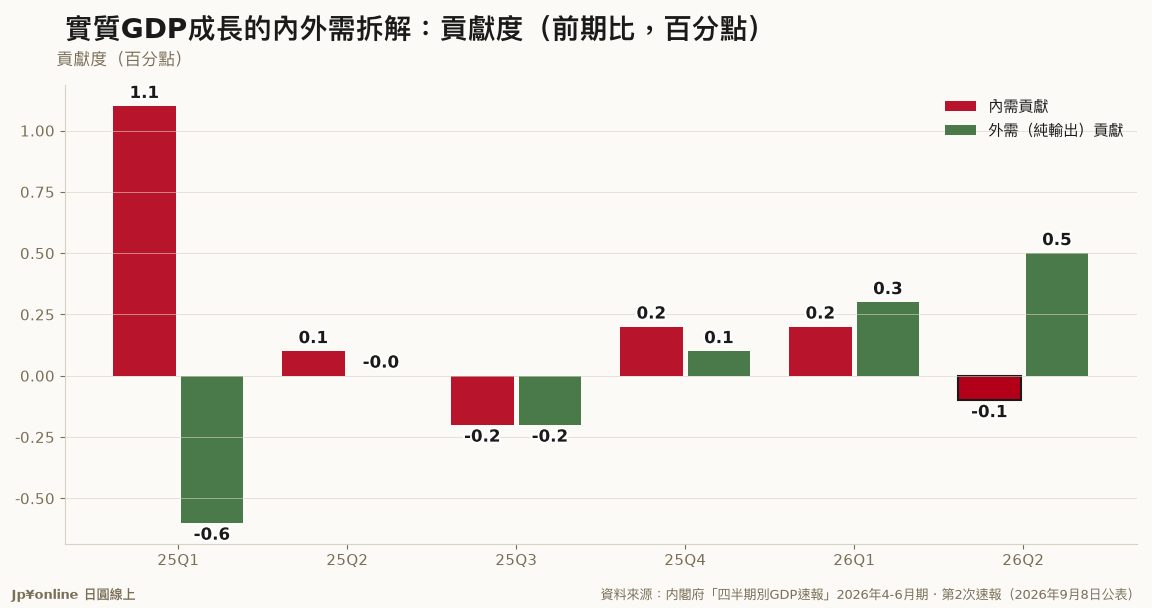
- Q2 2026 (second preliminary): real GDP rose 0.4% q/q, or 1.4% annualized, a third straight quarterly gain (Q1 was +1.9% annualized)
- This series now tracks three things each quarter: the real growth rate, contributions from the four demand components, and the GDP deflator
- Growth came almost entirely from external demand: net exports added 0.5 point q/q while domestic demand subtracted about 0.1 point — private consumption contributed nothing, capex -0.2, and public inventories -0.5 were the main drags
- Nominal vs real: nominal GDP rose 5.5% annualized, far above real 1.4%; the gap is prices. The GDP deflator was up 2.6% y/y (down from 3.2%), so inflation pressure eased but persists
- Versus pre-pandemic: real GDP at about 599.0 trillion yen (seasonally adjusted, annualized) is above the roughly 581 trillion of early 2019 — output has recovered past its pre-COVID level
This series now tracks Japan's GDP each quarter around three things: the real growth rate, how much each of the four demand components (private consumption, private investment, government/public, and external demand) contributed, and the GDP deflator that separates nominal from real. Comparing the same set every quarter is how a trend shows through single-quarter noise.
This quarter (Q2 2026, second preliminary): real GDP rose 0.4% q/q, 1.4% annualized, a third straight gain. On the surface that looks fine, but the composition tells a different story — growth came almost entirely from external demand. Net exports added 0.5 point q/q, while domestic demand as a whole subtracted about 0.1 point. In detail: private consumption contributed zero, residential -0.0, business capex -0.2, government consumption +0.3, private inventories +0.3, but public inventories alone dragged -0.5. Strip out net exports and domestic demand was flat-to-shrinking.
Four benchmarks. Versus last quarter (Q1 2026): annualized growth eased from +1.9% to +1.4%. Versus a year earlier: real GDP was up 0.9%, a touch above the prior quarter's +0.6%. Versus pre-pandemic: real GDP at about 599.0 trillion yen (seasonally adjusted, annualized) is above early-2019's roughly 581 trillion. On the nominal side, nominal GDP rose 5.5% annualized, far above real — the gap is prices; the GDP deflator was up 2.6% y/y, down from 3.2%.
For investors and lodging readers: three straight quarters of growth with output above pre-COVID says the economy's base is holding, but growth leaning on external demand while domestic demand is weak means household spending and business investment have not yet taken the baton — a recovery propped up by exports and inbound is not the same as locals starting to spend.
[Quarterly GDP, Q2 2026 second preliminary — key official results, translated] 1. Real GDP growth. Real GDP (expenditure side, seasonally adjusted) rose 0.4% q/q, an annualized 1.4%. The prior quarter (Q1 2026) was +0.5% q/q, +1.9% annualized. Real GDP was up 0.9% year on year. 2. Contributions to q/q real GDP by demand component (percentage points). Private consumption +0.0, residential investment -0.0, business capex -0.2, private inventories +0.3, government consumption +0.3, public fixed investment -0.0, public inventories -0.5, net exports +0.5. Domestic demand summed to about -0.1 and external demand +0.5, together equal to the +0.4% q/q (rounded). 3. Nominal GDP and deflator. Nominal GDP rose 5.5% annualized (prior quarter +3.1%). The GDP deflator was up 2.6% year on year (prior quarter +3.2%). 4. Real GDP level. Seasonally adjusted, annualized real GDP was about 598.95 trillion yen, versus 596.80 trillion in Q1 2026 and 581.28 trillion in Q1 2019. Note: these are second-preliminary figures, subject to revision at the annual final; component contributions may not sum exactly to the total because of rounding.