Japan Private Demand Q2 2026: Consumption Flat, Housing Down 0.6%, Capex Falls a Second QuarterA · FULL TRANSLATION
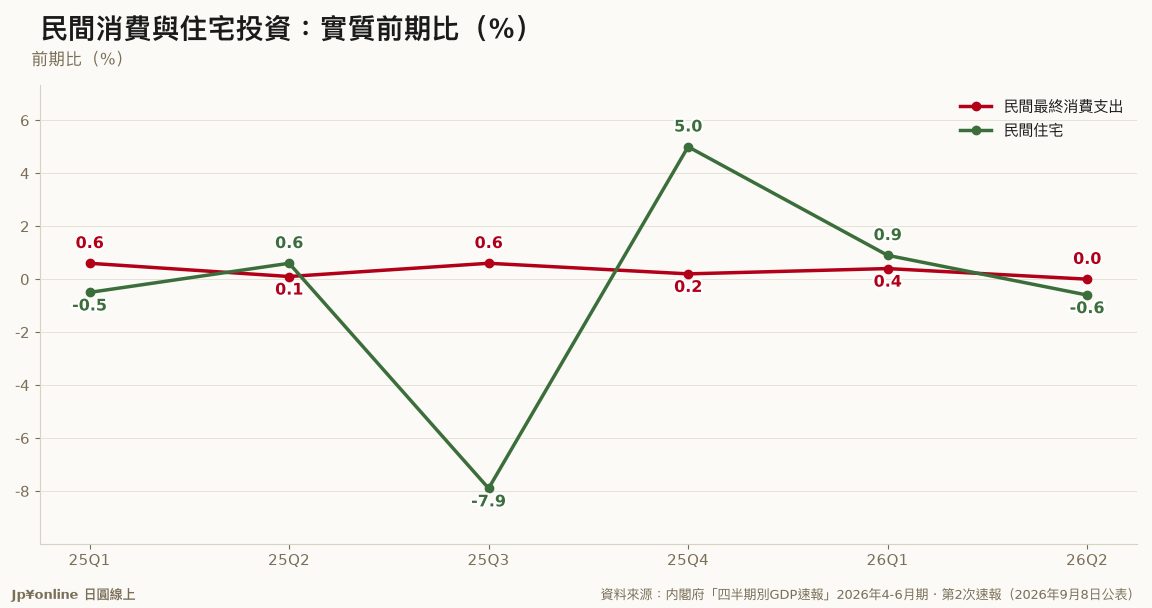
- Q2 2026 second preliminary, real q/q: private consumption +0.0% (annualized +0.0%), residential investment -0.6% (annualized -2.3%), business capex -0.9% (annualized -3.7%)
- This series now tracks three items each quarter — private consumption, residential investment and business capex — as the macro backdrop for housing and domestic demand
- Consumption slowed from +0.4% last quarter to flat; even with real wages turning positive, households did not convert it into spending this quarter — the weakest link in domestic demand
- Residential investment was -0.6%, but it is highly volatile: the prior four quarters were -7.9%, +5.0%, +0.9%, -0.6%, so read it over a longer window
- Business capex fell for a second straight quarter (-1.0% then -0.9%), a softening in private investment that was a main reason domestic demand dragged on GDP
This series now tracks Japan's private domestic demand each quarter through three items: real q/q private consumption, residential investment and business capex. The first is household spending; the latter two are housing and corporate investment. Together they answer whether Japanese people are spending, building and investing — the key backdrop for housing and domestic-facing services.
This quarter (Q2 2026, second preliminary, real q/q): private consumption +0.0%, residential investment -0.6%, business capex -0.9%. All three sit at or below zero; annualized, that is +0.0%, -2.3% and -3.7%.
Consumption is the standout. It was +0.4% last quarter and fell to flat this quarter. At the same time real wages have risen for seven straight months, so households' purchasing power is recovering — yet it did not translate into spending this quarter. There is a lag between rising wages and actual consumption, a signal worth watching for retail, dining and domestic travel.
Residential investment matters most to our readers. It was -0.6%, but it is very volatile: the prior four quarters were -7.9%, +5.0%, +0.9%, -0.6%, largely statistical swings from project-completion timing — read the direction over a year, not a single quarter. Business capex fell for a second straight quarter (-1.0% then -0.9%), a clear softening in private investment and a main reason domestic demand dragged on GDP.
On the four benchmarks: this preliminary is built around the seasonally adjusted q/q change; component-level comparisons versus a year earlier or pre-pandemic levels are not published in the same release, so we report only what the preliminary contains and make no estimates. Overall, all three domestic-demand items softened, and the macro backdrop for housing turned from warm to flat-to-cool.
[Quarterly GDP, Q2 2026 second preliminary — main private-demand components, translated] Real (seasonally adjusted) q/q change: - Private final consumption +0.0% (annualized +0.0%). Prior quarter (Q1 2026): +0.4%. - Private residential investment -0.6% (annualized -2.3%). Prior quarter: +0.9%. Earlier quarters: Q3 2025 -7.9%, Q4 2025 +5.0%. - Business capex -0.9% (annualized -3.7%). Prior quarter -1.0%; a second straight quarterly decline. For reference, contributions to q/q real GDP were +0.0 point for private consumption, -0.0 for residential and -0.2 for capex. Note: second-preliminary figures, subject to revision at the annual final. Business capex and household final consumption use common demand-side and supply-side estimates.