Import Prices & FX Pass-Through | Aug 2026: Import Inflation Eases to 24.8%, Yen-Weakness Contribution Falls From 11.9 to 8.1 PointsA · FULL TRANSLATION
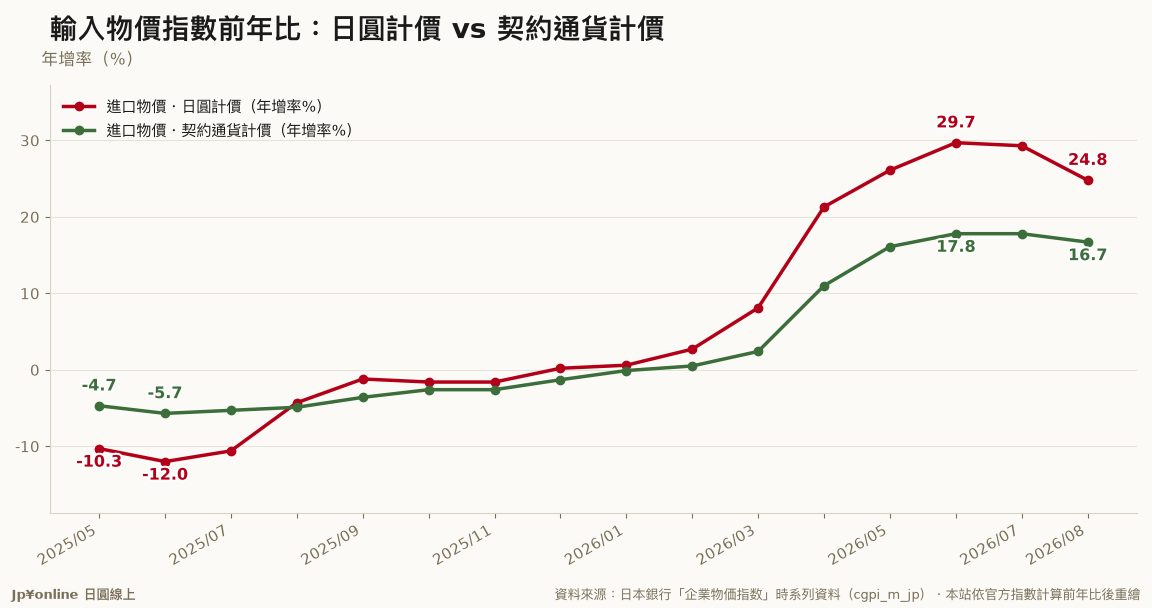
- August 2026 corporate goods prices rose 7.6% YoY (-0.2% MoM), easing for a second month from the peak.
- Yen-based import prices rose 24.8% YoY, down about 4.9 points from June's 29.7%; contract-currency terms +16.7%.
- FX contribution (yen minus contract-currency) was +8.1 points, well below June's +11.9 — the yen-weakness push is fading.
- August USD/JPY averaged 158.7 (up 2.4% MoM), the main driver; a year earlier the FX contribution was just +0.6 point.
- For visitors and buyers: cooler import inflation plus a firmer yen slow the pace at which Japanese goods get pricier in foreign currency.
The push from a weak yen on Japan's import costs is fading. In the August 2026 corporate goods price index released by the Bank of Japan on 11 September, yen-based import prices rose 24.8% year on year, down about 4.9 points from June's 29.7%. The FX contribution — yen-based inflation minus contract-currency inflation — also fell from +11.9 points in June to +8.1. Each edition this series asks one question: of the rise in import costs, how much is the goods themselves and how much is simply a weak yen? In August, the yen's share is shrinking, driven by an August USD/JPY average of 158.7 (up 2.4% on the month) and a higher year-ago base. Headline corporate goods prices rose 7.6% year on year (-0.2% on the month), easing for a second month. For those planning spending or property purchases in Japan, the signal is directional: cooler import inflation and a firmer yen mean Japanese goods are getting more expensive in foreign-currency terms more slowly.
When we last tracked this series (June 2026), Japan's import prices were up 29.7% year on year in yen terms and 17.8% in contract-currency terms; the gap between the two — the pure FX contribution — was a hefty +11.9 percentage points, meaning nearly 40% of the import-cost surge came simply from a weak yen. In the August flash reading (released by the Bank of Japan at 08:50 on 11 September), that force clearly faded: yen-based inflation slowed to +24.8%, contract-currency inflation to +16.7%, and the FX contribution narrowed to +8.1 points.
Two forces overlapped. First, the yen stopped falling in one direction: the August average USD/JPY was 158.7, a 2.4% appreciation from the prior month (a minus sign denotes yen strength in the BOJ's convention). A firmer yen shrinks the yen-converted rise of the same foreign-priced imports. Second, the base effect: a year ago (August 2025) import prices were still falling (-4.4% in yen, -5.0% in contract currency, FX contribution just +0.6 point), so this year's denominator is no longer low.
Across four benchmarks: versus the prior edition (June) the FX contribution is down 3.8 points and headline import inflation down 4.9 points; versus a year earlier it has widened from +0.6 to +8.1 points; and in index-level terms the August yen-based import-price index stands at 193.7 (2020 average = 100), still about 90% above the base — the long-run expensiveness remains, but this year's extra blow from yen weakness is easing.
Note a discontinuity: the BOJ also published a scheduled retroactive revision of the corporate goods price index on 11 September; historical points here follow previously published values, with only July and August appended. For visitors and property buyers the read is directional — cooler import inflation plus a firmer yen means Japanese goods are getting more expensive in foreign-currency terms more slowly, not cheaper.