【Trade Balance|Aug 2026】Monthly Deficit Widens to ¥1.106tn, Nearing January's Trough — Exports +19.3% Trail Imports +28.0%A · FULL TRANSLATION
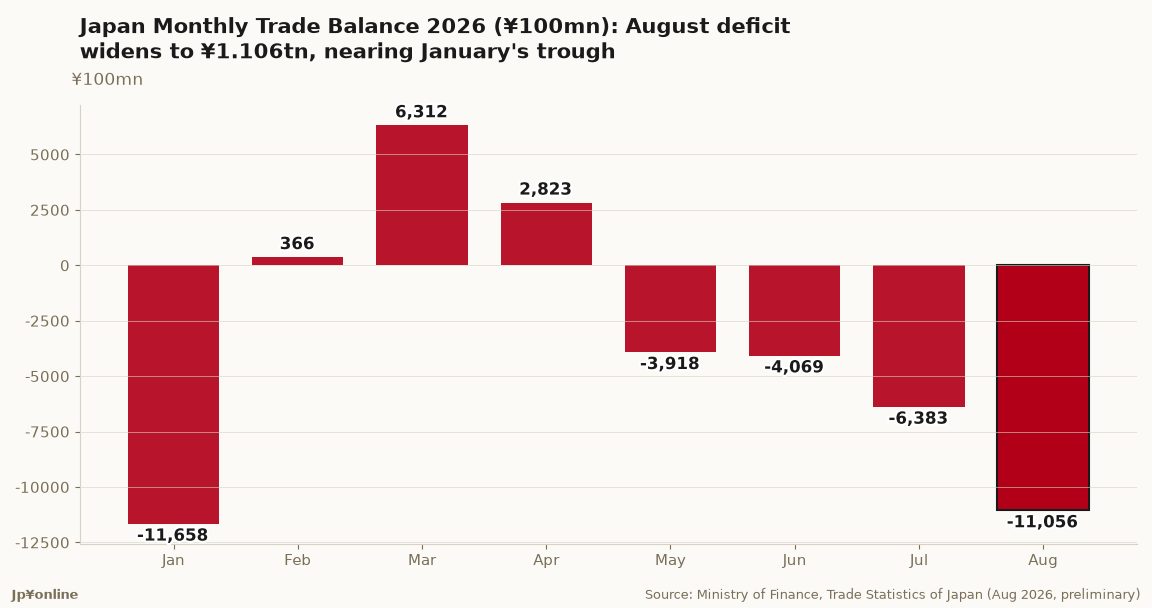
- August's trade deficit widened to ¥1.106tn, up nearly ¥700bn from June (-¥406.9bn, our last write-up) and close to January's ¥1.166tn trough.
- Exports ¥10.05tn (+19.3% YoY); imports ¥11.15tn (+28.0% YoY) — import growth outpaced exports for a second straight month, widening the gap.
- A year earlier the deficit was just ¥294.1bn, so on a YoY basis the deficit widened 275.9%; the Jan-Aug 2026 cumulative deficit is about ¥2.76tn.
- July's ¥638.3bn deficit (not written up separately) is added here and to the charts; the deficit widened for two straight months (July and August).
This series tracks one thing: whether Japan's monthly trade runs a surplus or a deficit, and how that moves with the yen. The last time we covered it on its own was June 2026, when the monthly deficit was ¥406.9bn. Today's Ministry of Finance preliminary release for August shows the deficit widening sharply to ¥1.106tn — close to January's ¥1.166tn trough. July's deficit of ¥638.3bn, which we hadn't written up separately, is added to the charts here so the two-month widening is clear.
Exports rose 19.3% to ¥10.05tn — not bad — but imports jumped 28.0% to ¥11.15tn, outpacing exports for a second straight month and pushing the gap wider. Imports are especially sensitive to the yen: when the yen is weak, the same volume of energy and raw materials costs more in yen terms.
For readers watching the yen, a widening goods-trade deficit is a structural weak signal that drags on the currency from the fundamentals side. Our last logged monthly average was June's 160.69 (BOJ series); August's average awaits BOJ publication. Next period we'll add September's point and see whether the deficit narrows or sets a new low.
[Ministry of Finance, Trade Statistics of Japan (Preliminary), August 2026 — Summary translation]
Release date: 16 September 2026. Reference period: August 2026 (Reiwa 8).
1. Totals (year-on-year change vs the same month a year earlier) Exports: ¥10.05tn, up 19.3% year on year. Imports: ¥11.15tn, up 28.0% year on year. Balance: a deficit of ¥1.106tn. A year earlier the balance was a deficit of ¥294.1bn, so the deficit widened by 275.9%.
2. Comparison with the same month last year August 2025: exports ¥8,420.1bn, imports ¥8,714.2bn, deficit ¥294.1bn. Both exports and imports grew this year, but because import growth (+28.0%) exceeded export growth (+19.3%), the trade deficit widened substantially from a year earlier.
3. By region (preliminary) Asia: exports ¥5,752.9bn (+21.4%), imports ¥5,422.7bn (+29.0%), leaving a surplus of ¥330.1bn with Asia. Detailed breakdowns by partner (China, the United States, etc.) appear in the regional tables of the original release.
4. On preliminary figures These are preliminary values and may be revised when the finalized figures are published. Amounts are compiled from customs-clearance results under the Ministry of Finance's trade-statistics accounting standards. For full commodity- and region-level detail and trade indices, please refer to the original data published on the Ministry of Finance Trade Statistics website.
(This is an editorial summary translation prepared by jpyonline under the Standard Terms of Use for Public Data (Ver 2.0); the official Ministry of Finance release prevails for the original data and complete tables.)