2025 Japanese Inbound Tourism Market Redrawn: China Surges to Top with 30.4 Million Stays, US and Europe Rise SteadilyA · FULL TRANSLATION

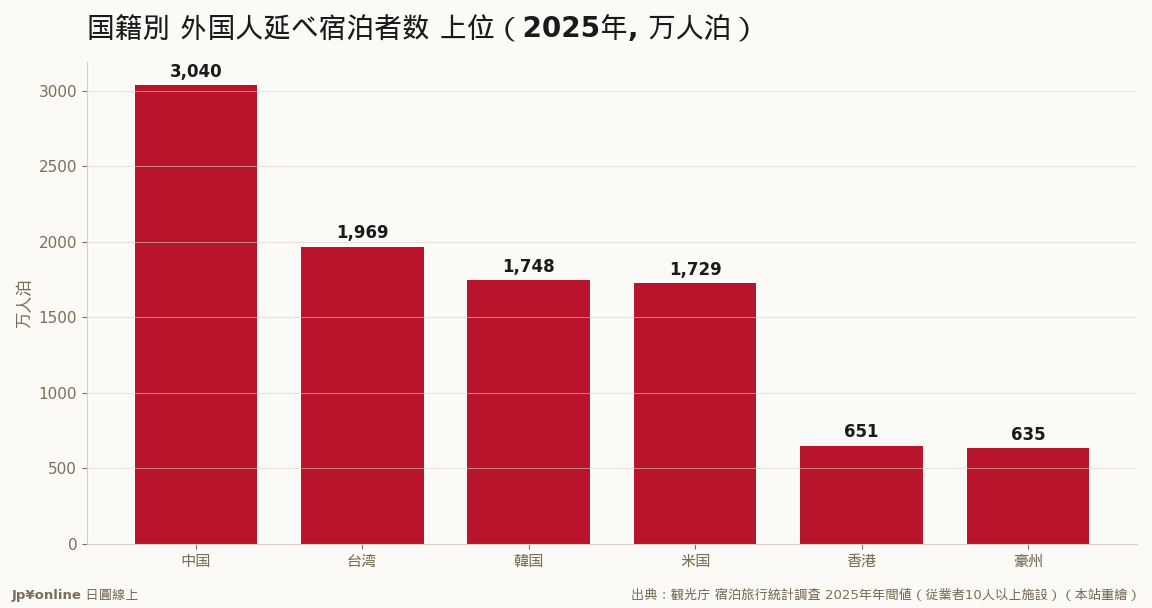
- China reclaims top spot with 30.4 million stays (+20.6%), Taiwan second at 1,969 million stays (+7.0%)
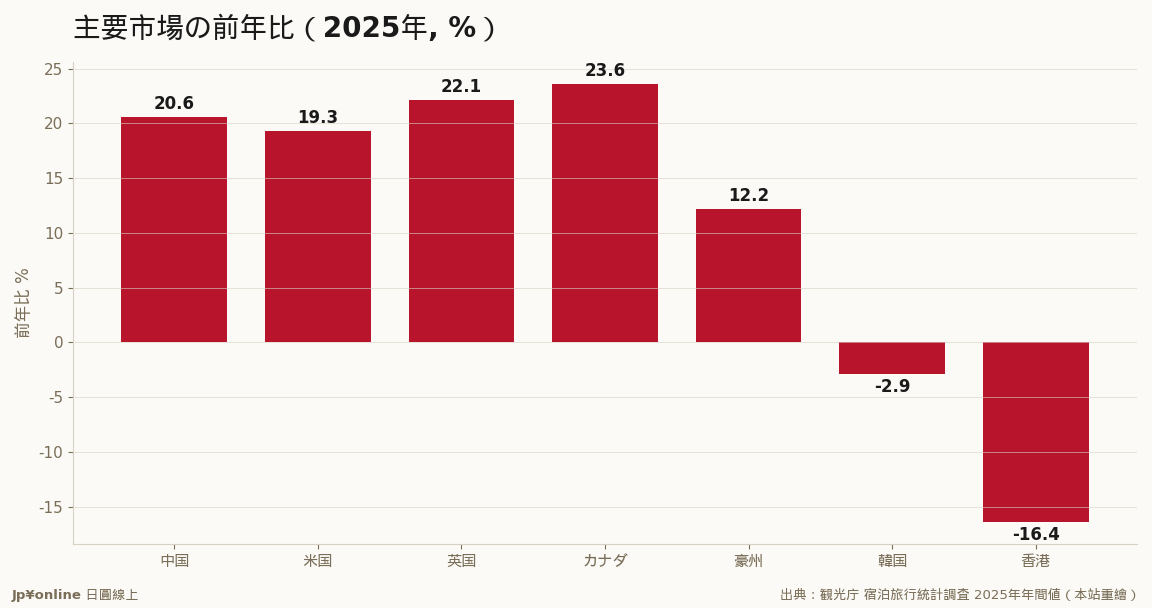
- Three forces driving the change: Chinese return, steady growth in US/Europe, and decline of nearby markets (South Korea -2.9%, Hong Kong -16.4%)
- Emerging markets surge (Russia +105.3%, India +42.9%); market diversification increases
- Choosing the right customer base equals choosing your business model: urban shopping and drug stores with China, local experiences and long-term stays with US/Europe
- Warning signs include political risks from a single market (China), potential reversal of weak yen benefits, and early warnings from neighboring markets like Hong Kong
The inbound tourism market landscape in Japan for 2025 has been redrawn. With a surge of 20.6% to 30.4 million stays, China reclaims the top spot from Taiwan and Hong Kong. Meanwhile, the US, UK, and Canada experience double-digit growth (up 19.3%, 22.1%, and 23.6%, respectively). South Korea and Hong Kong both see a decline of 2.9% and 16.4%, respectively. The source of visitors is shifting towards multi-engines including China’s return, long-term growth in the US and Europe, and new emerging markets like Russia and India.
The analysis desk concludes that the inbound tourism market landscape for Japan in 2025 has been significantly reconfigured. With a surge of 30.4 million stays from China (19.8%, +20.6%), Taiwan (1,969 million stays, +7.0%) retains its second position. The key drivers are threefold: the return of Chinese visitors; steady growth in US and Europe (+19.3% for the US, +22.1% for the UK, and +23.6% for Canada); and a decline in South Korea (-2.9%) and Hong Kong (-16.4%). Emerging markets like Russia (+105.3%) and India (+42.9%) also make significant contributions.
The dominant players—China (19.8%), Taiwan (12.8%), South Korea (11.4%), the US (11.3%), and Hong Kong (4.2%)—account for 59.5% of total inbound stays, making the market highly concentrated among these sources. The story is defined by both the rise of China and the decline of its neighbors like South Korea and Hong Kong.
The first force driving this change is 'Chinese return.' Despite economic and emotional constraints in 2024, Chinese tourists have returned to boost inbound tourism significantly (30.4 million stays, +20.6%). The second major factor is the steady growth of long-term US and European visitors (+19.3% for the US, +22.1% for the UK, +23.6% for Canada, +29.9% for Germany, +27.3% for Spain), benefiting from a weak yen that makes Japan an attractive destination. The third factor is the decline of nearby markets (South Korea -2.9%, Hong Kong -16.4%), with Russia and India presenting new opportunities.
Understanding which market is rising or falling is crucial rather than focusing on total numbers. Different sources mean different business models: Chinese tourists favor urban shopping, drug stores, and high traffic; American, British, and Canadian tourists seek experiences and local immersion with higher spending power in off-peak seasons; while Taiwan, South Korea, and Hong Kong are frequent short-stay return customers.
Three warnings to keep in mind: the dual nature of China’s influence, potential reversal due to a stronger yen, and cautionary signals from neighboring markets like Hong Kong and South Korea. New emerging markets such as Russia (+105.3%) and India (+42.9%) offer significant growth opportunities.
For Taiwanese operators, strategic decisions on customer base are critical: focus on urban shopping and duty-free products with Chinese tourists; engage long-term US and European travelers for luxury experiences and cultural immersion.