Monthly Report: A 4.2% Drop in Accommodation Despite Annual HighA · FULL TRANSLATION

- December 2025 nationwide accumulated overnight stays at 53,590,000 (-4.2%)/domestic visitors at 38,120,000 (-4.9%)/foreign visitors at 15,470,000 (-2.3%)
- Contradiction: full-year foreign accommodation hit an all-time high of 177,870,000 people nights (up 8.2%), yet December showed a month-to-month decline—due to the exceptionally strong base in December 2024 (+26.2%)
- Main drop was domestic tourists (-4.9%); foreign visitors declined less and purely due to base effects, with room occupancy rates at 59.7% still higher than in December 2024
- Practical advice for Taiwanese investors: do not misinterpret single-month red numbers; use conservative low-season occupancy rates for cash flow forecasts; focus on January-February 2026 foreign visitor numbers to determine if base period effects have reversed or growth has truly slowed
In December 2025, nationwide accumulated overnight stays reached 53,590,000 (down 4.2%), with even the strongest foreign visitors down by 2.3%. However, full-year foreign accommodation exceeded 177,870,000 people nights, a record high—underscoring the year-over-month decline despite annual growth. The key is understanding the impact of an exceptionally strong December 2024 (up 26.2%) as a base for comparison in January 2025, making any month-to-month dip more of a mathematical anomaly than a sign of demand collapse.
【Concluding Analysis】The December 2025 accommodation statistics present a misleading signal: nationwide accumulated overnight stays amounted to 53,590,000 (down 4.2%), with even the strongest foreign visitors down by 2.3%. Yet, full-year foreign accommodations hit an all-time high of 177,870,000 people nights, up 8.2%—contradicting a month-to-month decline. For Taiwanese readers interested in Japan’s hospitality and real estate markets, understanding this 'high year, low month' anomaly is more important than being scared by the monthly red numbers. It's largely due to an inflated base period rather than a demand crash.
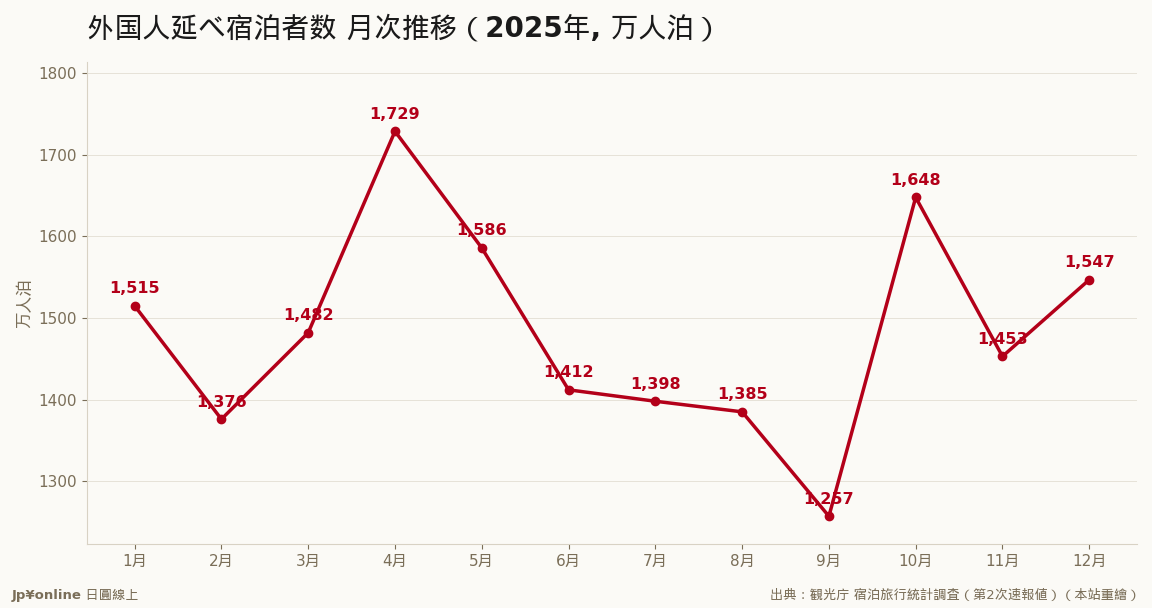
【Unpacking the Contradiction】In December 2025, total overnight stays amounted to 53,590,000 (down 4.2%), with domestic visitors at 38,120,000 (down 4.9%) and foreign visitors at 15,470,000 (down 2.3%). But looking at the year as a whole: foreign stays reached 177,870,000 people nights, up by 8.2%, setting a historical record. Why is there an annual high but a month-to-month decline? The key lies in comparing bases. December 2024 saw foreign visitors surge by 26.2%, an unusually high base period, making the same month in 2025 easier to show negative growth compared to 2023. This is typical 'reversal' (base period effect) where looking at monthly changes can be misleading; focusing on absolute numbers is more accurate—December 15,470,000 nights were still among the highest of non-peak months.
【Decoding the Numbers: Main Drop is Domestic】The drop was not driven by foreign visitors but domestic tourists (down 4.9%). Higher prices and squeezed real wages have dampened domestic tourism in December as seen throughout the year where domestic stays were down 3.8%. Foreign visitor numbers dropped only slightly (-2.3%), purely due to base effects; room occupancy rates at 59.7% in December still exceeded those of the same month in 2024—reflecting fewer older hotels closing rather than a real decline in visitors. Looking at the longer trend, foreign stays peaked in April (17,290,000) and October (16,480,000), supported by spring cherry blossoms and autumn foliage; September saw a dip to 12,570,000 before climbing back up to 15,470,000 in December. Using the previous year's comparison for an entire market definition during a transition month is misleading.
【Counter-Argument】While not all pessimistic, it’s important to note that a single-month negative foreign visitor trend since early 2024 might indicate slowing growth if sustained into early 2026. Additionally, the persistent decline in domestic demand could make peak seasons unsustainable and off-seasons even colder. Lastly, December is typically a quieter season with mixed high domestic demand from year-end events, making single-month fluctuations more pronounced.
【Practical Advice for Taiwanese Readers】Firstly, don't be misled by monthly red numbers: the full-year 2025 saw record foreign visitors despite some months turning negative. Focus on annual and absolute figures. Secondly, expect increased seasonal volatility in cash flow forecasts; use low season occupancy rates as a conservative scenario rather than relying on peak seasons. Thirdly, monitor January-February 2026 foreign numbers to determine if the base period is still positive or if growth has truly slowed—considering Lunar New Year timing can also impact monthly fluctuations.
【Next Steps】Firstly, verify whether December's drop was a base period effect or a trend by looking at January 2026 foreign accommodation data. Secondly, monitor any domestic tourism recovery signals tied to real wage stabilization as inflation subsides. Thirdly, pay attention to the revised figures for December 2025 based on June 30, 2025.