January 2026 CPI Falls Below 2% for the First Time in 3 Years and 10 Months—But Core Core Still at +2.6%A · FULL TRANSLATION
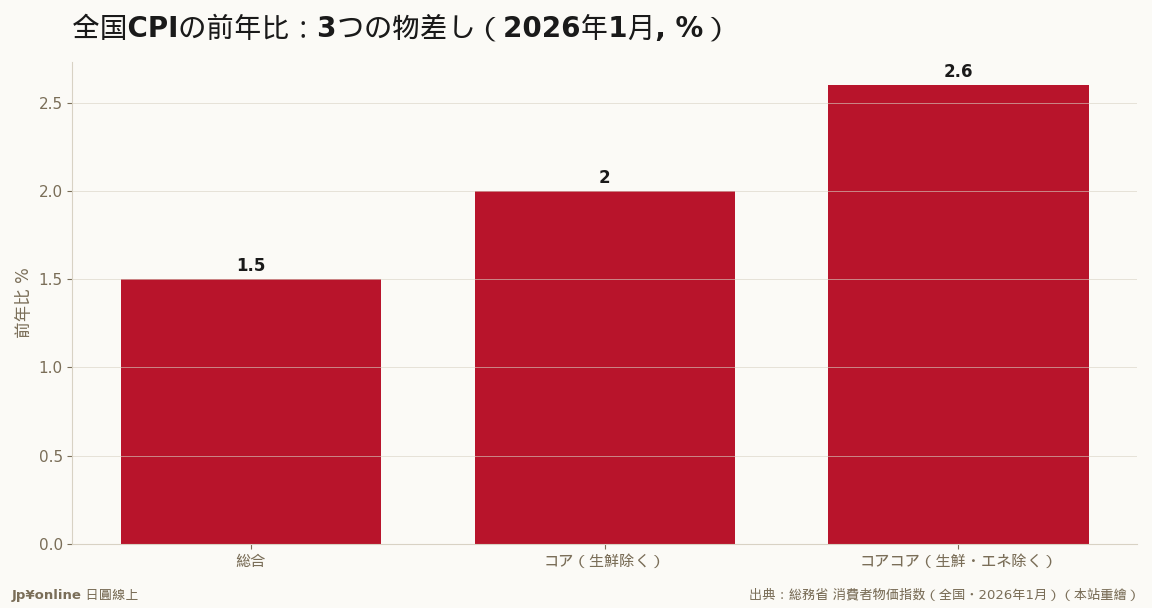
- Total CPI fell to +1.5%, first below 2% in 3 years and 10 months since March 2022; Core CPI excluding fresh food slowed to +2.0%
- Core-core (excluding both energy and fresh food) still at +2.6%—reduction mainly from policy-controlled energy prices, domestic demand inflation persists
- Energy prices significantly reduced: gasoline tax rate abolished, electricity and urban gas support restarted; expected -10% year-on-year in Feb-Mar 2026, Core CPI may dip to 2% (after 3 years and 11 months)
- Food excluding fresh still +6.7% for fifth consecutive month—continues to press household wallets; implications for yen and mortgage rates: rate hike urgency decreases, but core-core +2.6% indicates inflation persists
- Use Core CPI rather than headline numbers, weak yen window remains open but focus on subsidy withdrawal and weak yen-driven import food increases, central Tokyo CPI as free leading indicator
Japan’s overall consumer price index (CPI) for January 2026 fell to a year-on-year increase of just +1.5%, marking the first time in 3 years and 10 months since March 2022. The core CPI excluding fresh food slowed to +2.0% from December’s +2.4%. However, the core-core, which excludes energy, remained at +2.6%. While the decrease is largely due to policy-driven reductions in energy prices, domestic demand-induced inflation persists. For Taiwanese readers tracking the yen and Japanese mortgage rates, this “fall” below 2% is partly a result of policy measures, making Core Core more reflective of reality than headline numbers.
【Concluding Summary】The Ministry of Internal Affairs and Communications released Japan’s national CPI for January 2026 on February 20, 2026. The overall inflation rate fell by another notch: the broadest measure, 'total', saw a year-on-year increase of +1.5%, which is the first time it has fallen below 2% in 3 years and 10 months since March 2022; the core CPI (excluding fresh food), a key reference for market participants, slowed to +2.0%. However, inflation is far from cooling down—core-core, excluding energy, remains at +2.6%. The reduction primarily stems from policy-controlled energy prices rather than natural demand decline.
【Breaking Down the Three Levels of CPI】Japan’s CPI has three levels: total (including all items), core (excluding fresh food, valued by the Bank of Japan and market participants), and core-core (excluding both energy and fresh food). The downward trend is consistent across all measures, but the gap is crucial. While total and core have fallen to around 2%, core-core remains high at +2.6%. This indicates that most of the inflation slowdown has come from directly controlled energy prices rather than a natural decline in demand.
【Analysis: Policy’s Hand on Energy Prices】The main driver behind this deceleration is energy. The temporary tax rate on gasoline was lifted, and support measures for electricity and urban gas were reactivated, significantly lowering year-on-year price increases. According to analysis by the Nichiyu Basic Research Institute, energy prices are expected to fall nearly -10% in February and March 2026. As energy prices drop, so do total and core CPIs. However, food prices (excluding fresh) continue to rise at +6.7% for a fifth consecutive month—still a burden on household budgets. The cold snap of energy cuts and the heatwave of rising food costs highlight this data’s true picture: while headline numbers look good, underlying inflation in food and services remains high.
【Why This Matters for Yen and Mortgage Rates】The only legitimate reason for Bank of Japan (BoJ) rate hikes is sustained 2% inflation. With total CPI below 2%, and a forecasted dip in core CPI to 2% in February (3 years and 11 months since March 2022), the urgency for rate hikes has decreased, making the yen weaker in the short term (due to reduced interest rate differentials). For those with Japanese adjustable-rate mortgages, this provides temporary relief. However, as long as core-core CPI stays at +2.6%, BoJ will not abandon its path of rate hikes, bringing good news for mortgage holders with a limited shelf-life.
【Practical Lessons for Taiwanese Readers】Firstly, don't interpret the fall below 2% as the end of inflation; it's driven by policy measures that can reverse once subsidies are withdrawn. Core CPI is more reliable than headline numbers (still at +2.6%). Secondly, the window for a weaker yen remains open: reduced rate hike expectations will weaken the yen in the short term, benefiting tourists, foreign currency exchanges, and imports. However, monitor when energy subsidies end and how rising import food prices impact overall costs. Lastly, use central Tokyo CPI as a free leading indicator; it is published a month earlier and offers insights into national trends.
【What to Watch Next】Firstly, whether core CPI will dip below 2% in February 2026 will determine the BoJ’s next move. Secondly, when energy subsidies are withdrawn will dictate how soon suppressed energy prices rebound. Thirdly, can core-core CPI ease from +2.6%—only if domestic demand inflation subsides, will interest rate hikes be less of a threat.