Analysis: New Residential Construction in May Up 33.9% Reflects Baseline EffectA · FULL TRANSLATION
- May new residential construction up 33.9% (2 consecutive months of increase): owner-occupied +31.8%, rental +33.3%, sales +39.2% (apartments +37.6% after 5 months of first increase, detached houses +38.7%) = all types increased uniformly due to baseline effect
- Mirror reflection: May 2023 is up from the lowest point in April 2025 (-34.4%), a result of building code changes; March -29.3%, April +11.4%, and now May +33.9% = all three months showing positive year-over-year growth
- Honest numbers: seasonally adjusted annual rate at 757,000 units in May, first increase in five months, indicating a slight upward trend; January to May cumulative down 2.8%
- Apartment market: cumulative -16.3%, but sales up 90.5% in the Kanto region and 161.2% in the Chubu region vs -20.5% in Kansai, reflecting supply-side dynamics
- Japan-specific insights: new construction numbers are heavily influenced by baseline effects; take seasonally adjusted annual rates and cumulative figures for accurate analysis
The Ministry of Land, Infrastructure, Transport, and Tourism reported that 57,877 new residential units were started in May 2023, a 33.9% increase from the same month last year. This includes a 31.8% rise in owner-occupied homes, a 33.3% increase in rental properties, and a 39.2% jump in sales (with apartments up 37.6% after five months of first increases). However, this is largely due to the low baseline from May 2025 when construction was hit hard by building code changes. The cumulative figure for January to May stands at -2.8%. Seasonally adjusted annual rates show a slight upward trend with an increase in May to 757,000 units.
Conclusion: The May 2023 new residential construction figure of 57,877 units is a significant increase from last year (+33.9%). However, it reflects the low baseline set by April 2025 (-34.4%) due to building code changes. The cumulative figure for January to May remains -2.8%. The seasonally adjusted annual rate of 757,000 units in May is a first increase in five months and indicates a slight upward trend.
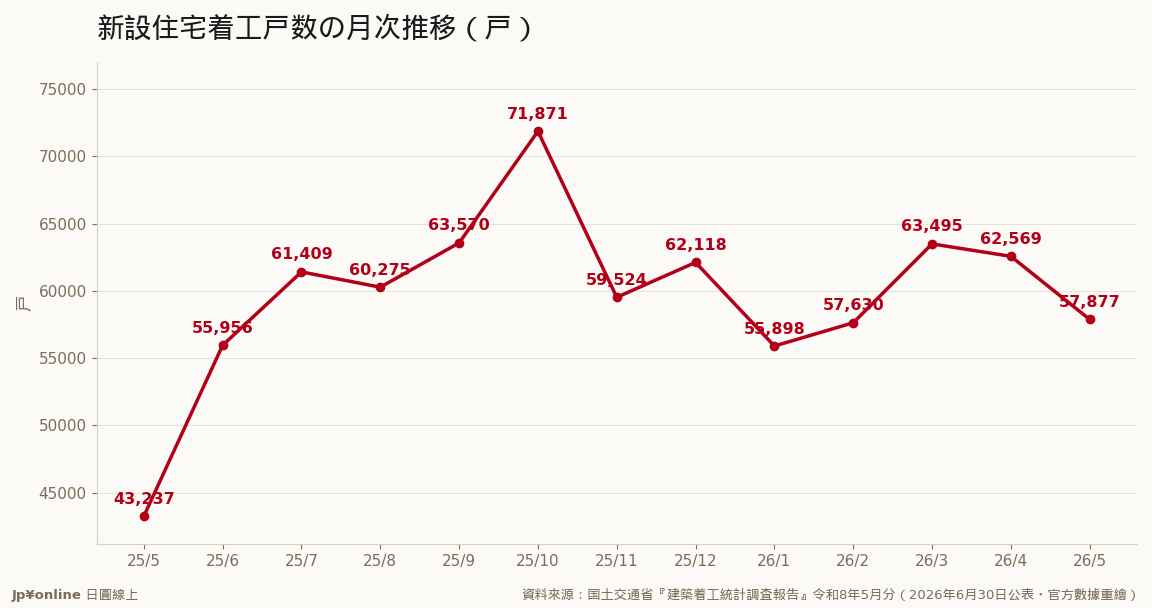
Key metrics: new residential construction refers to the actual number of residential units started in a given month, representing the upstream end of the housing supply chain. It takes about 1.5-2 years from start to completion for apartments and around half that time for detached houses. Today's figures determine the new house supply and workloads for the construction industry starting in 2027-28. Two canes are used to interpret monthly numbers: year-over-year comparison (affected by baseline distortions) and seasonally adjusted annual rate (removes seasonal effects, providing a yearly pace).
Breaking down the figures: all categories increased uniformly—owner-occupied +31.8%, rental +33.3%, sales +39.2% (apartments +37.6% after five months of first increase, detached houses +38.7%) and floor area +34.1%. This is a typical baseline effect: May 2025 was the lowest point for all categories (-34.4%), and this year each category is rising from that low.
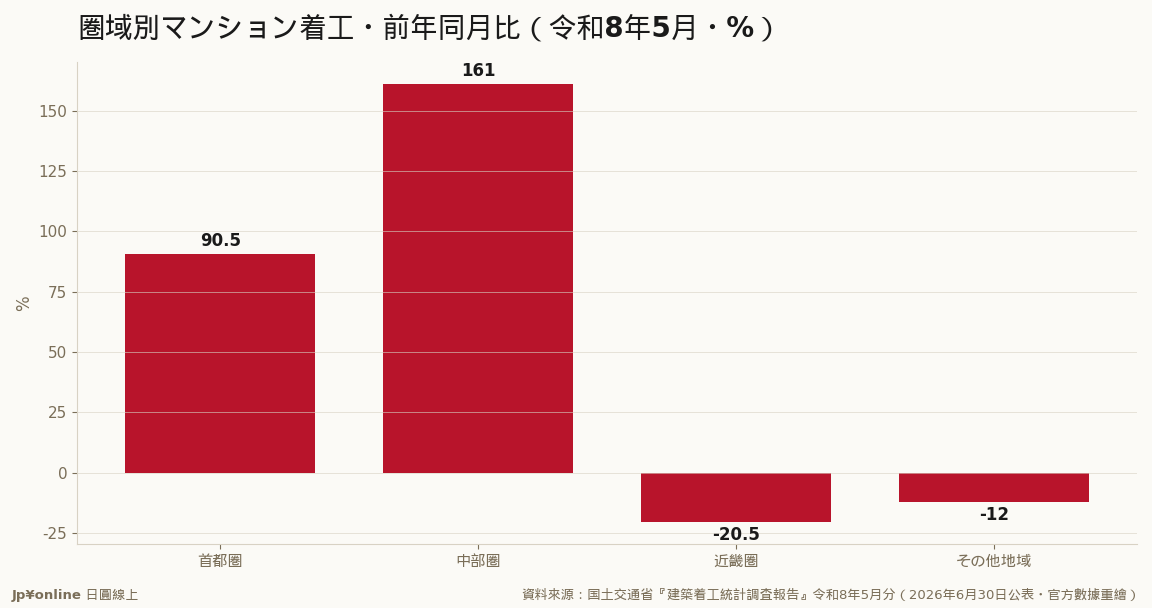
The apartment market's numbers are mixed. Monthly increases look strong, but cumulative figures show otherwise: January to May saw a decrease of -16.3%, with apartments accounting for 39.9% of sales (down from 41.3% in the previous year). Regional data further highlight the case-by-case nature of monthly numbers: Kanto region +90.5%, Chubu region +161.2% (due to large-scale projects), vs -20.5% for Kansai and -12.0% elsewhere. The long-term contraction in apartment starts has not been reversed by the recent monthly increases, aligning with real estate research predictions of low supply levels in 2026.
Overall numbers show an increase across regions: Kanto +35.4%, other areas +40.2%, Kansai +27.1%, Chubu +22.3%—'Other areas' led the nation with a 40.2% increase, reflecting strong recovery in owner-occupied and rental properties from their lowest points. Combining April and May figures can filter out monthly noise: 8,596 units combined for April and May up 21.1%, compared to -30.2% in the same period of 2022—showing a rebound following a significant decline.
The apartment market's share as a percentage of total sales has been declining over three years: from 45.8% in fiscal year 2021 to 41.3% in 2022, and now at 39.9%. This trend indicates that the construction industry is increasingly focusing on detached houses rather than apartments, reflecting both supply-side dynamics and demand patterns.
Counter-argument: There are also signs of genuine recovery. The seasonally adjusted annual rate has increased for two consecutive months, with owner-occupied and rental properties showing synchronized increases in monthly figures. This could indicate that the practical implementation of building code changes is complete, and pent-up demand is returning. Additionally, there might be a