Tokyo Prime Office Vacancy Falls Below 2% for First Time in 5 Years
- June central-Tokyo (5 wards) office vacancy 1.99%, -0.08pt MoM, first sub-2% since June 2020
- Down 1.38pt YoY from 3.37% a year earlier
- By ward: Shibuya 1.11% and Chiyoda 1.26% tightest; Chuo 2.84% loosest
- Existing buildings 1.80% still falling; new-build vacancy 13.09% (+1.31pt) the caveat
- Net vacant area in the 5 wards shrank ~6,900 tsubo in June
Miki Shoji's July report shows central Tokyo office vacancy at 1.99% in June, the first sub-2% level since June 2020 and down from 3.37% a year ago. Vacancy is the most direct supply-demand gauge in commercial real estate: the lower it goes, the more pricing power shifts to landlords. Shibuya (1.11%) and Chiyoda (1.26%) are extremely tight; Chuo (2.84%) is looser but improving. It signals a consolidating landlord's market, though new-build vacancy rising to 13.09% is the variable to watch.
[Conclusion] Treat office vacancy as commercial real estate's thermometer and Tokyo just crossed a threshold: the central five wards fell to 1.99% in June, back under 2% for the first time in five years. It is a year-long downtrend, not a one-month blip.
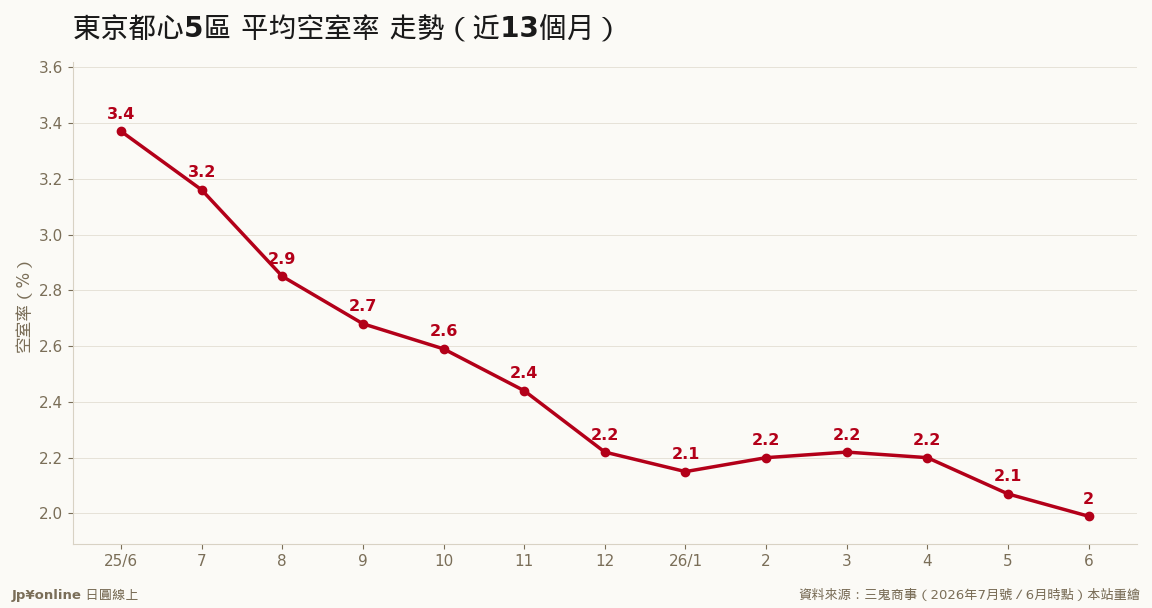
Miki Shoji tracks ~2,577 central-Tokyo buildings. The 5% line is the market's rough divide between a tenant's and a landlord's market; Tokyo has gone from 3.37% a year ago to 1.99% now, tighter than Osaka (3.07%) or Yokohama (5.31%).
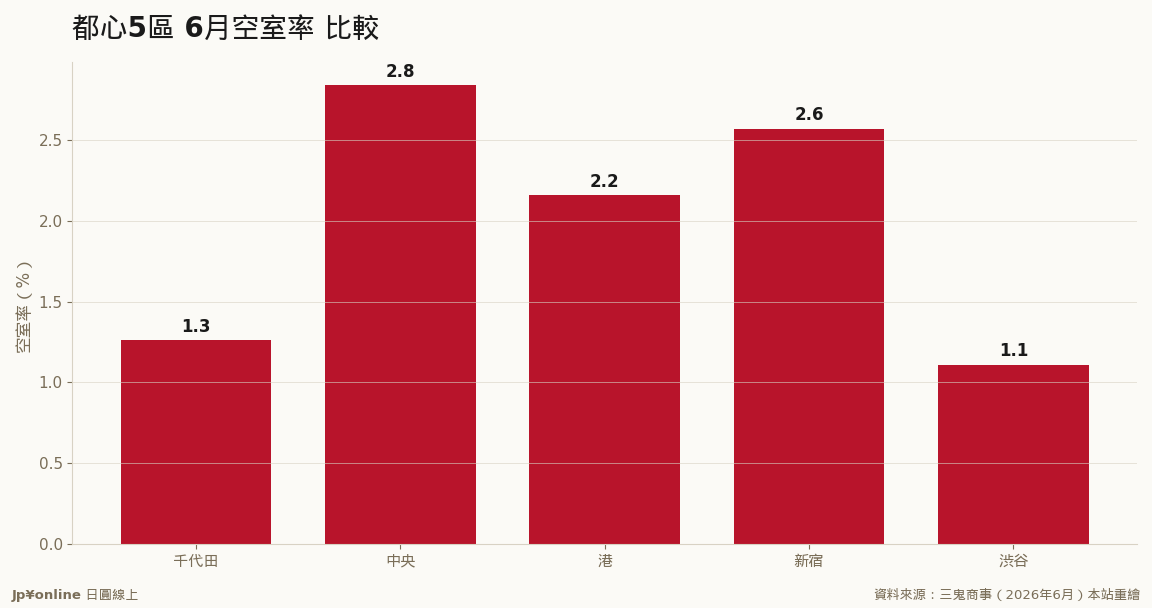
Averages mislead — by ward, Shibuya (1.11%) and Chiyoda (1.26%) are effectively full, while Chuo (2.84%) and Shinjuku (2.57%) still offer room. For investors that is where yield-plus-absorption still exists. The one counter-signal: new-build vacancy rose to 13.09% (+1.31pt), a reminder that the tightness rests on existing stock while fresh supply is still being absorbed.