Japan's 60 Million Target: H1 2026 Annualises to 41.8 Million, 69.7% of GoalA · FULL TRANSLATION
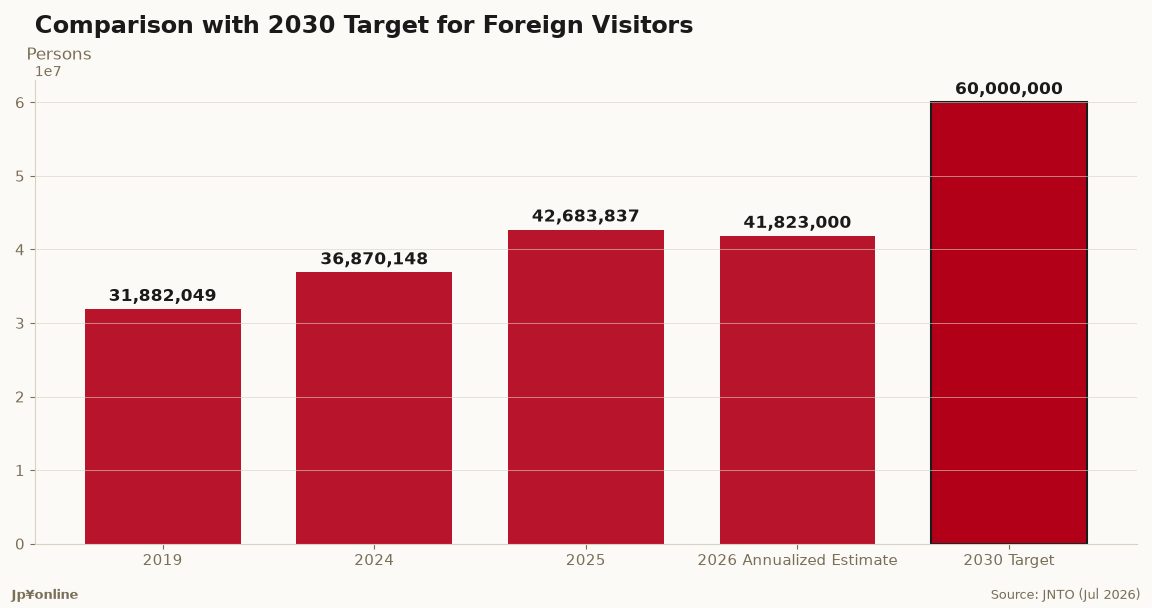
- First-half 2026 arrivals of 21,084,800 annualise to about 41.8 million using the 2025 first-half-to-full-year ratio.
- That is 69.7% of the 2030 target of 60 million; full-year 2025 arrivals of 42.68 million represented 71.1%.
- Reaching 60 million by 2030 from an annualised 41.8 million requires roughly 9.4% compound annual growth for four years.
- The Fifth Basic Plan for Promoting a Tourism-Oriented Country, adopted 27 March 2026, keeps the 60 million and 15 trillion yen targets.
- The plan adds targets of 40 million repeat visitors, 250,000 yen per-visitor spending and 130 million regional overnight stays.
Placing the first half's 21,084,800 arrivals against the 60 million target depends on how you annualise. Using 2025's split, where the first half was 50.4% of the year, the full year comes to about 41.8 million, or 69.7% of target. Using 2024's 48.2% gives 43.7 million; using 2019's 52.2% gives 40.4 million. The three methods bracket 40.4 to 43.7 million.
Against 2025's actual 42,683,837 arrivals, at 71.1% of target, the 2026 annualised figure is lower. Reaching the goal is no longer automatic: going from 41.8 million to 60 million in four years requires 9.4% compound annual growth; from 2025's 42.68 million over five years requires 7.0%. Japan grew 47.1% in 2024 and 15.8% in 2025, but that was post-pandemic catch-up and cannot be extrapolated.
The shortfall is concentrated. First-half arrivals fell by 434,000 while China alone fell by 2.66 million. If China returned to its 2019 level of 9.59 million a year, the target becomes far easier. If China stays near its current annualised 4.1 million, other markets must generate roughly 4 million additional trips a year. On first-half evidence, South Korea added 892,000 and Taiwan 687,000, together around 1.5 million a year.
The Fifth Basic Plan holds 60 million and 15 trillion yen and adds 40 million repeat visitors and 250,000 yen per visitor. 2025 preliminary actuals were 9.5 trillion yen and 229,000 yen. This site begins regular monthly tracking of this series from this edition.
Translated from JNTO's "Visitor Arrivals (June 2026 preliminary figures)" and the Japan Tourism Agency's summary of the Basic Plan for Promoting a Tourism-Oriented Country (Fifth), adopted by Cabinet decision on 27 March 2026.
JNTO cumulative data: January-June 2026 arrivals were 21,084,800, down 2.0% from 21,518,575 in the same period of 2025. Full-year 2025 was 42,683,837. June alone was 3,148,600, down 6.8% year on year. JNTO states that the Fifth Basic Plan, formulated in March 2026, sets government targets including traveller numbers with repeat visitors, travel spending and overnight stays in regional areas, and that it will continue analysing market trends closely and pursue strategic inbound promotion toward those targets.
Japan Tourism Agency targets under the Fifth Basic Plan. Plan period: fiscal 2026 to fiscal 2030. 1. Number of regions balancing strategic visitor attraction with residents' quality of life (new): 100 regions. 2024 actual 26; 2025 definitive 47. 2. Inbound visitor arrivals: 60 million. 2024 actual 36.87 million; 2025 provisional 42.68 million. 3. Repeat visitors among inbound arrivals (reset): 40 million. 2024 actual 24.22 million; 2025 preliminary 27.61 million. 4. Inbound travel spending: 15 trillion yen. 2024 actual 8.1 trillion yen; 2025 preliminary 9.5 trillion yen. 5. Spending per inbound visitor: 250,000 yen. 2024 actual 227,000 yen; 2025 preliminary 229,000 yen. 6. Overnight stays in regional areas: 130 million.
The plan notes that inbound travel spending of 9.5 trillion yen (2025 preliminary) carries an economic ripple effect of about 19 trillion yen, making tourism a strategic industry driving regional and national economic development, and that achieving 15 trillion yen would produce a ripple effect on the order of 30 trillion yen.
Note: If JNTO data is reproduced, credit to the Japan National Tourism Organization (JNTO) is mandatory.