【BOJ Outlook|July 2026】FY2026 Inflation Median Cut from 2.8% to 2.5% — But the Cut Is an Energy Subsidy, Not a Change of ViewA · FULL TRANSLATION
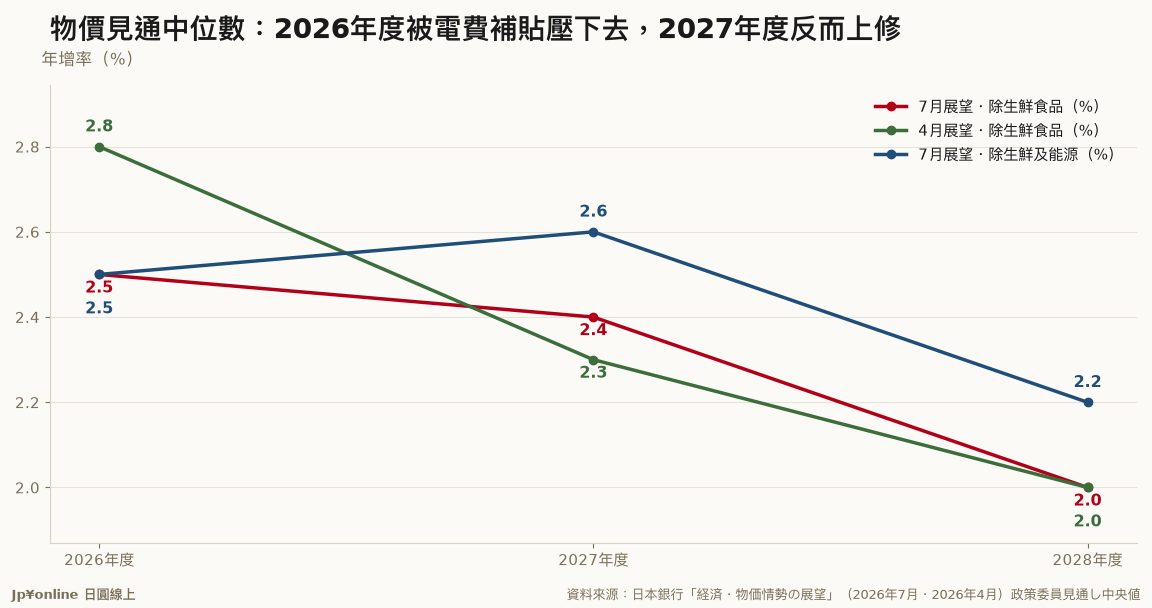
The Bank of Japan published its Outlook for Economic Activity and Prices alongside the rate decision on 31 July. This is the first instalment of our standing series on the Policy Board's forecast medians, so there is no prior entry to carry forward; the comparison here uses the April forecasts printed inside the report itself.
The eye-catching number: the median forecast for consumer prices excluding fresh food in fiscal 2026 was cut from +2.8 per cent in April to +2.5 per cent, a 0.3 point reduction. This is not a change of view. The report states plainly that the downgrade reflects the government's summer measures to ease electricity and gas costs — a temporary policy effect on the price level.
The check is the column that excludes energy: fiscal 2026 +2.5 per cent (April +2.6), fiscal 2027 +2.6 per cent (April +2.6), fiscal 2028 +2.2 per cent (April +2.2). Essentially untouched across three years. And the fiscal 2027 core figure was actually revised up, from +2.3 to +2.4 per cent — an acknowledgement that prices come back once the subsidy lapses.
Growth was nudged higher: real GDP medians of +0.6 per cent for fiscal 2026 (April +0.5), +0.8 per cent for fiscal 2027 (April +0.7) and +0.8 per cent for fiscal 2028. Rising AI-related demand supports the outlook; higher crude prices weigh on it, with Dubai crude assumed at around $80 a barrel falling to about $70 by the end of the horizon.
The asymmetry in the risk assessment is what matters. Risks to growth are described as broadly balanced; risks to prices are explicitly skewed to the upside, with the report naming the risk that underlying inflation overshoots the 2 per cent target. Read alongside the same day's decision to hold at 1.0 per cent, the message is that the pause is about observing the June hike, not about ending the cycle.
This series starts here; the next instalment is due with the October 2026 Outlook Report.
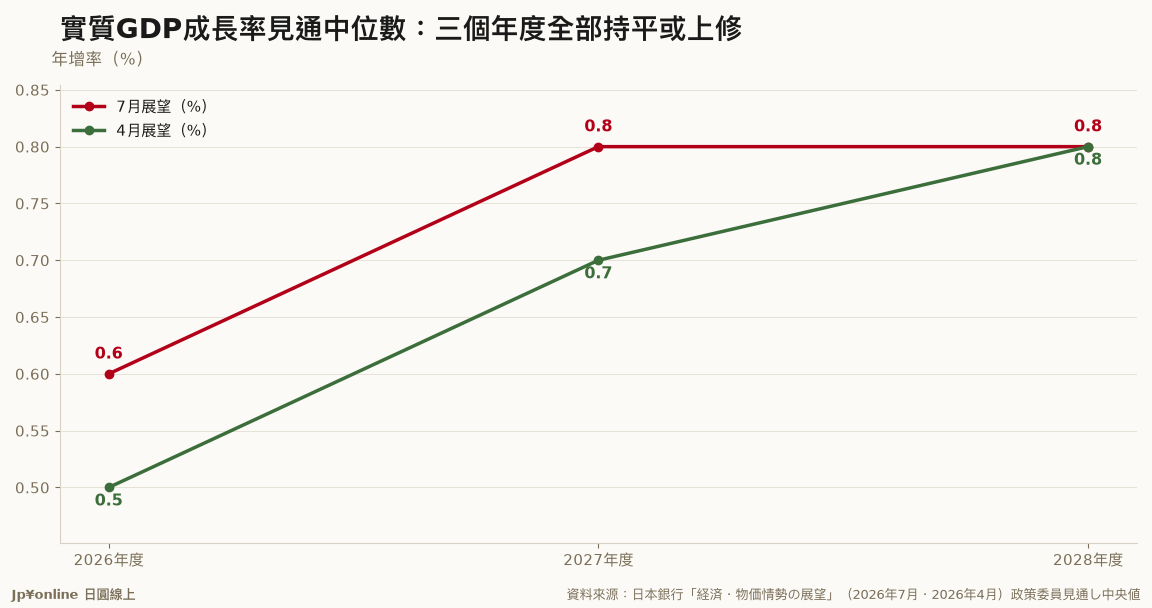
Full translation of the summary section of the Bank of Japan's "Outlook for Economic Activity and Prices (July 2026) [The Bank's View]", published 31 July 2026, together with the Policy Board forecast table.
Summary - On the outlook for Japan's economy in fiscal 2026, although the rise in crude oil prices since the spring, driven by the Middle East situation, is a drag, growing global AI-related demand, various government measures and accommodative financial conditions are expected to support activity, so the economy should continue to grow moderately while the pace of growth narrows. From fiscal 2027, as the negative effect of higher oil fades and the virtuous cycle from income to spending strengthens, the growth rate should gradually pick up. - On prices, the year-on-year rate of consumer prices excluding fresh food is expected to rise to a level clearly above 2 per cent from the second half of fiscal 2026, as pass-through of wage increases to selling prices continues, past oil price rises push up energy and goods prices, and higher semiconductor prices from AI demand and the recent weaker yen lift durable goods prices. Thereafter, in the second half of the projection period, the rate should narrow towards around 2 per cent as the effect of higher oil dissipates. Meanwhile, with labour shortages persisting, the mechanism by which wages and prices rise moderately in tandem is maintained, and medium- to long-term inflation expectations are expected to rise. Underlying inflation should therefore rise gradually, reaching a level broadly consistent with the price stability target from the second half of fiscal 2026 through fiscal 2027 and remaining there. - Compared with the previous projection, growth is broadly unchanged. The year-on-year rate of consumer prices excluding fresh food has been revised down for fiscal 2026, reflecting the effects of the government's summer measures to ease energy costs (electricity and gas). - Among the many risk factors, the effects of the Middle East situation on financial and foreign exchange markets and on Japan's economy and prices warrant particular attention for the time being, as do global AI-related demand and future exchange rate movements. - Risks to economic activity are broadly balanced. Risks to prices are skewed to the upside. Given firms' more active wage- and price-setting behaviour and continuing rises in medium- to long-term inflation expectations, there is a risk that underlying inflation overshoots the 2 per cent price stability target. Sufficient attention is needed so that such a risk, were it to materialise, does not later harm the economy.
Policy Board members' forecasts for fiscal 2026-2028 (y/y, %; medians in brackets) - FY2026: real GDP +0.6 to +0.7 [+0.6]; CPI excl. fresh food +2.3 to +2.7 [+2.5]; excl. fresh food and energy +2.3 to +2.6 [+2.5]. April forecasts: +0.4 to +0.7 [+0.5]; +2.8 to +3.0 [+2.8]; +2.5 to +2.7 [+2.6]. - FY2027: real GDP +0.7 to +0.8 [+0.8]; CPI excl. fresh food +2.2 to +2.5 [+2.4]; excl. fresh food and energy +2.2 to +2.7 [+2.6]. April forecasts: +0.6 to +0.8 [+0.7]; +2.3 to +2.4 [+2.3]; +2.6 to +2.7 [+2.6]. - FY2028: real GDP +0.7 to +0.8 [+0.8]; CPI excl. fresh food +2.0 to +2.2 [+2.0]; excl. fresh food and energy +2.1 to +2.3 [+2.2]. April forecasts: +0.7 to +0.8 [+0.8]; +2.0 to +2.2 [+2.0]; +2.1 to +2.4 [+2.2]. (Source: Bank of Japan. Original document linked below.) Original: https://www.boj.or.jp/mopo/outlook/gor2607a.pdf