【BOJ Decision|July 2026】Policy Rate Held at 1.0%, 8-1 — This Time the Lone Dissenter Wanted a Hike, Not a PauseA · FULL TRANSLATION
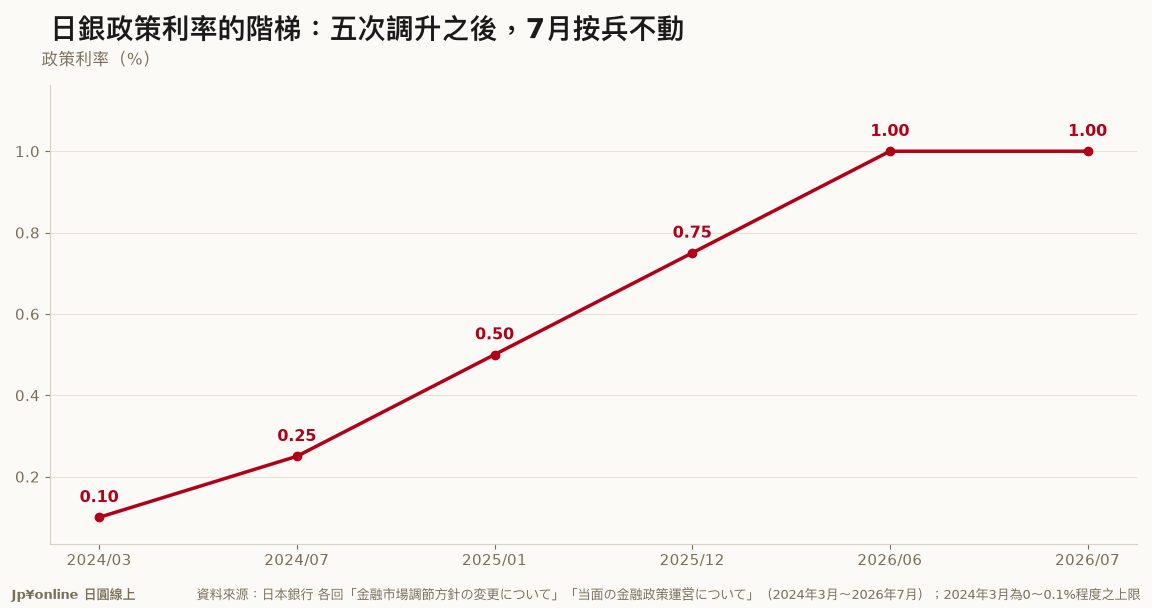
At its 30-31 July 2026 meeting, the Bank of Japan left the uncollateralised overnight call rate target at around 1.0 per cent, by a vote of 8 to 1. Last time out, at the 15-16 June meeting, the Bank raised the rate from 0.75 to 1.0 per cent by 7 to 1. This time the move was zero: the level is identical to the previous period.
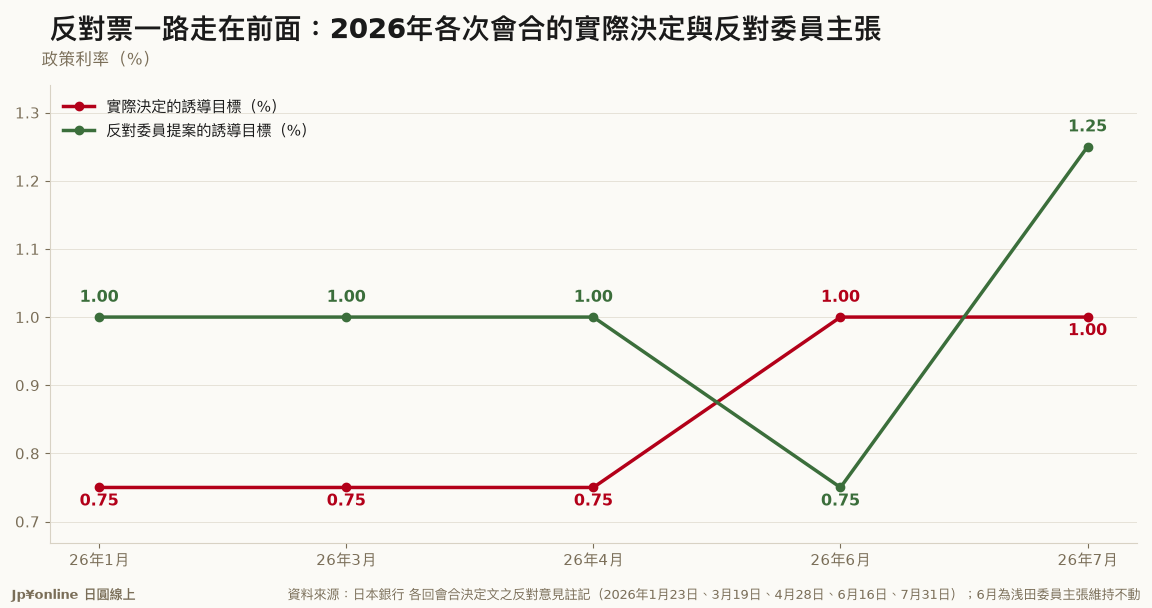
What changed was the direction of the dissent. In June the lone objector was Toichiro Asada, who argued that downside risks to output and employment from the Middle East outweighed upside price risks and wanted the rate left alone. In July Asada voted with the majority and Hajime Takata dissented instead, formally proposing a rate of around 1.25 per cent — a motion rejected by majority vote. Same one-vote margin; opposite complaint.
Line up 2026's five meetings and the direction has never wavered. Takata dissented alone in January and March, each time proposing 1.0 per cent; in April three members — Nakagawa, Takata and Tamura — proposed 1.0 per cent; in June the Bank duly went to 1.0 per cent; in July Takata moved the marker to 1.25 per cent. Dissent at the BOJ runs one or two meetings ahead of the decision.
The Summary of Opinions released on 10 August explains the pause: rate rises take a year to eighteen months to reach prices and activity, so the June hike needs watching first. Yet the same document carries members arguing that the policy focus has shifted from lifting underlying inflation to 2 per cent to preventing it overshooting, that the risk of waiting is not small, and that hikes could come faster than markets assume.
The minutes of this meeting are due on 28 September 2026.
Previous instalment: 【日銀政策決定|2026年6月會合】政策利率升到1.0%、7比1通過,反對的是浅田委員 — https://jpyonline.pages.dev/article/2026-08-05-52-bank-japan-june-2026-meeting-policy-rate-1/
Full translation of the Bank of Japan's "Statement on Monetary Policy" (31 July 2026) and of Section II ("Opinions on Monetary Policy") of the "Summary of Opinions at the Monetary Policy Meeting of 30 and 31 July 2026", released 10 August 2026.
I. Statement on Monetary Policy (31 July 2026) At the Monetary Policy Meeting held today, the Policy Board of the Bank of Japan decided upon the following guideline for money market operations for the intermeeting period, by a vote of 8 to 1: The Bank will encourage the uncollateralised overnight call rate to remain at around 1.0 per cent. Voting for the action: Ueda, Himino, Uchida, Tamura, Koeda, Masu, Asada and Sato. Voting against: Takata. Mr Takata, holding that Japan had entered a new phase requiring flexible responses to upside price risks from an overseas-driven demand shock and to the turn in overseas financial conditions, proposed that the Bank encourage the uncollateralised overnight call rate to remain at around 1.25 per cent. The proposal was defeated by majority vote. The meeting ran from 14:00 to 16:00 on 30 July and from 9:00 to 12:04 on 31 July. The minutes are scheduled for release at 08:50 on 28 September 2026.
II. Opinions on Monetary Policy (Summary of Opinions) - Japan's financial conditions remain accommodative: short-term real interest rates, which matter most for activity, are negative, banks' lending attitudes remain active, bank lending is accelerating and corporate funding demand is rising. - In assessing financial conditions, the Bank should also consider whether funding is being raised under disciplined investment plans. - The effects of rate rises are thought to reach inflation and the domestic economy with a lag of about one year to eighteen months. To assess carefully the effects of the hike at the previous meeting, keeping the policy rate unchanged this time is appropriate. - With underlying inflation approaching 2 per cent and financial conditions still accommodative, it is appropriate to continue raising the policy rate and adjusting the degree of monetary accommodation in line with economic, price and financial developments. - On the timing and pace of that adjustment, it is appropriate to examine the effects of the Middle East situation, expanding AI-related demand and exchange rate movements. This is now a phase that requires close attention to upside risks to underlying inflation. - So that an overshoot of underlying inflation beyond the 2 per cent target does not materialise and later harm the economy, the perspective of stabilising underlying inflation at around 2 per cent has become important. - In judging whether future underlying inflation settles in a manner consistent with the price stability target, it is necessary to check carefully whether medium- to long-term inflation expectations, which have risen recently, remain stable at around 2 per cent. - With underlying inflation approaching 2 per cent, upside price risks warrant more consideration than before; depending on developments, the pace of rate rises could be faster than markets assume. - Underlying inflation in Japan is settling at around 2 per cent. With financial conditions still accommodative, it is important to pay particular heed to upside price risks and to adjust the policy rate flexibly. - Even without knowing the precise neutral rate, the Bank needs to raise a policy rate that sits below the lower bound of the widely presented range of estimates, giving direction to normalisation and preserving flexibility in policy judgement. - As the world turns to a tightening phase, a new phase has begun in which the Bank should not be bound by a fixed pace of hikes and needs to discuss flexible responses, including the size of hikes. With downside fears for the real economy receding and inflationary pressure liable to emerge from the summer, the Bank needs to shift from its stance of encouraging underlying inflation to rise and show markets a clear will to prevent an overshoot. - If upside price risks materialise, the damage to Japan's economy and household livelihoods would be large, and the Bank would then be forced into abrupt, large rate rises — a double shock. The focus of monetary policy has shifted from raising underlying inflation to 2 per cent to avoiding a further overshoot. It cannot be said that the risk of waiting is small; the pace of adjusting accommodation needs to be stepped up. - Long-term rates rose in early July, but in recent markets the policy stances of individual countries are drawing attention as the driver of daily price action. (Source: Bank of Japan. Original documents linked below.) Originals: https://www.boj.or.jp/mopo/mpmdeci/mpr_2026/k260731a.pdf / https://www.boj.or.jp/mopo/mpmsche_minu/opinion_2026/opi260731.pdf