Real Estate White Book Reveals Contradictions: Price Up, Trading Volume StagnantA · FULL TRANSLATION
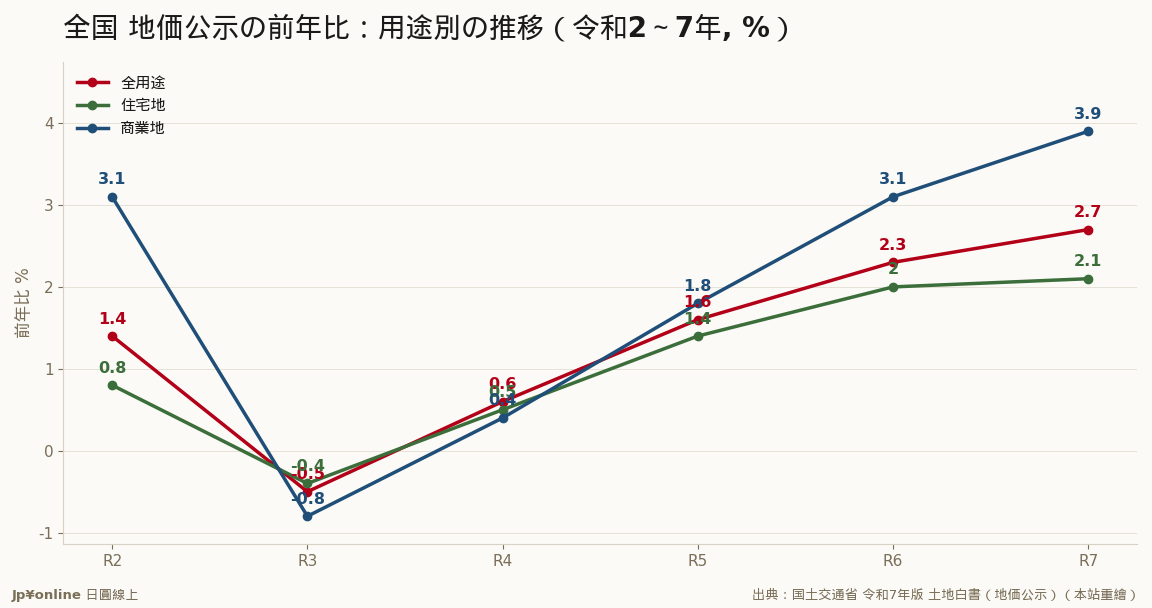
- Land price increases for four consecutive years with rising vigor: 2025 national overall +2.7%/residential +2.1%/commercial +3.9%
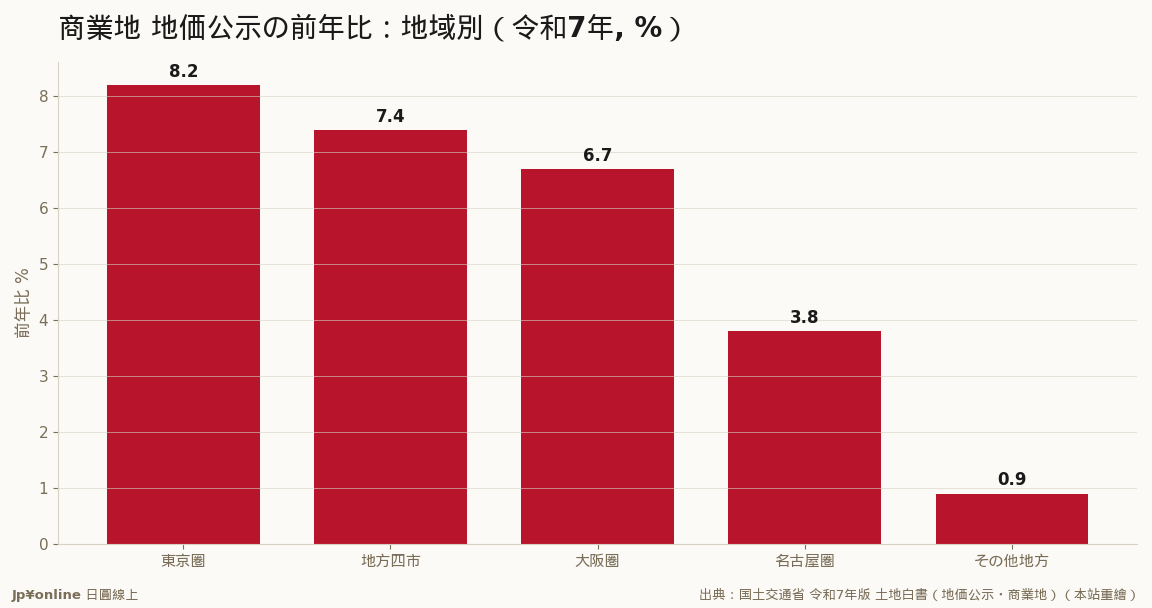
- Two commercial strongholds: Tokyo area +8.2%/four regional cities +7.4% leading, Osaka +6.7%, Nagoya +3.8%, other regions only +0.9% trailing
- Thin market: Land transaction volumes steady at around 1.32 million in 2024 = sellers reluctant to sell, good properties hard to find, pricing stable but low liquidity
- Overseas investors account for about 17.1% (around ¥939.7 billion) of Japan's real estate investments—bargain hunting era over, focus on location and story selection
- Focus on three success stories: rejuvenating Onuma hot springs, Akita science park + tourism, station front complexes generating traffic
The 2025 Real Estate White Book highlights a paradox: Japan’s land prices have risen for four consecutive years with increasing vigor (2.7% national average overall in 2025, 2.1% residential, 3.9% commercial), yet the number of land transactions barely moved (around 1.32 million in 2024). Prices up, volume stagnant means sellers are holding back, and foreign buyers find it hard to enter the market. Tokyo area leads with an 8.2% increase, while four regional cities top at 7.4%. Other regions only add 0.9%. Foreign investors now account for about 17.1% of Japan’s real estate investment (around ¥939.7 billion), with a consistent high presence.
The conclusion is clear: the 2025 Real Estate White Book (approved by Cabinet on May 27, 2025) presents a paradox for those looking to invest in Japanese real estate—land prices have risen four consecutive years with increasing vigor, yet transaction volumes barely moved (around 1.32 million in 2024). Prices up and volume stagnant indicate sellers are holding back, making it hard for foreign buyers to enter the market. In this thin market, overseas investors now account for about 17.1% of Japan’s real estate investment (approximately ¥939.7 billion), which is a consistent high presence.
The key figures: The Land Valuation Report by the Ministry of Land, Infrastructure, Transport and Tourism annually assesses land prices on January 1st. In 2025, overall land values increased 2.7%, residential 2.1%, commercial 3.9%—a four-year consecutive rise with increasing vigor since 2020. Looking at the trend from 2020 to 2025, it's a complete story: 2021 saw a decline across all categories due to the pandemic (overall -0.5%, commercial -0.8%), but by 2022, they had turned positive and continued accelerating. Commercial land values showed particularly strong recovery.
Commercial Land’s Two-Strong Pattern: In 2025, the commercial land market split clearly across regions—Tokyo area saw an 8.2% increase, followed closely by four regional cities (Sapporo, Sendai, Hiroshima, Fukuoka) at 7.4%. Osaka saw a 6.7% gain, while Nagoya added 3.8%, with other regions only seeing a meager 0.9% growth. A 'metropolitan + core regional city' double strength emerged, while other areas fell behind. The four regional cities’ increase in 2025 (overall 5.8%) was slightly lower than the previous year's 7.7%. As top performers slow down, this could be a key indicator of how the price trend will continue.
Why the Thin Market: Prices Up, Volume Stagnant: Another overlooked figure in the White Book is that land transaction volumes have stayed steady at around 1.32 million in 2024. Four years of rising prices and stagnant trading volume suggest sellers are holding back due to expectations of further price increases and higher transaction costs and taxes. This scarcity makes it hard for foreign buyers, offering both stability and challenges.
The Presence of Foreign Capital: In this thin market, overseas investors now account for about 17.1% (around ¥939.7 billion) of Japan’s real estate investments, maintaining a steady high presence despite recent trends. Weak yen discounts Japanese core assets, making Tokyo and Osaka office buildings, logistics warehouses, and hotels attractive to international institutions. For Taiwanese readers, this 17.1% signifies that you are not alone; overseas buyers are already regulars in the market. But as you compete with global institutions for these scarce premium properties, the support is firm, but so too is the competition.
Government’s Prescription: The White Book focuses on 'leveraging private investment to revitalize regions.' Successful cases include revitalizing the historic Onuma hot springs in Yamaguchi Prefecture, developing a science park in Akita with a hotel and educational facilities, and creating vibrant station districts. Common themes are public sector land provision and private sector operational capabilities.
Counterarguments: Four reminders. First, a combination of four years of rising prices and weak yen benefits could reverse if the Bank of Japan raises interest rates or the yen strengthens, pulling foreign capital away. Second, successful cases in regional cities are selected examples; many projects have failed to take off. Expecting steady gains from regional revitalization could lead to disappointment. Third, while thin market resilience is positive for investors, it also poses liquidity risks—buy easy, sell hard.
Operational Insights for Taiwanese Investors: Three judgments. First, recognize that the Japanese real estate market has shifted towards 'selecting stories' rather than 'finding bargains.' High prices and 17% foreign investment suggest premium returns come from choosing the right location and theme, not waiting for discounts. Second, follow successful models of private investment in regional revitalization—rejuvenating hot spring towns, integrating research parks with tourism, and station-front complexes. These have official backing and real traffic. Third, take the slowdown in four regional cities as a leading indicator—the top performers slowing down suggests this price trend is nearing its peak.
What to Watch: Three indicators. First, Bank of Japan interest rates and yen trends will determine if foreign capital stays or leaves. Second, whether the slowdown in four regional cities spreads could be a turning point—whether prices continue to rise or start falling. Third, transaction volumes must increase as sellers ease up, offering more liquidity.