Analysis: Japanese New House Starts Rebound by 11.4% in April – Apartment Supply Continues DeclineA · FULL TRANSLATION
- April 2026 new residential constructions rebound by 11.4% (62,569 units)
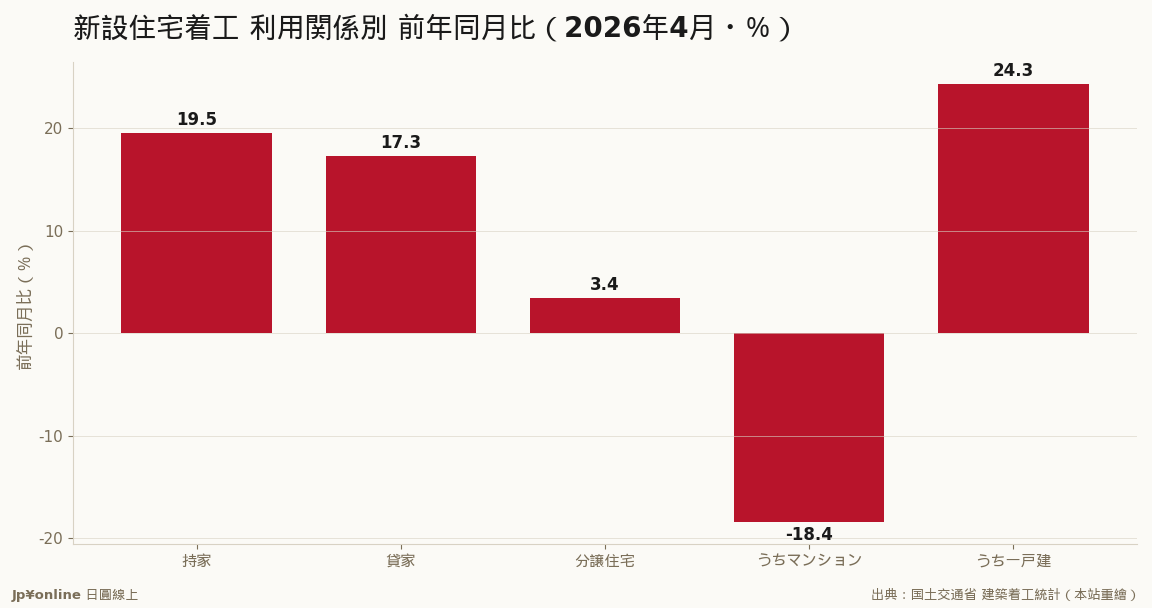
- Driven primarily by rental homes (+17.3%) and owner-occupied houses (+19.5%), while apartments decline for fourth consecutive month
- Construction data reveals supply-side dynamics – apartment starts continue to decline despite overall rebound in new housing
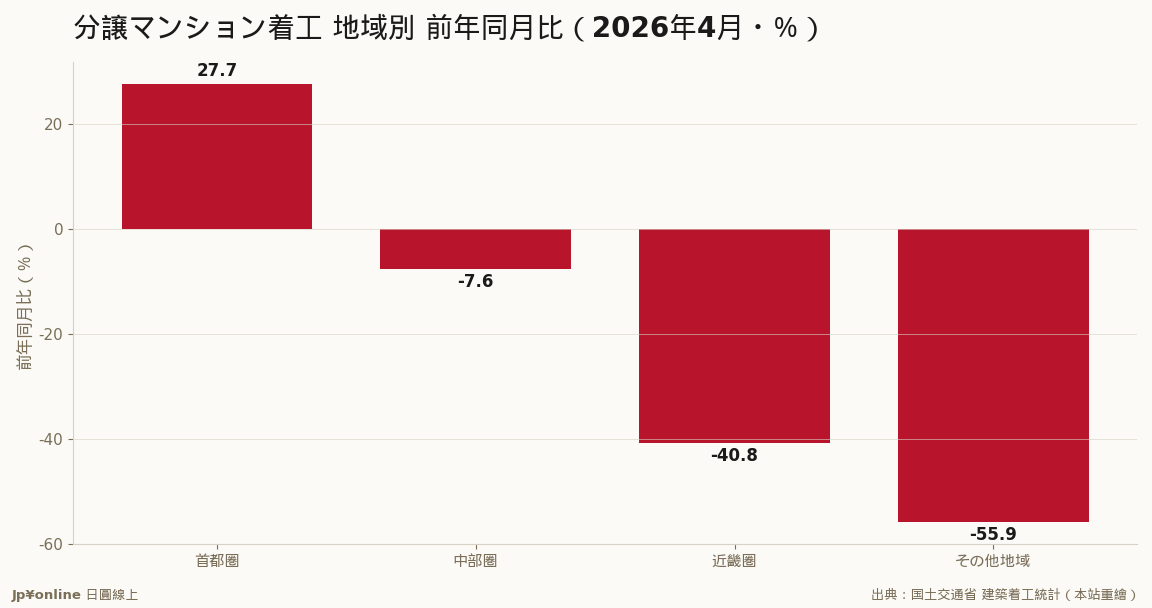
- Regional trends: strong growth in Tokyo circle, significant declines elsewhere (Kansai -40.8%, other areas -55.9%)
- Rental homes' surge driven by tax-saving motives, not increased demand
- Historical context shows long-term decline in new residential construction
According to the Ministry of Land, Infrastructure, Transport and Tourism’s data for April 2026 (Reiwa 8), new residential constructions rebounded by 11.4% with a total of 62,569 units, reversing a six-month decline. However, it was driven primarily by rental housing and owner-occupied homes, while condominium (bunjo mansion) starts continued their fourth consecutive month of decline. This analysis delves into the supply dynamics impacting Tokyo’s new home prices.
【Why Taiwanese Readers Should Care】The Ministry of Land, Infrastructure, Transport and Tourism's April 2026 construction data shows a 11.4% rebound in new residential constructions with 62,569 units (floor area +13.4%) after six consecutive months of decline. This suggests the housing market is recovering. However, when broken down, it reveals that apartment starts have declined for four consecutive months while rental homes and detached houses showed significant increases.
【Understanding the Data】The construction data categorizes new residences into several types: owner-occupied homes, rental housing, company-provided housing, and built-for-sale residences (which include condominiums and detached houses). This data serves as a leading indicator for housing investment and construction sector trends, reflecting market expectations more accurately than transaction data.
【Key Figures】In April 2026, the total number of units reached 62,569 (+11.4% from last year), with an increase in floor area by 13.4%. The main contributors to this rebound were owner-occupied homes (16,296 units, +19.5%) and rental housing (29,265 units, +17.3%), which together accounted for over 70% of the construction volume. Residential lots saw a marginal increase in detached houses (10,156 units, +24.3%) but a significant decline in apartments (6,293 units, -18.4%). This indicates that almost all types except new apartment starts are showing growth.
【Supply-Side Insight: Construction Data Unveils the Supply Dynamics】Many ask why Tokyo’s new apartments continue to rise. The answer lies within the construction data. New apartments’ prices = demand ÷ supply, and while low interest rates, asset preservation, and foreign investment make up part of the demand side, the supply-side reality is that developers have reduced apartment starts for four consecutive months. Rising land, material, and labor costs force builders to push fewer units but higher-priced ones, leading to structural supply reductions.
【Regional Variability: Strong in Tokyo, Weak Elsewhere】Breaking down the data by region, the trend is stark: the capital circle saw a 27.7% increase (outperforming), while central Japan (-7.6%), Kansai (-40.8%), and other areas (-55.9%) declined significantly. This mirrors long-term demographic shifts with capital and development resources concentrating in Tokyo, reducing apartment construction elsewhere.
【Why Rental Homes Spike】The spike in rental housing to 29,265 units (+17.3%) is driven by tax-saving and inheritance motives specific to Japan, leading to a significant increase this month. However, it's important to note that this surge reflects tax-saving rather than actual demand for rentals.
【Historical Context】Long-term trends in new residential constructions show a decline due to population shrinkage and fewer households. The April rebound (6 months of first reversal) should be seen as recovery from low baselines, not a trend shift.
【Counterarguments】Three key points: 1) The year-over-year increase has a base effect; 2) Rental housing's surge is tax-driven, distinct from owner-occupied demand; 3) Apartment starts' decline reflects controlled supply by developers to push higher prices, indicating potential price support rather than weakening supply.
【Practical Advice for Taiwanese Readers】1) Use apartment construction data as a leading indicator of future new home supply; 2) Regional analysis: Tokyo’s apartment market (+27.7%) versus other regions’ decline (-40.8%, -55.9%); 3) The overall rebound is driven by rental homes and detached houses, not owner-occupied apartments.
【Next Steps】1) Monitor apartment construction to stop four consecutive months of declines; 2) Watch the duration of high rental home starts; 3) Track the sharp decline in regional apartment construction.