Tokyo Central Office Vacancy Drops Below 2% for First Time in Five Years; Rent Up 10% but Momentum Cools
- June average vacancy 1.99% (-0.08pt), back under 2% for the first time since June 2020
- Average rent 22,993 yen/tsubo, +10.14% YoY, but monthly gain slowed to +0.65%
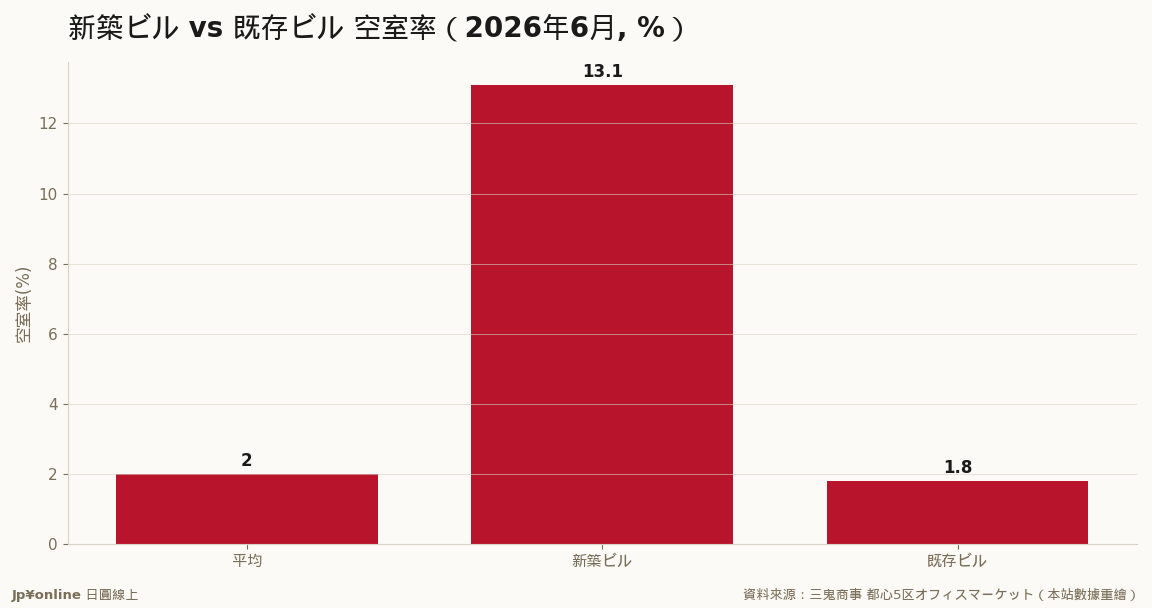
- New-build vacancy 13.09% is a composition effect (four full buildings reclassified), not real weakness
- Existing-stock vacancy 1.80% signals the market is effectively full
- By ward: Shibuya lowest at 1.11% and priciest; Minato improved most (-0.22pt)
According to a report from Sankei Shoji released on July 10th, the average office vacancy rate in Tokyo's central business district dropped below 2% for the first time in five years, reaching 1.99%. The average rental rates increased by ¥22,993 per tsubo, marking a year-over-year increase of 10.14%, but only up 0.65% month-over-month. While new buildings' vacancy rate rose to 13.09%, this is due to the reclassification of four fully rented buildings from new to existing categories.
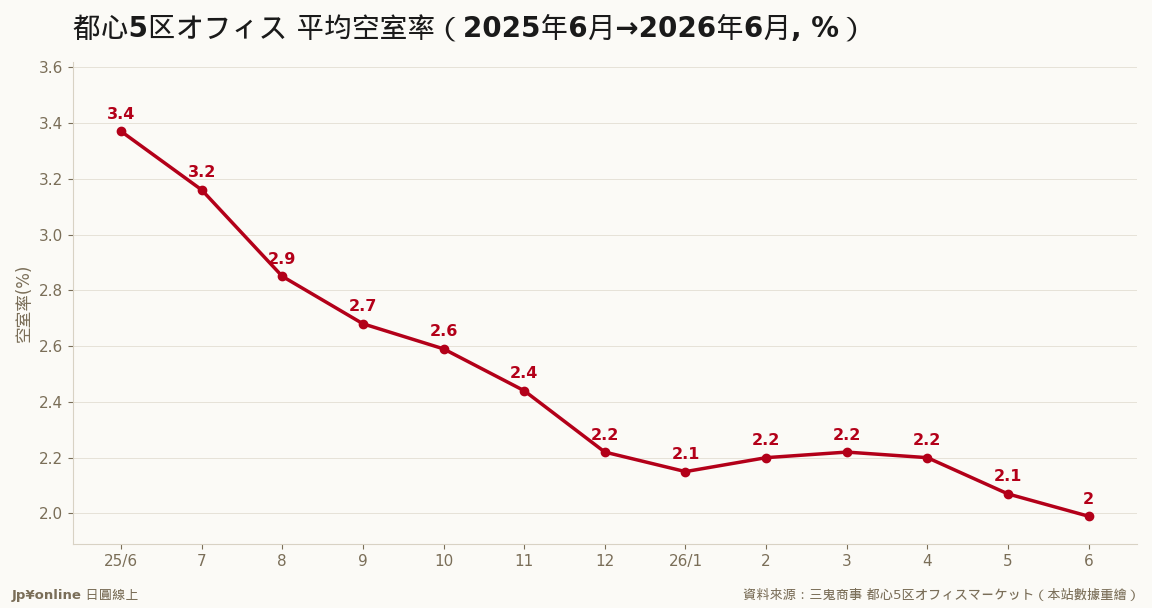
[Conclusion first] Sankei Shoji's July 10th report on Tokyo's central business district (Chiyoda, Chuo, Minato, Shinjuku, and Shibuya) office market has passed an important psychological threshold: the average vacancy rate dropped to 1.99%, down 0.08 percentage points from the previous month, marking a return to single digits after five years. At the same time, average rental rates increased by ¥22,993 per tsubo, up 10.14% year-over-year (+¥2,116). With fewer empty spaces and double-digit rent increases, Tokyo's central business district office market is at a seller's strongest position.
[Clarifying the data] Sankei Shoji's monthly report is one of the most closely watched private statistics in Japan, tracking the vacancy rates and rental rates for existing office buildings in commercial areas of Tokyo. The vacancy rate is calculated as 'rented floor area divided by total rentable area,' with lower numbers indicating higher demand; generally, 5% is considered a balanced supply-demand line, while below 2% indicates extreme scarcity. This 1.99% means that almost all office buildings in the central business district are fully occupied.
[A misleading number: new buildings at 13.09%] On the surface, the vacancy rate for new buildings increased to 13.09% in June, seemingly worsening. However, this is due to four fully rented buildings being reclassified from 'new' to 'existing,' and there were no new buildings completed in June, which reduced the denominator and raised the ratio. Meanwhile, existing buildings saw a vacancy rate drop to 1.80%, down 0.09 percentage points, indicating that existing stock is nearly fully occupied. The true market sentiment lies in the existing data line—this shows extreme scarcity at 1.80%.
[Monthly rental increases, but slowing] On the rental side, a year-over-year increase of ¥22,993 per tsubo reflects accumulated price hikes over the past year. However, looking closer, the month-over-month increase was only 0.65% (¥148), much milder than the force needed to break through the 2% vacancy rate barrier. With vacancies at a minimum and rental rates still increasing by double digits annually, but with monthly momentum starting to contract—this is a common combination when markets approach their peaks: scarcity keeps prices high, but there's less room for further increases each month.
[Regional differentiation] The five districts are not uniform. Shibuya has the lowest vacancy rate at 1.11% (down 0.17 percentage points) and the highest rental rates at ¥25,765 per tsubo; Chiyoda at 1.26%, Minato's vacancy rate dropped from 2.38 to 2.16% (the biggest improvement of 0.22 percentage points); Chuo has the highest vacancy rate at 2.84%, while Shinjuku saw a slight increase to 2.57%. For companies looking for office space in the central business district, Shibuya and Chiyoda are the most viable options; Minato is the area that loosened up this month, offering relatively more negotiation opportunities.
[Practical significance for Taiwanese readers] First, for those holding Japanese office assets or J-REITs focused on offices, a 1.99% vacancy rate and double-digit year-over-year rental increases provide strong grounds for continued income growth, but the slowing monthly increase signals reduced profit growth—do not linearly extrapolate past annual gains. Second, Taiwanese businesses setting up in Tokyo face a reality of almost no availability in central business district core areas; new supply is being rapidly absorbed, with negotiation opportunities concentrated in districts like Minato that loosened up this month and non-central outskirts. Third, office space serves as an indicator of economic conditions and corporate expansion—low vacancy rates and high rental prices corroborate recent positive sentiment from the corporate sector—but be mindful of diminishing marginal rental growth.
[What to watch next] Two things: how long can existing buildings' vacancy rate stay at 1.80%, and whether monthly rental increases will further converge towards zero—the latter would be the first signal that this office market bull run is peaking.